
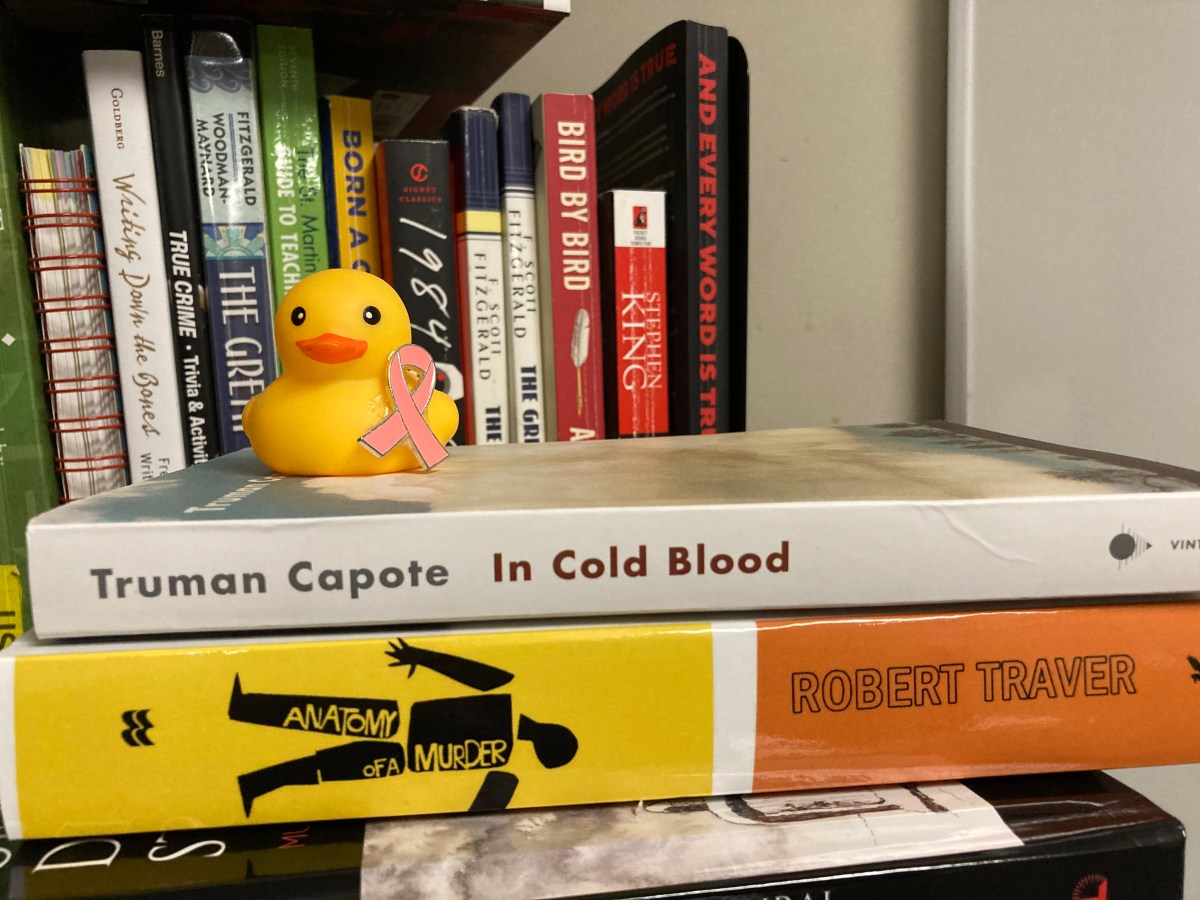
I received my cancer diagnosis on a Friday near the end of the school year. I teach at a small rural high school, and they do something different from my own high school: the seniors finish before the rest of the grades. It ended up being the day the seniors took their last final exams, less than a week before graduation. Maybe it was denial or the minute-by-minute coping you enter into after such a diagnosis, but graduation was the first thing that I real felt cancer take from me. Because we’re in such a rural area, and because my parents live near a larger hospital downstate, I ended up meeting my surgeon on graduation day and watching the ceremony streamed on Facebook.
The timing meant that my surgery and at least a chunk of the following treatment would take place during summer break. On the one hand, this was good because it meant I wasn’t missing class and didn’t have to worry about sub plans and all the rest. On the other, I didn’t get either a summer or a break. But, back in May, I had no idea exactly how long treatment would take.

Because of others’ experience, I knew that the bare minimum would be surgery and radiation. Another reason to transfer all of my care downstate was because there’s no local radiation. The individual treatments are short, only a matter of minutes, but they can be daily, and the closest center is still more than 60 miles from where I live. Practically moving back in with my parents for the summer wasn’t really top on my list of things to do, but they used to work at the hospital. Their house is less than a mile from the cancer treatment center. I just had no idea how long I’d be there.
A (very brief history) of breast cancer treatment
Back in the day, but still recent enough to be in living memory, patients went in for breast cancer surgery without knowing what the procedure would be. They could tell their diagnosis as soon as they woke up from the anesthesia: if both breasts were still present, the lump was benign. Cancer meant an immediate mastectomy.
It might have been effective as far as making sure the cancer didn’t spread, but this had a negative effect on the patients. It’s jarring enough waking up to see how much a lumpectomy has changed the body you’ve known for years. One of the items I was given at the hospital is a recovery camisole which not only had pockets for drains in case I had those after surgery, but comes with two breast forms that can be put in the top pockets. The drain pockets can be medically necessary; the breast forms can be mentally or emotionally necessary.
When they started doing lumpectomies, though, the recurrence rate was too high for comfort. It seemed like it should have been a good compromise between the 0 and 100 end points of doing nothing and doing a full mastectomy, but it wasn’t until they added in radiation treatments that the recurrence rates lowered enough to be acceptable. Even patients who have a double mastectomy can benefit from radiation treatment, so, from the get-go, I knew that there’d be radiation. What I didn’t know, and what you don’t find out until after surgery, is whether I needed chemo first.
Another pathology report
The first thing that helps say one way or another is the post-surgery pathology report. There were two things my mom and I skimmed for as soon as I got it: whether both the margins and the sentinel nodes were clean.
Margins refer to the tissue that’s been removed during surgery. Ideally the tumor is in the middle, surrounded on all sides by healthy tissue. If this is the case, the margins are clean, or noncancerous. If margins aren’t clean, that means some of the tumor is left inside and needs to be removed with further surgery. The goal is to eliminate every possible cancer cell, because even one can start the whole thing up again.
The sentinel node biopsy is a check to see if the cancer was trying to spread. The lymphatic systems deals with filtering and draining bodily fluids, so they’d catch any cancer that comes their way. My surgeon said the standard procedure is to biopsy the lymph nodes first before moving to the lumpectomy with the idea of moving from a non-cancerous area to a cancerous. He also shrugged and said he wasn’t entirely sure it mattered, but it’s better to be safe than sorry.
It was about two weeks after my surgery that my dad pointed out some of the information we’d skimmed over: exactly how much tissue had been removed, both by size and weight. Remember he’s a gynecologist, so he had some more insight than most. Hot tip: maybe just skim your pathology report for your margins and biopsy results at first. A lumpectomy sounds like it should be nice and small, but once you start actually picturing the size of the wound left inside … let’s just say there’s a reason tenderness and swelling can last 3-6 months.
Clean lymph nodes are a good indication, but they’re not the final say. For that, your oncologist needs the results of another test.
Another number
I spent almost two months wondering if I’d need chemotherapy which, for me, meant the specific “Will I make it back for the first day of school?” question. That was my mental and emotional touch point. If I could do that, then cancer wouldn’t have ruined my life. It might—and did—suck, and I knew I’d have to eventually deal with the various consequences of my lost summer, but being back for “my kids” was the important part. The will-I-or-won’t-I chemo question was answered when I finally got the results of a test called the oncotype dx.
The result itself comes in a number from 0 to 100. It’s called a recurrence score, and even though it looks like it might be a percentage, it’s not. Your percentage of recurrence is different from your oncotype dx, but it’s included on the same document. Mine told me my recurrence chances if I only did hormone therapy, and if I did hormone therapy plus radiation.
The number you’re hoping for is different if you’re pre- or post-menopausal. Since I’m pre-menopausal, my oncologist said we wanted a number of 18 or lower. That indicates that chemotherapy would not be helpful in treating my cancer. If the number is 26 or higher, then a more aggressive form of treatment is recommended, including chemotherapy. If it’s in the middle, then there are charts to say how likely it is for chemo to help, and that’s more of a discussion with your doctor.
I should note that every treatment plan was presented to be as a suggestion, from the lumpectomy to radiation to hormone therapy. At one point when talking about how to proceed, my surgeon said “We discussed the lumpectomy.” I nodded, which prompted him to say, “No, I was asking you if that’s what we’re doing.” The pendulum’s swung a long way from being wheeled into the operating room and having no idea—and no say—in what’s going to happen to you.
The oncotype dx results provide a lot of information to help you and your doctor decide what treatment comes next. When mine came back as 11, we all breathed a sigh of relief. It was clearly low enough that I wouldn’t need chemo. (If any readers did go through chemotherapy and would like to write a guest blog post on the experience, please reach out.)
The end of the beginning
My oncotype dx result meant my next appointment was with the radiation oncologist to determine exactly what my treatment course would look like. I’ll go over radiation in my next post, but for now, do something to relax. Maybe take a nap. You deserve it. Memento vivere.
 Rebecca Frost
One thought on “A Millennial’s Guide to Breast Cancer: Can I Get the Final Answer?”