
On the last day of radiation treatment, one of the techs asked me a very important question: was Duck with me? He’d met Duck on the first day, when I took the photo of the room, so Duck had to be there to ring the bell.
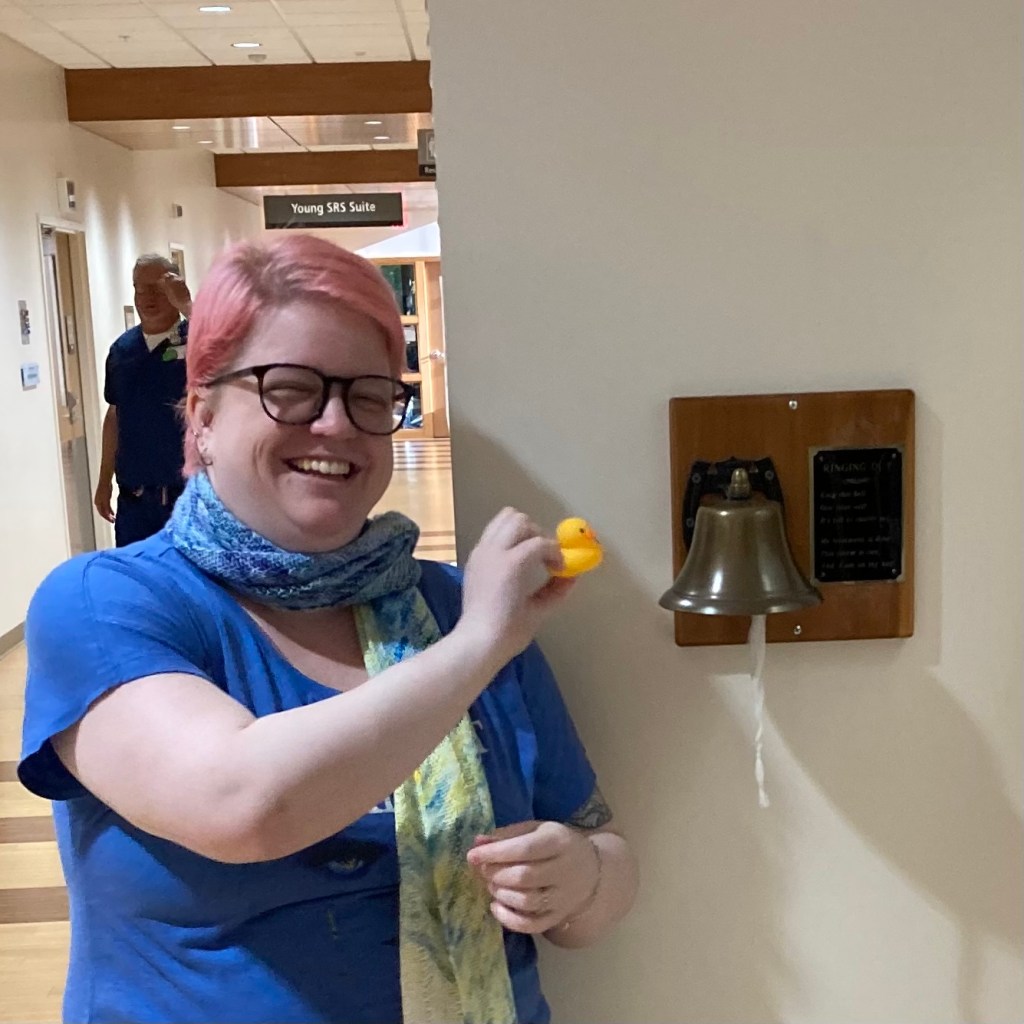
Patients undergoing treatment like chemotherapy or radiation ring the bell on their last day to signify that it’s over. It’s apparently a fairly recent tradition, just under 30 years old, and has its roots in the Navy: one of the reasons to ring it is to celebrate a major accomplishment. Admiral Irve Charles LeMoyne is credited with being the first person to use a bell for cancer treatment.
Mark time
The last day of treatment is a very specific date and a very clear ending. It’s a day we look forward to because it means this part is going to be over. It’s the end of the active treatment, the flurry of appointments and procedures and hospital gowns that may or may not be missing some of their ties. At the end of radiation it means not having to come back tomorrow, even if tomorrow’s a weekday. Even knowing that side effects can still worsen after that last treatment, at least it is the last treatment. You won’t continue to actively do something to make it worse.
As humans we like stories, and what that really means is we like stories with endings. One of my three areas for comprehensive exams during my Ph.D. was narrative theory. Check out the initial definition from that page:
Narrative theory starts from the assumption that narrative is a basic human strategy for coming to terms with fundamental elements of our experience, such as time, process, and change.
There’s just no way to tell about our experiences except to put them into a narrative. Anything with cause and effect is a narrative: the app says it’s going to rain later, so I should take an umbrella. The bus was late, so I ended up walking to work. We use narratives to talk about real events and imagined events, and both of these are ways of making sense of the world.
Think about your favorite book. It’s divided in so many different ways. There are pages, which just happen because of how many words can fit on them, but there are also chapters, where parts of a page are purposefully left blank. You have to turn the page to see what happens next. There can also be scene breaks within a chapter, denoted by a blank line – blankness again, like a visual cue to rest – or maybe a cute little symbol. (Apparently that’s called a dinkus. I learned something today.) There’s also a beginning and end to the whole book. It has to start somewhere, and it ends somewhere. Even Stephen King’s heftiest tomes finally come to a close.
You see these choices when you’re watching movies, shows, or documentaries, too. These are the moments when, back in the day, the network would cut away for ads, or the points where viewers would have to wait a whole week to find out what happens next. Maybe there’s even a recap at the start of the next episode, in case you forgot what happened or you missed a week. Today we binge as we please, but our narratives are still set up with these various arcs and pausing points.
When “The End” isn’t the end
Ringing the bell at the end of treatment feels like the end of something. We’d absolutely love it to be the absolute end of us thinking about cancer, much less having to deal with it ever again. A lot of people in my life seemed to think of it that way, too: oh, that’s over. She had cancer, but it’s gone. Go back to your lives, citizens.
I’ve barely begun to scratch the surface of cancer’s emotional toll. This has all been the basic survival mode recitation. This happens, then this happens, then this. I’m still not going to get into the emotional (in this post, at least) but even with just the facts, I can tell you that ringing the bell isn’t the last part.
There is a short break where your focus is on recovering from treatment. Ringing the bell is an emotional day because of all the symbolism and expectations around it. My parents and husband came with me, and my husband made sure to film it because his parents and others wanted to see me ring the bell. It was honestly kind of stressful because of all of those expectations and I wasn’t sure what my emotions would be doing at that point. Even the techs came out to clap, but then I basically went to bed and collapsed.
This is the point where we have to remember a lot of what we’ve learned about breast cancer. One of the first tests tells us the hormone receptor status of the tumor: how many colors of cat food will my little old lady eat? And one of the later tests is the oncotype dx, which tells us how tenacious the cancer is, and how likely it is to return. Based on those results, your doctor might prescribe hormone therapy.
In my case, I was prescribed Tamoxifen, and right away I’ll suggest you don’t read about all the possible side effects. It’s a selective estrogen receptor modulator (SERM) which stops estrogen from interacting with any place, benign or cancerous, that’s receptive to estrogen. In other words, this stops Van Go from eating one of the colors of cat food. If there are any cancer cells left after treatment, they should starve.
I’ll be on Tamoxifen for 5-10 years, and that’s part of the reason why the list of potential side effects is so long. They have to list anything that happened to anyone while they were on the drug. Some of them are common, like hot flashes and irritability, and some are rare. My sister-in-law, for example, had a side effect seen in less than 1% of people who are on tamoxifen, so she’s an unlucky outlier.
What this means, though, is that breast cancer survivors still have to think about their cancer at least once a day. Some have to take Tamoxifen twice a day, and some have more medications depending on their doctors’ recommendations. It’s a conscious, daily act for me, and then the hot flashes come whenever they feel like, and they’re just another reminder of what I went through.
Then there are the follow-up appointments. The surgeon needs to check on you at least twice, and I’ve had two appointments with my medical oncologist to start the hormone therapy and then check in to see how well I’m handling it. I’ve got another follow-up scheduled with the radiation oncologist later this year, and there’ll be one early next year where I have to go for a mammogram again. Considering how my very first mammogram found cancer, I can’t say I’m entirely looking forward to that experience.
No Evidence of Disease
I didn’t know I had cancer until the scan showed it, so it’s hard for me to think that I flat-out don’t have cancer now. The pathology report says my lymph nodes were clear and the margins were good, and the oncotype dx gives me a very low chance of recurrence with radiation and hormone therapy, but it happened once. I already got the fuzzy end of the lollipop. There’s no guarantee I won’t get it again.
My next post will shift toward managing some of the emotions surrounding cancer, but in the meantime, I have a request. I’m committing to knitting every day in November to raise money for the American Cancer Society, and I’d love it if you donated to support this cause. Obviously this is a cause very important to me, and I’m just getting my energy back after treatment, so knitting every day will be both a joy and a triumph. The scarf I’m wearing to ring the bell is one I knit early on in my treatment, after my diagnosis.
Memento vivere, friends, and take a moment to do something good.
 Rebecca Frost
One thought on “A Millennial’s Guide to Breast Cancer: After the Last Day”