location, location, lo…

It’s a frequent question in writer circles: can I set my story in a place I’ve never been? How much research do I really need to put into my setting? Can I name real places in my book?

There are about as many answers as there are writers, but here’s my two cents.

In Not Your Mary Sue, the first half of the book takes place “on an island in Lake Superior” and the second in an unidentified town in Illinois, so you can probably guess some of my answers from that. There are plenty of islands in Lake Superior, so just because you’ve never seen an island like the one I described, that doesn’t mean it doesn’t exist. (I’ve also had to explain to multiple people that yes, the water goes all the way to the horizon – largest surface area of any freshwater lake in the world, after all – because Superior is hard to imagine if you’ve never been here.)

Jay’s unnamed private island was my solution to the challenge of finding a location in the 21st century where my main character could be held captive and not be able to call for help. In Misery, Stephen King traps Paul Sheldon by a combination of factors including a dead landline (King didn’t have to deal with cell phones in 1987) and a pair of broken legs keeping him from escaping the isolated house in which he found himself. NYMS was written in 2017 and published in 2022, so I had to figure out the cell phone problem.

Cell phone coverage has increased in the UP since I first moved here, but it can still be slow or completely absent. Before we moved into our house we had to check and see if the internet even reached it, so not all of these technological advances are a given. When you drive across the UP, there are places where you phone goes wild because it suddenly has signal again and pings everything at once. And there aren’t cell towers in the middle of the lake. Add in the fact that Marcy can’t swim …

So it looks like I lean toward making it all up.

Especially with that unidentified Illinois city in the second half, right? Except, for the story, that location didn’t matter as much. Marcy wouldn’t have gravitated toward Chicago, because she didn’t need to be near another Great Lake, and it had to be still somewhere in the Midwest for plot travel time reasons, but otherwise … it wasn’t as restricted. There was nothing particularly special that meant I wanted, or needed, to tie it down to a single location. Let me put things where I want them, because there it’s the relationships and interactions that matter.

On the island, knowing about the location mattered.

Remember these?
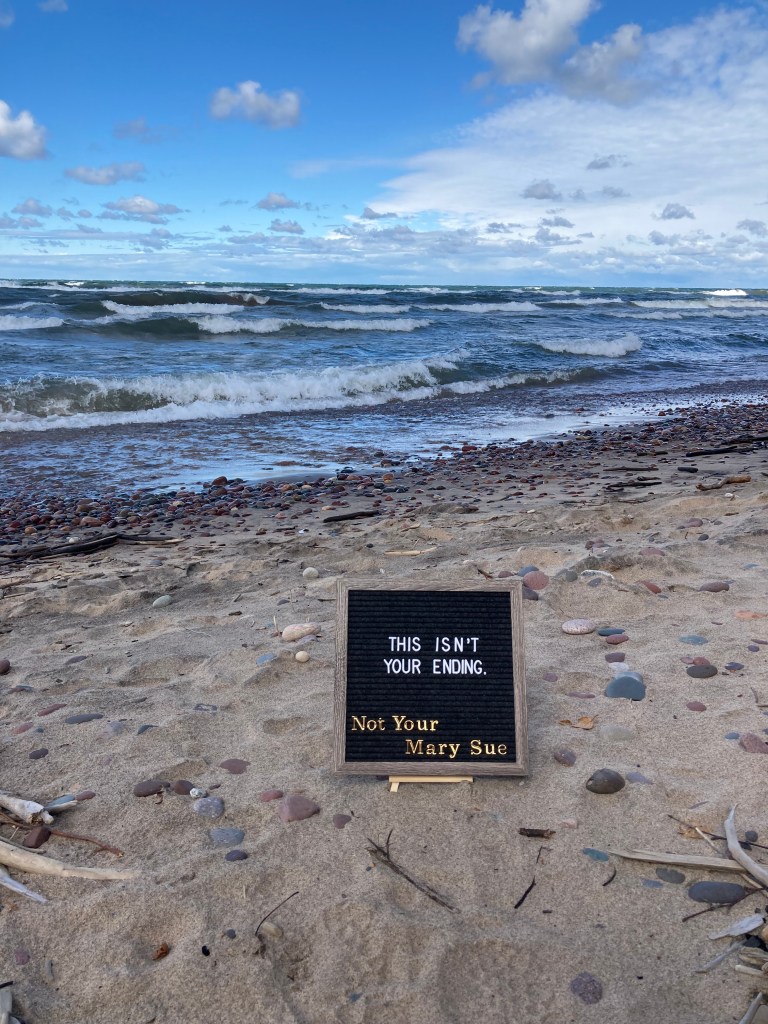

I went to various beaches and took these photos because of how much Superior played into the story. I knew about the isolation and the cell phone signal issues and water as far as you can see. If I’d never been to the UP or lived in these rural areas, it wouldn’t have occurred to me as a solution to my isolation issue. But I do live here, and I know what it’s like to live here, and isn’t Superior gorgeous after a storm?

Blood Sisters all but swings to the other extreme.

It’s probably the more expected version of “Write what you know.” The book opens in Cyberia Cafe, in Houghton, Michigan – I could point you to the exact table where Skye waits with her theory that her twin sister isn’t dead, but a murderer in hiding. Characters meet at the KBC (Keweenaw Brewing Company, for the uninitiated) and get burritos from Rodeo and eat at The Library (which is near the one with the books) and get fishbowls at the Ambassador and celebrate at McLain State Park with cakes from Roy’s Bakery and and and …

You could go to all these specific locations because they exist. (Well, at least for now – the parking deck won’t be around much longer, and 5th and Elm moved across the canal to Hancock, but the book’s set in 2019.) I know how long it takes to travel various places, how to navigate the Yooper Loop, and how you can expect traffic to stop when the bridge lifts for the Ranger to come back through. I was at Michigan Tech for graduate work from 2007-2015, and I’m still close enough to easily visit, so I know the area. I don’t have to depend on Google street view.

And, as a reader, I’ve been burned before.

There’s a certain disappointment when you read a book that specifically names the location as, say, the city you grew up in … and then completely botches the layout. I once read a book where the chapter title listed my hometown, city and state, and then said the character was in the parking lot outside of two stores … that have never been next to each other. (It went downhill from there.)

Now I understand that the author wasn’t from Michigan. In this particular case, the author wasn’t American. It doesn’t seem likely to me that the author had ever been to my hometown, or at least hadn’t gone looking for those business to get the lay of the land. (It’s not just that they’ve never been next to each other – a character got into the surrounding area and it wasn’t realistic, either. If you’ve never been to my hometown or haven’t paid attention to those businesses, you wouldn’t know, either.

But I knew, and it bothered me.

Which probably explains my own personal response:

Keep the location vague so I can make it up entirely, or make it something I know quite well.

That’s my two cents. How about you? Have you set a book in a place you’ve never been? How did you handle the research?
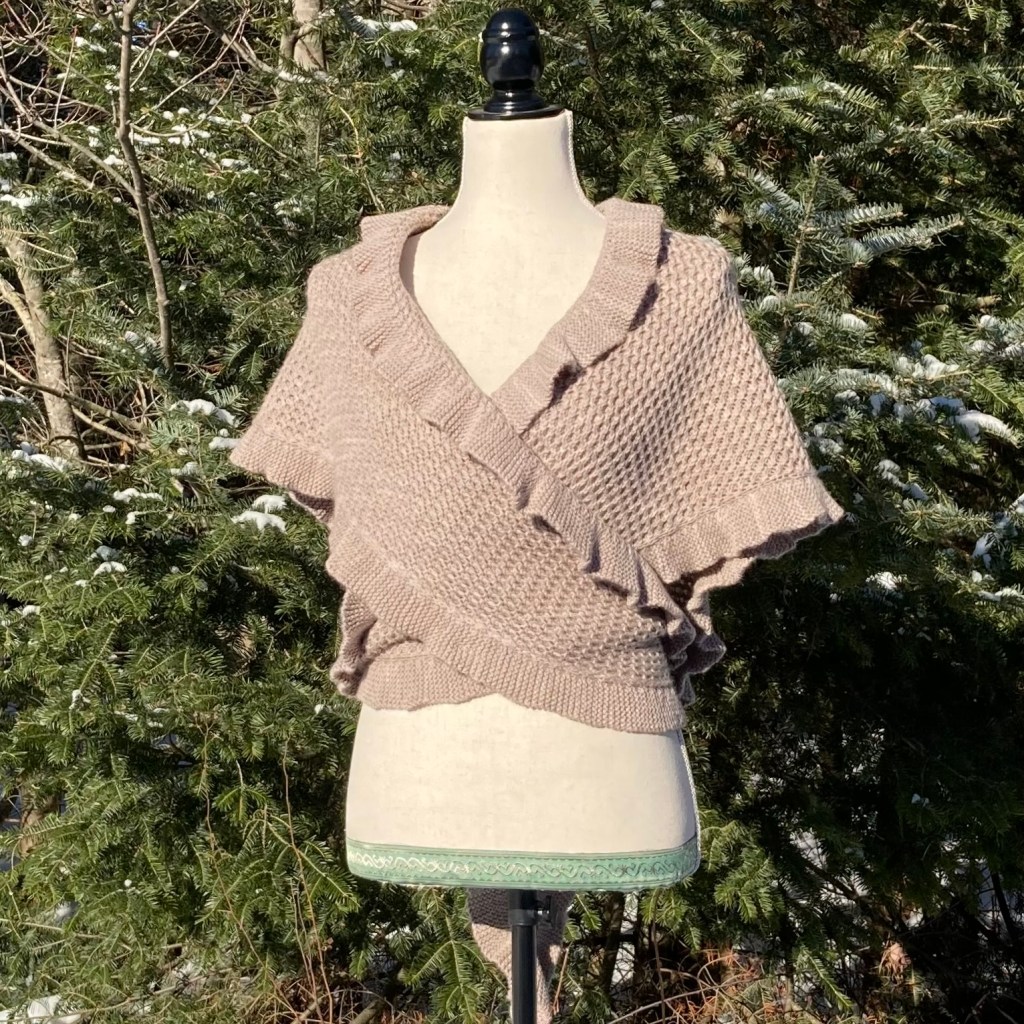
The Marcy Shawl – a knitting pattern

Please note: The book referenced in this post is no longer in print. I’m leaving this post up so that the pattern can remain and be knitted. If you’re so inclined, you may purchase any of my in-print titles to offset the work behind offering this pattern. Thank you!

If you’ve been following my Instagram posts, then you know I’ve been working on writing something a bit different for me: a knitting pattern, known as The Marcy Shawl. And I’ve said I’m posting it on my blog for free.

The Marcy Shawl – DK weight version

Here’s the thing: yes, this pattern is totally part of my marketing for the book. Absolutely. I’d love to do something like “Show me you preordered the book and I’ll send you the free pattern!” but I’m kind of hoping I’d be swamped and not be able to keep up with sending out the pattern at top speed, so … honor system, everyone. I’m trusting you. Pattern immediately. Novel June 7. Low, low price of $9.99.

If you buy my book, then maybe I can keep writing books and make this “main character shawl” thing a series instead of a one-off. If the book doesn’t sell well enough for me to get an offer for a second, then … one and done. I really want to keep writing, and I’ve been putting out content on my blog for over a year now basically hoping that, if you like what I do, you’ll buy the book that goes along with the posts you like. So this is just me saying it outright.


If that’s enough and you want to go straight to the pattern, scroll down to the torn paper image. The download link is below it. If you want to know a bit more about Marcy – why a shawl? Why knitting? – read on.


The Marcy Shawl – sock weight version

Marcy is the heroine of Not Your Mary Sue. It’s her story. And we see here in the opening pages that she’s got a set of interchangeable knitting needles with her, since she’s a knitter and she’s going to be on this island for the whole summer. A woman needs her hobbies. But take a look at that link if you can’t picture what I mean when I say she uses the cord key to pick a lock – it’s one of those four little twists of wire. That’s what she pulls out of her suitcase to get herself out of the most immediate problem. (It’s probably not going to be all that helpful with everything else, but you never know. Knitters, like all makers, are resourceful.)

Like me, Marcy knits when she’s stressed. (Write what you know, hey?) And, um … yeah, I’m pretty mean to her. So she’s frequently stressed.

I learned how to knit when I was 8 years old. Nana – my dad’s mom – was the one equipping the family with knit dishcloths, and I asked if she could teach me. At the time I produced half of one (pretty awful) headband, but I’ve improved a bit since then. I’ve been knitting longer than I’ve been writing, and I made leaps and bounds during grad school simply because the stress meant I was knitting more. Every night. (Which is the way to improve on something, by the way – keep doing it. Breaks are fine, but if you quit, you’re not going to get better. And you have to make the pretty awful headband before you make anything good.)

Knitting’s a background thing for Marcy in the book, but it got me thinking about the sort of thing Marcy would knit for herself. Something that she, in her old life, would both be comfortable wearing and be allowed to wear.

Her father’s a televangelist, so she’s often on display with him and has to dress to his standards. In this case that means she’s frequently in a dress with a cardigan for modesty’s sake, a very specific idea of femininity. I wanted to design her a shawl that could go over her dresses, and I had a few steps here:

The shape – I love the shape of the traditional sontag shawl, which I can’t help but think of as a heartwarmer shawl because of the OG American Girl Addy doll and her nightwear. Apparently that was retired in 2010, but I liked the idea of a shawl that could stay on Marcy’s shoulders, cross over the front, and tie in the back to warm her. (You might know this kind of shawl from Outlander, proving it’s a useful shape no matter what era you end up in.)

The Marcy Shawl – basic schematic

The stitch pattern – I didn’t want something that was plain stockinette. Marcy’s quiet (her dad very much subscribes to the Little House on the Prairie idea of children being seen and not heard, which he extends to adult daughters, as well) and very much a background figure in her father’s life, but that doesn’t mean she’s plain. On the other hand, she’s not overly fussy or troublesome – she goes out of her way to be helpful – so I picked the ray of honey pattern from my copy of 750 Knitting Stitches. It’s an all-over cable pattern, but each cable is only 1×1, so it’s an easy one to do without a cable needle.

The ruffle – this isn’t just about the extra touch of a traditional feminine element, but about the weight the ruffle adds to the shawl. I really like the feel of wearing my Cambridge Shawl by Carol Sunday and how the ruffle at both the neck edge and along the bottom makes it feel more secure. It’s not a shawl that’s going to blow away.

The construction – Marcy’s the sort of person who would save all her scraps and use up as much yarn as possible. (Was it Pa or Ma Ingalls who emphasized “Waste not, want not”?) By starting at one tip of the shawl and working increases for half of your yarn before working the decreases, you can maximize what you have. The ruffles are made with short rows, which means no saving any yarn back and trying to calculate how much to leave for it and then how much to bind off along it. You cast on 22 stitches and bind off 22 stitches, and I had less than 4g left for each of my shawls.

I chose neutral colors for my two samples, since Marcy’s dresses are usually of the flower-print variety.

The DK Marcy Shawl

My first one, the larger DK shawl, was knit in two skeins of Blue Moon Fiber Arts silky Victoria – one of my favorite bases, and each skein is a whopping 695 yards (!!!). It definitely makes my winder work for it. I used the color “spores” and did the slightly risky thing of not actually alternating skeins. I just started with the heavier skein and switched at the middle of the back.

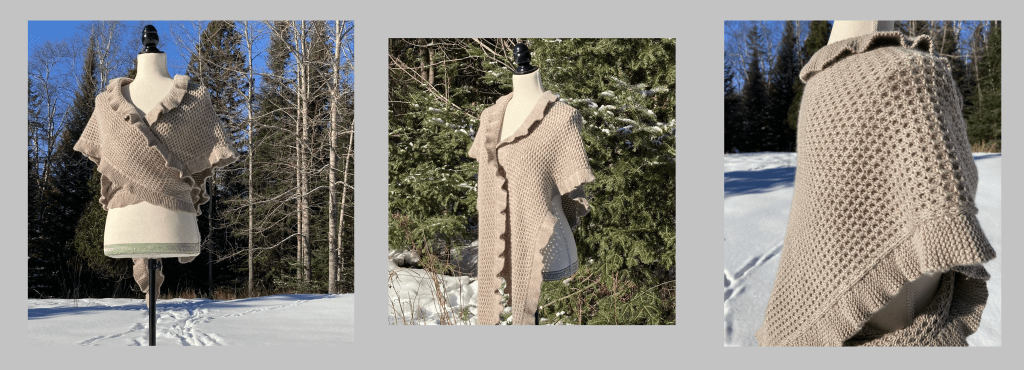
For the sock weight version, I used two skeins of Handmaiden Fine Yarns Casbah sock in the color “bone.” Casbah skeins come in at 355 yards, so they’re a bit under what sock skeins usually run and, as you can see, two skeins still makes a nice size of a shawl. That middle photo has the sock version on top of the DK version, for comparison’s sake. The difference isn’t as much in the depth of the back as it is in the length of the wings (and measurements of my sample shawls are provided in the pattern).

My photos are all taken in winter (or maybe at the very start of spring if we’re being generous), but since Marcy’s spending her summer on an island in Lake Superior, she’ll appreciate all the extra warmth she can get.


Thank you for helping me keep writing and keep blending my love of words and my love of knitting.

so you want to talk about flesh prisons (aka characters’ physical descriptions)

The other night at dinner, my husband was talking about Ready Player One. He read the book (in English) first shortly after it came out, then saw the movie, and now he’s reading the book in Italian. (Which he’s taught himself, because this is the guy I married.) He commented on how, since he’s seen the movie, he kept picturing the character Art3mis as her on-screen version and not the book version.

Which got me going about describing characters and using the phrase “flesh prisons” (yes, while we were eating) and he asked a) if I’d write it up, and b) if I’d use the phrase “flesh prisons” in my post.

So. Here we are.

I’m even going to throw in the asterisk that I gave him before going on my rant: this doesn’t work for all genres. If you’re writing romance, for example, you’re going to go right ahead and slow down while focusing on the love interest. There are times, be it in genres or just scenes, when more description matters. Just bear in mind that longer descriptions do slow down the action, so they’re more suited to certain places in your book than others.

Okay. Asterisk out of the way. When boiled down, my own personal decision on how much to describe my characters is this:

What do we decide to do with our meat prisons?

Bearing in mind that my characters are contemporary figures who get put into “basically today, usually Michigan” for their thriller settings, they’re humans. And human beings can be interesting, but part of what I’ve come to realize about myself is that physical appearance is most interesting to me when it ties into characterization.

Maybe also that I’m just not good at in-depth character descriptions. Anyway.

Let’s take Jay for a minute. I know, I know, only a handful of people have read Not Your Mary Sue so far since it’s not out until June, but you can meet him in the opening pages here. And most of the description comes when you first meet a character, right? So we can see some elements of Jay’s appearance: reddish hair (currently messy instead of purposefully tousled); blue eyes; tall; has a smile that lights up his entire face. I’ve even dropped in a clue about whether he’s right- or left-handed, but that’s not really a physical descriptor.

The thing is, in the first draft of the novel (from NaNoWriMo 2017) I did something that made me cringe a little when I went back over it: I described him based on which actor would play him in the movie version. It made sense within the book itself – Jay wants his story to be told and become a bestseller, so it’s not a stretch to imagine it then getting turned into a movie, the way both Mark Harmon and Zac Efron have played Ted Bundy – but I ended up cutting it.

Naming a well-known actor basically locks us all in to the same Jay, forever and ever, amen, the way my husband’s been picturing the Art3mis from the movie while reading the book. If I describe someone as “Avengers-era Chris Evans” (not my Jay model, in case you were trying to make it work), then we’re all stuck with Avengers-era Chris Evans in our head. We might not complain, but … we’re still all picturing the exact same thing.

I want to give you some leeway.

Pick whatever kind of nose you want for Jay. Imagine his eyebrows. Fill in the rest of his face.

You’ll learn later about why his smile maybe isn’t such a welcome thing, and Marcy has her own reasons to focus on his physique in the early pages of the book, but there’s enough to play with so that your Jay doesn’t have to be my Jay. And I’ve gone for sort of the low-hanging fruit: hair color, eye color, and height. Basically sketched in a roughly humanoid figure.

The rest of what you learn about Jay has to do with his character: who he is as a person. When Marcy describes his physique, it’s in comparison to what she associates with his favorite hobby. (Spoilers there, so that’s vague. No, it’s not serial killing.) His hair matters because it is messy instead of deliberately tousled, each of which says something different about a person.

What I like to describe about my characters’ physical selves are the things that tell us something about them as people.

It’s usually not something they had no control over – whatever genes blessed or didn’t bless them from birth – but the things they do: hair style. Tattoos or piercings. Hair dye. Clothing. Hobbies and learned skills that show themselves physically, like a guitar player’s calluses. Sometimes things they didn’t necessarily have control over, but tell us about their lives, like scars.

In the Ready Player One example, Art3mis is encountered first – and for the vast majority of the book – as an avatar. Cline spends a lot of time having his main character describe that avatar, in part for those romance novel reasons (Wade knows who Art3mis is before encountering her “in person” so he already knows she’s interesting) but also because the avatar was entirely created. Art3mis chose not only her screenname, but every element of her avatar. Everything about her appearance is therefore a deliberate choice that tells Wade something about her before he ever meets her.

And to be fair, I have wondered if character descriptions are one of my weakest points. (If you’re going to tell me I’m right, please be kind while you do so.) Maybe it’s something to do with being ace and just not looking at people the “usual” way. Or maybe I just think motivations and internal aspects of character are more interesting than flesh prisons.

How do you approach describing characters’ physical appearances? Do you have any favorite authors who seem to be really good at it?

Not Your Mary Sue – preorder links

Not Your Mary Sue releases on June 7 from Aesthetic Press, and the preorder links are here!

Amazon Kobo Google Play

A not so classic girl meets boy story begins when a televangelist’s adult daughter, Marcy, journeys to a secluded island resort where she awakens a captive of the handsome, charming, notorious Fresh Coast Killer who requests she pen his autobiography explaining all of his intentions and crimes in detail. She finds herself horrified that she is intrigued by him and maybe even…infatuated by him. He has more control than she realizes as he slowly begins to brainwash her just as the autobiography is completed. Once she is rescued and he is arrested, Marcy begins to pull her life back together only for her captor to escape and her brother becomes a new suspect in a cold case that alters what she thought she knew about her family.

If you missed my intro and reading of the opening, you can find that here, both as an audio track and the written transcript.

Rest assured that there will be teasers and more discussion over the coming months. I’m so excited to share this story!

(Did I specifically time this announcement to be my 100th post on my blog? No … but sometimes things just work out.)

Writing and waiting

As of yesterday, I can finally – finally! – announce that my debut novel, the psychological thriller Not Your Mary Sue, will be published in June 2022 by Aesthetic Press. *throws glitter confetti everywhere* I’ve been sitting on this news since this spring, and really, the entire backstory to the book story is one of waiting.

I drafted the novel during National Novel Writing Month in 2017, which means I was vaguely plotting the novel since the beginning of that year. I had the idea based off of one of my favorite Stephen King novels, Misery, where the two characters are stuck together in a house. The author character is held prisoner and forced to write. I substituted Ted Bundy for King’s captor and the novel just flowed.

(Fun fact: you can look back at any of your NaNoWriMo stats if you’ve entered the project into the site. I finished the draft on November 27 that year.)

So I’ve known this story and my characters, especially my main two, since 2017. In fact, the part where they’re stuck together – on an island instead of a house in Colorado – hasn’t changed all that much since 2017. I’ve known this story and these characters for years, but only a few other people had any idea about them.

So first there was waiting while I let the story settle so I didn’t still think it was already absolutely perfect in every way. Time to gain some distance before tackling the revisions on my own. And then more waiting when I started sending out queries.

Lots of waiting.

Do you get the waiting part yet?

I was seriously querying for over a year when I got the request for the full novel. (Queries generally ask for the query letter, a synopsis, and the first three chapters or so – check before submitting, but keep those documents on hands for when a rejection comes in and you need to send them out again. Getting a request for a full is A Big Deal. It’s not a guarantee, not yet, but incredibly exciting.) More waiting. Then the offer. Dancing! And more waiting.

I’ve been sitting on the news of the deal for months, because publishing is allllllll about waiting. You still don’t get to see the cover – not yet. You have to wait until mid-September. And the book itself? Wait until next June. (No, this isn’t weird for publishing. Yes, this is how it works. And yes, it’s hard to wait!)

But then – then! – I’ll be able to talk about my story and my characters with more than just my dad and my husband and a few friends. We can have more in-detail conversations about how Misery and Ted Bundy inspired things. Maybe argue about what happens.

I can’t share too much more right now, but I can leave you with this teaser from my publisher.

A not so classic girl meets boy story begins when a televangelist’s adult daughter, Marcy, journeys to a secluded island resort where she awakens a captive of the handsome, charming, notorious Fresh Coast Killer who requests she pen his autobiography explaining all of his intentions and crimes in detail. She finds herself horrified that she is intrigued by him and maybe even…infatuated by him. He has more control than she realizes as he slowly begins to brainwash her just as the autobiography is completed. Once she is rescued and he is arrested, Marcy begins to pull her life back together only for her captor to escape and her brother becomes a new suspect in a cold case that alters what she thought she knew about her family.

Oh yeah. I’m excited. I can’t wait!