current state of the (nonfiction) manuscript

I don’t often talk about my in-progress writing, except, whenever I do, it’s with other people who are also writing (or trying to write) and it’s a useful conversation for both of us. It’s also something I see less of when it comes to nonfiction/academic writing. I don’t think that’s just because I hang out with a bunch of creative writers, since it didn’t even really happen in grad school. We had to take that class and buy Writing Your Journal Article in Twelve Weeks, but … that was kind of it.

I’m also going to be all superstitious and secret about the actual content of this project, for the record. Partly because hyping it all up and then still having to write it feels like knitting the second sock (I don’t knit socks because I have to do the exact same thing twice) and partly because … well of course my ideas are so good you’ll want to steal them. Right? [Insert sweat smile emoji here]

So this week I picked up a draft I’d started back in November. When it grows up, it’s going to be a book, maybe 80,000-90,000 words. I haven’t really touched this one since the end of last year. It was about 33,000 words when I opened it up again to see what, exactly, I’d been trying to say.

Since it’s nonfiction, I’ve got the whole outline established. (This is in direct opposition to my fiction drafting.) All of the chapters are there, and even major headings within the chapters. Perfect.

I’ve been out of my normal routine for a while, so I wanted to re-establish that and make some realistic goals. Now in the past I have drafted academic writing at 5,000 words a day, every day, with no breaks, until it was done. That’s how I wrote Surviving Stephen King, for example, but a side note there: that was in April 2020, when I could pour all my emotions into my writing and let it distract me, and I’d just quit my job to write full time anyway, and I didn’t have any freelance work just yet. I’d also been researching King academically since 2014 and reading him longer than that. So. 5k/day was not a realistic goal for this past week.

I settled on a couple guidelines:

  • 1,000-2,000 words a day for all 5 weekdays
  • sit down to write by 10am

It looks so innocuous and simple, doesn’t it? But let me also explain why these were my goals.

First, like I said, I know I can produce 5k words a day. It’s physically, mentally, and emotionally possible. I’ve done it before. But that was then, and this is now. It’s a different book, a different topic, and I’m in a different place in my life.

Plus I’m coming back from a pretty long break. So. I wanted it to be realistic and achievable, but with a push. A push with breaks – weekends are still weekends. No need to go into burnout and frustrate myself trying to expand this draft.

As far as the “sit down by 10am,” I’ve got a couple things going on there. If I say “write from 10am until noon,” I might not get my word count goal. If I get up early, then I don’t really want to force myself to sit around until 10am to start. My sleep is something I try to put into my schedule, but it doesn’t always happen when I want it to, so some flexibility is good. Start by 10, check. Can do.

I’ve also clearly got that time free to schedule as I want – some of my freelance work is at specific times – and I know what time of day I’m most likely to be productive. So the point is to set myself up for success as much as possible, but also to show up and get my butt in the desk chair even when I don’t feel like writing.

I’m still at the point in the draft where I can easily skip around and fill in different parts depending on what catches my attention the most. I like this part. Monday I worked on Chapter 7, Tuesday Chapter 6, Wednesday Chapter 3 … I’ll have to go back through and make sure things flow properly, sure, but I know where the blank spots are.

Here’s a tip:

One of the first things I did was skim through what I’d already written and add [more] at the places that still need something: a transition, a whole section, whatever. The highlight helps me scroll through the document and see where I still need to do some work, and I chose the brackets because I don’t use brackets within the text. This makes it easy to search and see exactly how many places I still have left to work on.

Some of them are small (a transition) and others are pretty big (the conclusion chapter), but that part doesn’t matter for me right now. The important thing is that I can easily tell where more work needs to be done, and I can fill in all of the 0ther [more]s before tackling the conclusion. That’ll save me from printing it out for what I think is a final proofread and realizing I’ve left out an entire section.

Now when I sit down at or before 10am to write at least a thousand words, I can search for the missing piece that grabs me the most and start there.

I also like the Pomodoro technique.

Some days it takes longer than others to write a thousand words, so that can seriously be an extended time when I’m trying to force myself to focus … and nothing else. So most days, and especially days when I feel sluggish and like there’s no way in heck I’m getting 10 words, much less a thousand, I’ll start the timer. 25 minutes on, 5 minutes off. Or I’ll use my Pomodoro – Focus Timer app (I paid the one-time fee and it’s totally been worth it for me) and set it to 15 minutes on and 5 minutes off.

For the record, when I use the app, I set my phone on a stand where I can see it count down. It helps me to know how much longer I have to force myself to focus, or how much longer I can be on Twitter, and I like how I can set it to automatically run. Once it starts, it’ll tell me when the focus session is over and I can take a break, or when the break is over and I can get back to work. There’s no messing with individual timers to switch back and forth between 5 and however long I’m focusing. I really only use it in the moment and don’t even look at my stats, but you can try the official 25 minutes on, 5 minutes off for free. It’s setting up your own timing that’s part of the paid app.

Otherwise, it’s really just one word at a time.

If I hit my minimum goal, that’s 5,000 new words this week. If I max out, that’s 10,000 new words. They’re not necessarily all keepers, no, but once again, you can’t edit a blank page. Right now I’m still in full rough draft mode: nobody ever has to see this. I’m just shoveling sand in the sandbox and telling myself the story. Once I get all of those [more]s filled in, I’ll have to switch gears and get into revision mode, but that’ll be a while yet.

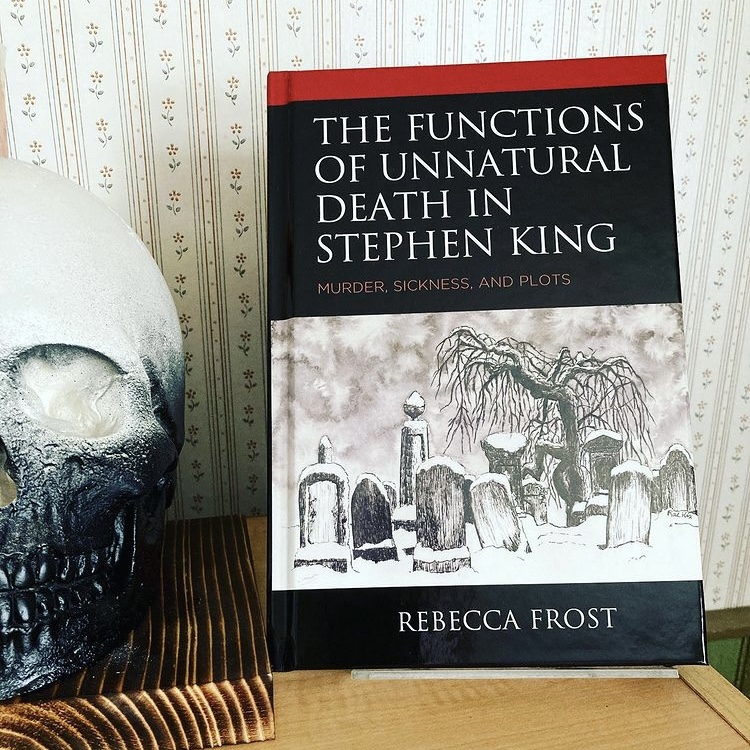
Current state of the manuscript: rough draft, over half of the way there

Ripper suspect: Richard Mansfield

We must once again remember that it doesn’t take much to be accused of having been Jack the Ripper. If a man can be shown to have been near the East End in the fall of 1888, then his name has likely shown up on the list.

Richard Mansfield, an English actor, was accused of being Jack the Ripper in an anonymous letter dated 1888. It’s hard to determine exactly how seriously the suggestion was taken, especially considering how phrenology and atavism were still in vogue. People were (and still are, to an extent) convinced that the darkness in someone’s soul would have to show on their faces and in their bodies. The more “rough” a person looked, than the rougher his character, and brutal murders of strangers was about as rough as it came.

But what, people started wondering, if there happened to be a man who could change his appearance so that he only looked like his essential self – a brutal, ugly murderer – part of the time? Sort of like how people think Ted Bundy is attractive despite the whole murder thing. In part that explains how he was able to isolate and then murder so many young women, but it also makes things scarier when we can’t look at someone and immediately identify them as dangerous.

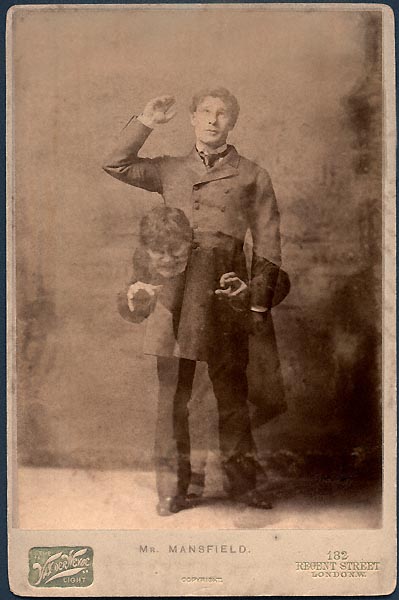
Promotional material emphasizing Mansfield’s shift from Jekyll to Hyde.

Enter Richard Mansfield, who happened to be playing the dual roles of Dr. Jekyll and Mr. Hyde in a West End theater during the Autumn of Terror. Audiences at the Lyceum watched as Mansfield transformed in front of their eyes, contorting his body and his face into the violent and base Hyde. The rumor was even spread that he managed all of this without any help from makeup or prosthetics, although the lighting choices certainly helped his transformation. It turned out that Mansfield did have some assistance, but at least one theater-goer bought into the belief that he could, in fact, change his physical self at will.

The novella was published in 1886, two years before the Ripper murders, and explored the idea of the alter ego or the gothic double. It seems that the restraint of the Victorian era was too much for Dr. Jekyll, outwardly the perfect gentleman, and he only needs the slightest push to revert to his baser instincts. This “push” comes in the form of a serum Jekyll drinks, so at least it’s not going to spread like some sort of social disease, but it’s also incredibly addictive. Even though Jekyll promises he won’t drink anymore and won’t become Hyde again, he can’t help it. First he drinks out of compulsion, and then he transforms into Hyde without even needing the serum.

On the one hand, it might make sense to accuse an actor of being the Ripper, since he would apparently have had the skills needed to blend in with others in the East End at least long enough to commit the murder and make his escape. On the other, Mansfield was only accused because of this dual role and his apparently perfect inhabitation of both of the characters. It was a role that made Mansfield’s reputation as an actor, so he must have done well.

The accusation did have an impact on Mansfield’s career, so it wasn’t completely ignored. In response to the publicity surrounding the suspicion, he put on a performance of the comedy Prince Karl as a benefit for reformed sex workers. Whether or not the police took the letter seriously, he certainly convinced his audiences that there was something to it.

Mansfield continued acting, including taking many roles on Broadway, and also went on to have a successful career as a theatrical manager. After his death at age 50, the New York Times declared that “As an interpreter of Shakespeare, he had no living equal.” Despite being accused of being a serial killer in his own lifetime, at the time of the murders, Mansfield managed to shake off suspicion and prosper.

the one about failure

All right, as promised (because I knew I could make myself write about this, but only if I’d actually put it out there): the failure stories. Okay. Honestly. Here we go.

*deep breath*

I actually feel pulled two ways about this. Some of my abandoned WIPs have gems buried in them: awesome phrases, sparkling dialogue, or a nugget of an idea that’s still worth pursuing. Others totally faltered for good reasons (mostly the reason being “I have no idea where I’m going with this”). But I think I’ve managed to hang on to at least 90% of them, so I can give you some actual numbers. (Even though I’m not sure I really want to look at the numbers myself.)

I wrote my first original “novel” in 2000, so in the past couple of decades …

I have 87 abandoned projects on record

Okay. I’m not sure if it hurts more or less to have the actual number written down like that. It works out to just under 4 abandoned projects a year, but in the cases where I’ve got the original dates, they totally group up. Some months I try and try and try and try and … nope.

Some of them are only a paragraph or two. Others are already tens of thousands of words (and I really want to know how they end, but … I still don’t). Many are variations on a theme, where I kept trying to find the proper path into the dark forest. For some of them, I eventually made it … after a dozen attempts. Others are just abandoned.

I’m not entirely sure why I saved them all, even if I’m grateful I did. Some were saved on a CD. Others were printed off and put into a three-ring binder. The more recent reside in the “nuggets” and “established beginnings” folders on my computer (with a sort of arbitrary line for when something’s long enough to become the second instead of the first).

And, if we compare my numbers with the titles in my “completed” folder, we’ve got 10:1 odds here.

For every plot arc I’ve completed, I’ve made 10 attempts

That’s just overall. Sometimes – the magic times – I complete a plot arc on the first attempt. Others take four or six or twelve false starts.

I think if I wanted to do more math I’d find that the ratio started out much higher and has come down over the years. I also don’t think it’ll ever be 1:1, but 3:1? Maybe. And I also think that’s only happening because I do keep trying.

I mean, aside from the obvious “You’ll never finish anything if you quit starting,” I like to think that bringing the ratio down is all part of the process. Maybe I’m finding myself more easily, or maybe I’m more wiling to circle the dark forest longer before trying to make my way in. And for me, finishing is the ultimate goal: getting a draft with a complete plot arc so I don’t flip the page years later and groan because it’s blank and I have no idea what happens next.

But I’m also really proud of Teenage Me for the fact that, despite the 20:1 or so ratio, I kept writing. Like I seriously want to go back and give myself a hug for it. I made repeated attempts and even kept the record of those attempts, even though it’s basically a record of failure. And that momentum has made it easier, or maybe even necessary, to keep saving everything like that. To keep on dropping breadcrumbs on my way.

So I’ve kept them, and every so often I’ll pull them out and go through them. I’ve even made lists of the lines that still strike me as good and the ideas that still intrigue me, just in case.

If I’m feeling very brave, I might even share some of those someday. (Right at this moment I’m not feeling very brave …)

When’s the last time you looked at your WIPs? How does your stack compare to mine?

To outline or not to outline: that is the question

I know I’ve already shared how I, personally, outline books – or, at least, how I outlined Ripper’s Victims specifically – but since I’ve also pointed out that each new project can feel like learning to write all over again (and since that first post is pretty darn old by now) I thought I’d come back to this question with a broader scope.

Yes, I outlined Ripper’s Victims using sticky notes before I ever started writing it. Yes, I’ve still got that poster board. And there are a lot of times I use sticky notes and poster boards to organize my ideas in the early phases, especially of nonfiction projects, but of course that’s not the only way.

I have friends who:

  • jump right into a project without any notes or outline or anything. She just sits down, goes “Hmmm,” and writes the first page. And it works. She’s written entire novels this way.
  • come to the first page with a pretty detailed world and the first couple scenes in mind, then see where that takes them.
  • outline everything very meticulously. And I mean very. To the point where it’s less of an outline and more … nearly-completed scenes. But she doesn’t like revising, and she can manage to keep up the energy not only of these outlines, but also then writing the book.

They’ve also all written more than one project, so these methods are the ones they’ve figured out to help them keep moving forward. It’s like Stephen King‘s “Write every day” advice (I wrote my own thoughts on that here): it works for him because he knows what doesn’t work for him. My outlining friend does so much work before “officially” writing because she’s seen what happens if she doesn’t. The friend who writes by the seat of her pants hasn’t had to change her method because it works for her.

And along with the “each project is new” aspect of it, I’ve also realize that – shock, I know – there are major differences between my nonfiction and my fiction approach.

I don’t outline my fiction with sticky notes.

Sorry. I should’ve warned you. That one’s probably a big shocker.

For Not Your Mary Sue, I don’t think I have any written notes … at all … before starting it for NaNoWriMo (at 12:01am November 1, because I’ll force myself to wait for November, but no longer). Even though the idea had been in my head since February that year.

I’d been thinking about Marcy, and her family, and her background, and how she’d react to waking up on that island, but I don’t have any character sheets written down. No timelines drawn out. I “cast” Jay in my head but I had even less on his background than Marcy’s.

Since it’s from Marcy’s POV, she was the one I needed to know better. I also knew Jay’s main goal would be talking and telling her all about himself, so … I figured that I’d be able to learn along with her. (Hey, it’s a first draft. Nobody ever has to see your first draft. If it crashed and burned, nobody ever had to know.)

And the thing is, the story I thought I’d be writing ended up being only about half of what actually came out. I saw where it could go, to a specific point, and assumed I’d then write a little tag scene to sort of wrap things up, but … the story didn’t want to be wrapped up there. I knew who Marcy was by then, had spent so much time with her, and realized her story wasn’t done yet.

So I had even less of an idea of how the second half of the book would go, but I followed her anyway and let her do her things and live her life, and followed her like Joe Goldberg and wrote it all down. (Maybe someday I’ll share how I thought Marcy’s story “should” have ended, before she told me how wrong I was.) But I was like my first friend and had no idea at all what was going to happen next until I typed it, and … it still worked. The story came out. It made a complete arc.

Okay but that’s a success story.

I get it – there are plenty of ways to outline a story or not, and they all work for different people, and look at how well they worked for me! Whee! But what about when something doesn’t work? What about all the failures and the discards and …?

Next post, I promise. We’ll talk about about the failures next. I’m going to need a lot of space for those.

12 Challenge, book two – State of Terror

Late last December, I decided to go ahead and do the “12 Challenge” that was going around Twitter: 12 months to read 12 books recommended by 12 friends. I specifically requested true crime and thrillers, looking for good books I haven’t read yet. Book one was Dark River: The Bloody Reign Of The Ohio River Pirates, and book two is State of Terror by Hillary Rodham Clinton and Louise Penny.

So, first: I don’t usually read political thrillers. Expanding reading horizons is part of the challenge, and the friend who recommended it pointed out that maybe it’s a stretch.

That being said, it reminded me a lot of Dan Brown‘s Robert Langdon books. You know. Angels and Demons? The Da Vinci Code? There’s a lot of globetrotting and seeing the sights, calling out different locations and well-known sights. There’s also the sort of “very few people in the world even know what I’m telling you” aspect to it that always made me wonder how, exactly, Dan Brown learned this secret information (and why it’d be safe to just tell the world in a best-seller if the information is indeed secret) but, in State of Terror, makes you remember who one of the authors is.

I spent a lot of time being very aware who one of the authors is.

The main character is, after all, the Secretary of State. She’s just come on board after a very awful president who gets a bunch of jibes thrown his way. Ellen Adams is also blonde and gets called names that quickly go viral – it’s not “nasty woman,” but … you know it totally is. So clearly any state secrets Ellen Adams reveals to readers can’t actually be real, but … I mean, it makes you wonder.

If I hadn’t known Hillary Rodham Clinton was one of the authors, some of those things probably wouldn’t have jumped out at me like they did. It’s all “write what you know” until “what you know” happens to be about a high-ranking informants’ council but I do trust that, when Ellen Adams says something in Washington, DC is a ten minute walk, it’s a ten minute walk.

I did struggle some with the chronology. I’ve talked about narrative timelines before, but this wasn’t an issue of how all travel takes place between chapters, with a single turn of the page. They sleep on flights or hey, nothing interesting happens, and then they go for hours and hours without sleeping. They’re running on adrenaline. That’s fine.

What really threw me – and it’s something that happened for the first time on page one – was how a chapter would open with a line of dialogue, bang, in media res, and then the narration would back up so we knew where we were, who was there, and what was going on … but that dialogue never showed up again to place it in proper context.

If a chapter opened at 8:00 PM sharp, the narration would back up to 7:30, where we’d last left everyone, and then apparently go until 7:59 … but skip ahead to 8:01? Maybe? I’m still not entirely sure, but until I caught on to what was happening, I was just forcing myself along and hoping it would make sense later. (Which happens a lot when I read large cast books for the first time. Stephen King, I’m looking at you.)

There’s also the fact that, as I said, I don’t read political thrillers, so maybe that’s a genre thing. You get the snappy dialogue immediately and then have to sort out all the rest as you go.

There was also a fair amount of head-hopping. It’s totally the bane of a lot of writers’ existence. It’s really easy to do subtly – have your point of view character understand what someone else is thinking, oops – but this was jarring at times. You’re following Ellen and suddenly you’re in someone else’s head, looking at Ellen and reading about her in terms she wouldn’t use for herself.

But those are structural things. Maybe generic things. (As in, specifically genre-related.) Was it a good book?

Wait, how do we define a good book?

I don’t like rating books for this very reason. I just keep a list of which ones I’ve read and that’s that. But if, for whatever reason, I want to keep reading to figure out how it all turns out – even if it’s because I want to know if the author’s actually going to give a good explanation (cough Stephen King again cough) then I consider it a good book. It did what I wanted it to do: took me away from whatever’s going on in the world or my life at the moment and made me care about something else for a bit.

So, by that standards: yes, State of Terror is a good book. I read it in a day. I’m a fast reader, sure, but if I don’t like a book, it’s slower than molasses. I wanted to know what was happening with Ellen, and to see if I figured out the FSO’s secret, and how some of the other characters’ relationships would shake out in the end. Plus I wanted to know the big whodunit, and there were a couple times I doubted my original impression, which is major for me. I read so many thrillers that it’s rare for a twist to truly shake me.

But I still don’t think I’m much of a political thriller fan.

Have you read State of Terror? Or do you read political thrillers and have some answers for me?

so you want to talk about flesh prisons (aka characters’ physical descriptions)

The other night at dinner, my husband was talking about Ready Player One. He read the book (in English) first shortly after it came out, then saw the movie, and now he’s reading the book in Italian. (Which he’s taught himself, because this is the guy I married.) He commented on how, since he’s seen the movie, he kept picturing the character Art3mis as her on-screen version and not the book version.

Which got me going about describing characters and using the phrase “flesh prisons” (yes, while we were eating) and he asked a) if I’d write it up, and b) if I’d use the phrase “flesh prisons” in my post.

So. Here we are.

I’m even going to throw in the asterisk that I gave him before going on my rant: this doesn’t work for all genres. If you’re writing romance, for example, you’re going to go right ahead and slow down while focusing on the love interest. There are times, be it in genres or just scenes, when more description matters. Just bear in mind that longer descriptions do slow down the action, so they’re more suited to certain places in your book than others.

Okay. Asterisk out of the way. When boiled down, my own personal decision on how much to describe my characters is this:

What do we decide to do with our meat prisons?

Bearing in mind that my characters are contemporary figures who get put into “basically today, usually Michigan” for their thriller settings, they’re humans. And human beings can be interesting, but part of what I’ve come to realize about myself is that physical appearance is most interesting to me when it ties into characterization.

Maybe also that I’m just not good at in-depth character descriptions. Anyway.

Let’s take Jay for a minute. I know, I know, only a handful of people have read Not Your Mary Sue so far since it’s not out until June, but you can meet him in the opening pages here. And most of the description comes when you first meet a character, right? So we can see some elements of Jay’s appearance: reddish hair (currently messy instead of purposefully tousled); blue eyes; tall; has a smile that lights up his entire face. I’ve even dropped in a clue about whether he’s right- or left-handed, but that’s not really a physical descriptor.

The thing is, in the first draft of the novel (from NaNoWriMo 2017) I did something that made me cringe a little when I went back over it: I described him based on which actor would play him in the movie version. It made sense within the book itself – Jay wants his story to be told and become a bestseller, so it’s not a stretch to imagine it then getting turned into a movie, the way both Mark Harmon and Zac Efron have played Ted Bundy – but I ended up cutting it.

Naming a well-known actor basically locks us all in to the same Jay, forever and ever, amen, the way my husband’s been picturing the Art3mis from the movie while reading the book. If I describe someone as “Avengers-era Chris Evans” (not my Jay model, in case you were trying to make it work), then we’re all stuck with Avengers-era Chris Evans in our head. We might not complain, but … we’re still all picturing the exact same thing.

I want to give you some leeway.

Pick whatever kind of nose you want for Jay. Imagine his eyebrows. Fill in the rest of his face.

You’ll learn later about why his smile maybe isn’t such a welcome thing, and Marcy has her own reasons to focus on his physique in the early pages of the book, but there’s enough to play with so that your Jay doesn’t have to be my Jay. And I’ve gone for sort of the low-hanging fruit: hair color, eye color, and height. Basically sketched in a roughly humanoid figure.

The rest of what you learn about Jay has to do with his character: who he is as a person. When Marcy describes his physique, it’s in comparison to what she associates with his favorite hobby. (Spoilers there, so that’s vague. No, it’s not serial killing.) His hair matters because it is messy instead of deliberately tousled, each of which says something different about a person.

What I like to describe about my characters’ physical selves are the things that tell us something about them as people.

It’s usually not something they had no control over – whatever genes blessed or didn’t bless them from birth – but the things they do: hair style. Tattoos or piercings. Hair dye. Clothing. Hobbies and learned skills that show themselves physically, like a guitar player’s calluses. Sometimes things they didn’t necessarily have control over, but tell us about their lives, like scars.

In the Ready Player One example, Art3mis is encountered first – and for the vast majority of the book – as an avatar. Cline spends a lot of time having his main character describe that avatar, in part for those romance novel reasons (Wade knows who Art3mis is before encountering her “in person” so he already knows she’s interesting) but also because the avatar was entirely created. Art3mis chose not only her screenname, but every element of her avatar. Everything about her appearance is therefore a deliberate choice that tells Wade something about her before he ever meets her.

And to be fair, I have wondered if character descriptions are one of my weakest points. (If you’re going to tell me I’m right, please be kind while you do so.) Maybe it’s something to do with being ace and just not looking at people the “usual” way. Or maybe I just think motivations and internal aspects of character are more interesting than flesh prisons.

How do you approach describing characters’ physical appearances? Do you have any favorite authors who seem to be really good at it?

Learning to write all over again

Writing can feel really isolating: just you and your computer as you stare at the blinking cursor and wonder when the document is going to have the desired word count. How you get from 0 to that word count is pretty much up to you. If you’ve got a deadline, you just have to be faster and figuring it out.

It’s also one of those things where you don’t always realize what you know or how valuable your own struggles – uh, experiences – might be until you’re talking to another writer and someone says “OMG, me too!” in clear tones of relief.

In grad school, we didn’t really talk about the writing process. It was like everyone assumed we already knew how to write and just had to be told the assignment parameters. When I submitted for my first conference, I felt like I was winging it. Same for my first chapter. We didn’t talk about writing, and it didn’t seem acceptable to ask anyone about writing. It was just this weird taboo.

So it was hard to tell if my own experience actually related to anyone else’s, or if mine was somehow … subpar. Like I’d missed a bunch of key information that everyone else somehow magically knew.

Part of my intent with this blog is to share the things that get me the “OMG, me too!” responses so I don’t play into the secret-keeping aspects. I’m (somehow) at a point in my career where people look up to me and think I’m a real writer (imposter syndrome what?) and there are so many things I wish I’d heard from someone when those positions were reversed, so …

Starting a new project can feel like learning how to write again from scratch.

There. It’s out.

You’d think, or maybe hope, that after you write one book, you’ve got it down. You’ve managed to go from 0 to 80k or so, get it passed editors and proofreaders and through the printing process, and you’ve learned a bunch of lessons along the way. All of which can be applied to Book #2. Right?

Uh. Well.

To be fair, at first I thought maybe I was just making things harder for myself by not approaching a new book project the same way I’d gone about the first. Like I was just reinventing the wheel to keep my stress level high for the fun of it. Except each book project is different, so why should the process look exactly the same?

For me, Book #1 was about Jack the Ripper. Book #2 was about H. H. Holmes. Two nineteenth century serial killers, right? Well, yes. But …

Ripper’s Victims came out in 2018, but I’d started reading about the Ripper in 2007. I’d already racked up a respectable number of books by the time I signed the contract, and bought even more in the process of researching it. But it wasn’t like I’d only looked into the Ripper from the moment of signing the contract. I’d already had a better part of a decade not only reading about the Ripper, but writing a paper on the women for a graduate independent study course and then presenting that paper for my first conference. I had this whole history with the Ripper, and there was such a huge bibliography to make my way through.

Take a look at this:

I know you can’t read it, but the framed poster board at the bottom with all the neon sticky notes is my outline for Ripper’s Victims. I went through and wrote down the titles of books about the Ripper and organized them chronologically. Which worked quite well until the 1990s, which spilled over, and then for the 2000s I ended up parsing out different themes because yowza. The Ripper was popular and still gaining.

Holmes isn’t that popular. I’ve had people hear I do true crime and name Holmes as their sort of “gotcha” killer, because apparently we’re gatekeeping true crime now. (Also apparently Erik Larson’s book, despite selling so many copies, hasn’t made Holmes mainstream. Who knew? Maybe everybody reads it for the architecture.)

But already straight off you can see I couldn’t start the same way with Holmes as I had with the Ripper. I’d read I think three books about Holmes when my editor asked if I’d be interested in writing my own, and three compared to my Ripper history seemed kind of pitiful. Except … there aren’t over 100 books about Holmes. My bibliography didn’t stay at three, but it certainly didn’t explode like my Ripper posterboard.

That’s just one major difference. Another is the subjects themselves: the Ripper was never named, but Holmes was. He’d been identified, put on trial, and even wrote both an autobiography and a confession before his execution. You can’t approach them the same way. It makes no sense to try.

And still I thought maybe I was just trying to make life difficult for myself.

Is this a case of form following function? (That’s for you architecture fans out there.) Granted, the final form – a book – looks very much like any other book. There’s a different cover, but … sentences and chapters and pages.

I think the biggest takeaway here is flexibility.

When you’ve written a book, you’ve learned one way to write a book, but it’s not the only way for anyone to write a book … and it’s not even the only way for you to write a book. The tips and tricks you’ve amassed are certainly there in your toolbox to be used as often as you need them, but they’re not the only tips and tricks in the world. And they might not always work on a new project. (I’d try for another architecture metaphor, but I personally read Devil in the White City for the serial killer.)

I’ll revert to Joseph Campbell and the hero’s journey: he says that the hero has to find his own path into the woods. If the journey’s easy, then you’re on a path someone else has made, and you’re not going to be a hero.

Writers have to find their own path into the woods … for each book. Maybe you can make some headway on a path you’ve made before, but not always. Sometimes you have to reassess your approach and start hacking away in a different direction, because this book isn’t the same as the last one. You’re not looking to end up in exactly the same place, and you’re probably not starting from the same place, either.

The woods are lovely, dark, and deep … and enormous. Starting a new book can feel like learning to write all over again, and that’s not a bad thing. It can be frustrating, but it can also be thrilling and rewarding.

What do you think? Do you find yourself still learning how to write, no matter how much you’ve written before?

book review: Love in the Time of Serial Killers by Alicia Thompson, out August 16

I was able to get an advance copy of Love in the Time of Serial Killers via NetGalley, so let’s start with the book summary:

Turns out that reading nothing but true crime isn’t exactly conducive to modern dating—and one woman is going to have to learn how to give love a chance when she’s used to suspecting the worst.
 
PhD candidate Phoebe Walsh has always been obsessed with true crime. She’s even analyzing the genre in her dissertation—if she can manage to finish writing it. It’s hard to find the time while she spends the summer in Florida, cleaning out her childhood home, dealing with her obnoxiously good-natured younger brother, and grappling with the complicated feelings of mourning a father she hadn’t had a relationship with for years.
 
It doesn’t help that she’s low-key convinced that her new neighbor, Sam Dennings, is a serial killer (he may dress business casual by day, but at night he’s clearly up to something). But it’s not long before Phoebe realizes that Sam might be something much scarier—a genuinely nice guy who can pierce her armor to reach her vulnerable heart.

And my official review:

I devoured this book in a single day because I just HAD to see how it all came out.

Phoebe Walsh has carefully bricked her heart in behind a wall of true crime facts and boy band lyrics, but they can’t save her from her current situation. She’s dealing with her estranged father’s death, her younger brother’s attempts to reconnect, and an intriguing new neighbor who might be a serial killer (see Phoebe’s wall of true crime facts).

I spent much of the book wanting to save Phoebe from her choices (and her insistence on relating every. single. thing. to a serial killer) but also rooting for her to figure it out herself. There were times I wanted to shake her and demand some more introspection, please, and not her usual avoidance, but Phoebe’s Phoebe. She’ll reference whatever she darn well pleases and avoid the rest, and if you experience second-hand embarrassment, maybe it’s because you recognize the tactic from personal experience.

This makes for some awkward interactions with others, including her younger brother and that possibly-a-serial-killer next-door neighbor, who’s not exactly a social butterfly himself. But Phoebe needs those difficult interactions to wear away some of her defenses and – hopefully – give her a second chance to look at so many people in her life with new eyes … if it isn’t too late.

… because there’s more to say than just “Pre-order Love in the Time of Serial Killers and follow Alicia on her socials!”

About a year and a half ago, I got an email from someone who asked if I’d be willing to talk about the process of writing a true crime dissertation, as background information for her character. See where this is going?

I was nervous about reading the book, both because Alicia and I have become internet friends and because I’m the one in the best position to read any of the background information about the dissertation and say uh, that’s not how this works.

Academia is its own world. So many things happen that just don’t make sense to people who haven’t been there, and it can be hard to explain what, exactly, the whole process feels like. How it works, or how it maybe doesn’t.

I ended up emailing Alicia back instead of taking her up on the offer for a phone call because I typed up this absolutely enormous document about my personal experience. It’s over 3,000 words, and yes, I saved it. If anyone else wants to know, I didn’t want to have to type it all up again.

I also figured that Alicia wouldn’t need or use anywhere near all of it, because she had a story she wanted to tell. If something didn’t fit, then she could ignore it. After all, it’s fiction, and she probably already had most, if not all, of the book drafted. There might not be much wiggle room. But, actually … wow. She used a lot.

Much of it is probably minor and nobody but me would catch it, but I spent a lot of the book nodding. At the true crime references, yes – I’m not sure if Alicia knew some of them before we chatted, but some of the ones I mentioned in that humungous word dump made it into the book – but also a number of Phoebe’s PhD experiences. And I definitely laughed out loud at one line that I’d sent her, which made it into the book as a piece of dialogue. No spoilers, but Alicia: I noticed.

Also, for the record, I’m not a romance reader. It’s not my usual genre. And I still read the whole book in one day and liked it, in spite of my initial concerns about … well, everything. The genre and the subject and the very specific experiences of the main character.

So I was a little surprised, and very relieved, to like the book as much as I did. You should pre-order it from your favorite indie bookstore. If you don’t have a favorite indie bookstore, you can borrow mine. And then, come August, we can talk some more about Phoebe.

“Do you ever get into a writing funk where you just can’t summon the energy to write?”

If you google “write every day,” you get over a million results. I mean, it’s Google, so there are usually tons of responses, but … it’s common advice. I don’t know if it’s the most common, exactly, but it’s out there enough that people who don’t write everyday are worried, or even convinced, that they’re doing it wrong. To the point where someone I know, who is in no way a slacker, asked me this question: do you ever get into a writing funk where you just can’t summon the energy to write? Because maybe she assumed that, being a “real” writer, my answer would be “no.”

How accepted is this idea? I wrote back “YES” and she responded “THANK GOD.” (We proceeded without shouting after that.)

The thing is, we get people like Stephen King telling us to write every day. And you’d think he knows what he’s talking about, right? World-famous bestselling author, and he says:

Once I start work on a project, I don’t stop, and I don’t slow down unless I absolutely have to. If I don’t write every day, the characters begin to stale off in my mind … I begin to lose my hold on the story’s plot and pace.

Stephen King

So … write every day. Right?

Not according to Cal Newport. Or Kristen Simental. Or Luke Eldredge.

I’d like to pick apart King’s quote, because even though it often gets repeated as the simple “Write every day,” he actually tells us more than that. In fact, he reveals a bit about his own writing pitfalls. Once he starts a project (so presumably not 365 days a year), he feels that he, personally, has to write everyday because otherwise he sees issues in characters, plotting, and pacing.

Remember how not all writing advice is universal? How there are so many books about writing out there, and they all have different advice? We call come from different backgrounds and have our own potential pitfalls. Not all advice is for every writer, and not all advice is shared in a way that’s actually helpful.

That’s why we need the full quote: to see what, exactly, “write every day” means to King, and why he stands by it. He’s noticed, in his own many decades of experience, that he, personally, has to write every day once he starts a project, or else these issues arise. He’s not “writing every day” because it’s been repeated so often, but because he knows what’s likely to happen if he doesn’t. For King, writing every day is the solution.

I’d say I more or less align with King here: once I get started on a project, I’m likely to write something in it every day until I hit my goal. Sometimes the goal is a completed draft; other times it’s a completed section of a draft. If I’m at the very beginning and I’m excited, then “every day” means 7 days a week. Other times it means 5 days a week, because even people with “real” jobs get weekends. (Mine aren’t always Saturday and Sunday, or two days in a row, but they’re still days when I don’t expect myself to write.)

The biggest argument I hear for “writing every day” is that writing is a job. If you’re serious about it, then of course you’ll do it every day.

Think for a moment about what you do every single day of your life. Breathe, eat, sleep. Take care of other humans or pets in our household. But even exercise plans have rest days built in. Work limits your hours if only because they don’t want to pay you overtime. We recognize the need for rest, recovery, and making space for other things when it’s not writing, so …

If writing every day burns you out, then it’s bad advice for you. Like all other writing advice, it’s something you need to consider for both practicality and personal adaptation. If you’ve never tried it, maybe it’s time to pick a project and adhere to the advice for a set amount of time – say, a month. Give yourself long enough to figure out if it’s working, and maybe long enough to become a habit. Maybe you’re a big don’t break the chain kind of person. But even then, remember that the true test of your chain is missing a day … and getting right back into it on the next.

You might mess around with expectations. Are you trying to write a specific number of words each day, or carve out a specific amount of time for writing? When you say “writing,” do you mean “putting words on the page” or will you count research, plotting, daydreaming, and so on? Are you willing to switch up your goals and your schedule to better match your actual daily output? Is this a 24/7/365 sort of goal, or a project-based goal?

So no, I don’t put words on the page every day. I don’t sit in front of my laptop for a set amount of time every day, either. When I’m working toward a deadline, it’s far more likely – but even then I remember that weekends are a thing. And, like King, I’ve been doing this for a while, so I have a pretty good idea of what works for me and how to avoid my worst pitfalls. But that doesn’t mean you have to do exactly what I do.

Sometimes I get into a funk and can’t summon the energy to write. It happens. I’ve barely worked on my book projects all month because so many other things have come up. Stress is real, and burnout is real. If writing every day adds to either of those, then it’s probably not your best solution right now. Because that’s what writing advice should be: a solution, not stress or shame.

How was your January? Were you more productive, word-wise, then I was?

12 Challenge, book one – Dark River: The Bloody Reign Of The Ohio River Pirates

Late last December, I decided to go ahead and do the “12 Challenge” that was going around Twitter: 12 months to read 12 books recommended by 12 friends. I specifically requested true crime and thrillers, looking for good books I haven’t read yet. I’ve finished my first selection from that list: Dark River: The Bloody Reign Of The Ohio River Pirates, by Robert Walsh and Wayne Clingman, recommended to me by Robert himself.

It’s a subject I knew nothing about. I read a lot of true crime, sure, from various centuries, but river pirates were new to me. I even looked through the indices of some of the surveys of murder in America that I’ve read to check for some of the names Walsh and Clingman mention, and nothing popped up. So at least I didn’t already read about these people and then forget them.

They cover multiple groups that worked along the Ohio River prior to 1850, and they all seem to be groups. River piracy wasn’t for loners, and it died out with the paddle steamers. Pirates depended on outnumbering their victims and being able to make a quick getaway.

There are different chapters for different groups, and some highlights include:

The Harpes, brothers – or maybe they were cousins – who get presented as “often been called America’s first serial killers.” This is where I first went to my other books, because … who? I’d never heard of them. But apparently river piracy wasn’t just for men who wanted to rob the rich. It was a good profession for men who just wanted to kill people.

James Ford, who was either “Lucky Luciano or Fagin with a Southern accent.” A lot of these pirates have a very mobster feel to them, and I don’t usually read books about the mob. The way to get around the law – aside from crossing the river and moving to land under control of another country entirely – was being the law, or at least paying those who had high positions.

The Potts Hill Gang, who may or may not have been fictional, but who had a very interesting story. Possible spoilers here: a son who had been kicked out of the gang decided to return years later, in disguise, to surprise his family. A “spotter,” sent out to gage the apparent wealth of travelers so the gang would take an unnecessary risk killing a poor man, decided the son looked like a good target. When the “stranger” came along, the father killed him. Which seemed fine, until rumors started that the son was supposed to have come back. In order to keep his wife from wailing that he’d committed filicide, the father dug up his latest victim so she could have a look … and positively identify her son. (Moral of the story: don’t try to trick pirates.)

There’s also some interesting information about forgery, a crime I also don’t usually read about. It’s very much situated in the time and place, between different countries and with changing/emerging laws to contend with, along with Regulators and lawmen and the rest.

It was an interesting read, although I think it’s pretty niche – these stories aren’t usually covered even in lengthy surveys of the history of crime in America. If that’s a crevice you’re interested in exploring, pick up a copy and dive in.