A Millennial’s Guide to Breast Cancer: And So It Goes

For my fortieth birthday, I bought myself a five-year journal. I’d gone back and forth on it for a while, because I’m not exactly a daily journal writer, but I figured I could make myself do a few sentences each day. It would be fun to look back on things and see what happened, even with the mundane stuff.

Before I ordered it I did think to myself that it was a bit of an optimistic gift for myself: This means I need to live another 5 years, ha ha ha.

It didn’t help that I was diagnosed with laryngitis on my birthday and we had to put off celebrating until I felt better. It didn’t feel like an auspicious start. But I kept up with daily updates, not forcing myself to fill up all the given space if I didn’t feel like it, for longer than I thought I would. My initial scans and biopsy are in there, and the surgery. Later in the summer, though, it felt like it was just another “Felt terrible today. No other updates.” And other such things that I actually don’t want to remember, thanks.

Fast forward to October.

I started these blog posts at a very low time, actually. In October 2024 I’d finally (finally, finally!) signed with an agent after four years of querying. In October 2025 my now-former agent released me from contractual obligations. (That’s the official wording. Honestly it feels like being dumped and, once again, told that I’m not good enough.)

The thing is, I’d focused on my writing and presumed future publications as my reason to get through treatment. In my lowest moments, I clung to the idea that I finally would be published and in bookstores. That was my reason to push through, and then … suddenly … that reason didn’t exist anymore. Where the heck was I supposed to go from there when my path forward was just dynamited?

So I started writing these posts. I outlined twelve things I felt like I was able to talk about now, and figured six weeks was actually a pretty long stretch of time. There’s a lot to say about being diagnosed with cancer, after all, and I’ve written about 18,000 words on the subject. That’s way past a short story and into novella territory. But now I’ve come to the end of those twelve ideas, and I don’t think I’m ready to write about some of the other things yet.

They’re still too nebulous.

Some day I’ll write about how the bad days now feel even worse, even though they’re better, because I’m sooooo close to being back to normal. The bad days remind me that hey, I had cancer, and no, things aren’t normal anymore. It’s just not fair.

I’ll write about the weird compartmentalization that means I forget that I had cancer, even though I’m taking medication for it daily. The incisions still hurt from time to time, and the scars are obvious, but otherwise I try to ignore it … unless it gets stuck in my head and I dwell on it.

I’ll look back on this first holiday season after my diagnosis and maybe have an answer as to whether this is normal “getting back to life after cancer” or if the holidays themselves actually add to the emotional tornado. There’s no way of knowing how bad things would be if I hadn’t had that mammogram, and the chances of me having died by now without a diagnosis are slim (breast cancer is usually slow-growing), but I can’t help but think these things. The what ifs? run in herds.

Someday—I hope—I’ll also be able to tell you exactly when you feel like you’re actually past the cancer and not just waiting for the next bad news. Yeah, that’s a pretty big hope. I don’t know if that will ever happen, but I won’t even have my first post-treatment mammogram until next spring. I didn’t know I had cancer before, so there’s no way for me to be sure I don’t have it now.

That’s also wrapped up in this idea that I shy away from thinking of myself as a “survivor.” Like yes, I’m still here, but have I won? Is it really over? And why does it feel like it’s the treatment I had to survive, not the cancer itself?

I’m sure there’s also a whole essay behind saying memento vivere instead of the more common memento mori, but right now I feel like it’s so obvious that, if you don’t get it, I can’t explain it. That means I’m still too close to really write about it.

So the main thing is, it’s not over.

I’m still reminded of my cancer every day, sometimes multiple times a day. I’m still negotiating the side effects of the medication I have to be on to reduce the chances of the cancer ever coming back. (I’m still doing gymnastics to word sentences that way because there’s no guarantee it will completely prevent the cancer from coming back.)

Since my own diagnosis, two people I know and one friend of a friend have been diagnosed with breast cancer. Sharing stories is remembering, too, and dealing with the conflicting emotions between the memory of how bad it was with the idea that I’m still so lucky. This is a thing that happened to me, and parts of it are still happening, and it’s not like I just “can’t let it go.” It’s simply not over. There will be more.

I hope you have a wonderfully warm and bright holiday season with those you love. Memento vivere, and find the joy everywhere it exists.
A Millennial’s Guide to Breast Cancer – all posts

A Millennial’s Guide to Breast Cancer: Write What You Know

I didn’t start reading Stephen King until the summer after college. I’ve always been a voracious reader, and I can only remember one time when my parents intervened. I wanted to read Pet Sematary (it had a kitty on the cover!) but I was in second grade, so they suggested that maybe I put that one off for a while. There’s no real reason I put it off for so long, but it generally surprises people that I got such a late start.

In ‘Salem’s Lot, Catholic priest Father Callahan visits another character in the hospital and spends some time musing about how his parishioners usually react to sudden medical news like cancer, a heart attack, or stroke. Father Callahan’s experience tells him that these hospital visits are usually with someone who feels betrayed by their own body, but they can’t get away from the betrayer like they could if it was a backstabbing friend. It’s a dark assessment from a priest who’s losing his faith but who, at that point, has only really observed such things from the outside.

King was 28 when it ‘Salem’s Lot was published, and although he had personal experience with Callahan’s alcoholic, he was still decades way from the car accident that turned him into the patient. Characters like Edgar Freemantle in Duma Key (one of my favorites, and sadly not as well known) clearly come from his own lived experience, but Callahan’s dour assessment comes as an outsider.

Even though I was in my early twenties when I read it, though, it stuck with me. You can bet that scene ran through my mind after my own diagnosis.

Callahan’s not my favorite character

At least, not in ‘Salem’s Lot. He shows up again in The Dark Tower series, and although he’s not exactly young in ‘Salem’s Lot, this second appearance gives him more depth and complexity. The original Callahan is a bit whiny, wishing he had a true battle to fight for his faith. It’s one of those “Be careful what you ask for” situations, and Callahan’s one of King’s tragic characters in his initial arc. When he goes to visit the sick character in the hospital, he hasn’t really been tested himself. He means well, but he doesn’t know what he’s talking about. Callahan’s looking from the outside in.

Even though I didn’t start reading King until I was older than most fans, his works are still a major component of my life. I’m the co-chair for the Stephen King area of the National Popular Culture Association conference, and I’ve written multiple chapters and two books about his works. I’ve got all his books in paper, digital, and audio formats. I’m most definitely a Constant Reader (but do not claim to be his number-one fan). Granted, King’s brand of horror isn’t exactly what you want to relate to in your daily life, anyway, but my mind automatically goes to make connections, not just from one of his books to the next, but between what he writes and what I experience.

To be fair, it’s not just King. When I was very young I read Eighty-Eight Steps to September and cried my eyes out when the main character’s little brother died from leukemia. Jan Marino just kind of paved the way for a Lurlene McDaniel phase later on. If you’ve never read one of her young adult novels, they’re full of teens going through incredibly traumatic medical diagnoses. Lots of her characters die. If the main character isn’t diagnosed with something, then their love interest is.

As we’re growing up, that’s our usual experience with intense medical issues: whatever we see or read in the media. And, let’s face it, a lot of those stories end with death. I remember my mom explaining to me that Eighty-Eight Steps to September was set far in the past (okay I think it was the fifties, but I’m trying to remember something I read in like 1991, so maybe that just felt like the far past to me at the time) and little kids don’t die from cancer like that anymore. That’s not quite true, but she had to say something to a six-year-old crying over a fictional character.

But that’s what fiction has taught me: that kind of diagnosis is an utter betrayal, once you can’t get away from, and one that’s going to end tragically.

Life imitates art?

At this point I think the most unrealistic thing about Father Callahan’s assessment is that it means his parishioners had to speed-run the stages of grief. I still have times when the thought “I had cancer” just doesn’t make sense. One of my friends said he mother-in-law sometimes gets hit with it, and her diagnosis was five years ago: “Huh. That happened. I lived through all that.” If I’m going to feel betrayed by my body, then I need to actually internalize what happened to my body.

And I also get that it’s weird to think that I should feel something just because some author somewhere put it in one of his character’s heads. It doesn’t even have to be what King himself thought back then, because he usually writes about entire towns and has plenty of opportunities to explore different points of view. It’s just a scene that was so vivid, something Callahan dwelt on in his own mind for quite a while, that it stuck. When you have cancer or a heart attack or a stroke, you feel like your body’s betrayed you.

I’ve actually spent a lot of time thinking about it. To my mind, the cancer isn’t a betrayal by my body, because it’s not me. It’s like a little mutant invasion. (Now y’all might also need to reassess how well you think I’m coping. The journey’s a long one.)

The other side of things—the Lurlene McDaniel side of things—means trying to work the whole “It’s statistically unlikely I’m going to die from this” thing into any initial announcement. Cancer is a big scary word, and the people who care about you want to know how bad it is. If caught early, invasive ductal carcinoma has a 5-year survival rate of 99%. I’m too old to be a Lurlene McDaniel heroine, anyway, but the odds were in my favor.

That doesn’t mean nobody asked if I was going to die. You can kind of guess how the age of the person in question factors into things, because hey, the younger you are, the more likely it is that your only association is cancer equals death. But even calling it “breast cancer” means there are so many possibilities for how things are going to unfold. People who’ve watched loved ones on their own journeys had more questions, and maybe more worries, than others. They had a better, more personal understanding.

Wait, so should authors stop writing outside their own lived experience?

Okay, that’s a whole can of worms and there are no easy answers. When it comes to the experience of cancer patients, though … yeah, it’s still complicated. Stephen King, writing before I was born, had no idea how much that scene would stick in my head when I read it later, or how it would come back after my diagnosis. Lurlene McDaniel started writing to deal with her son’s medical diagnosis, and honestly I think she can be credited for teaching a lot of us about the different conditions she gave her characters. That’s not something the average teen can just sit down with their parents for an in-depth discussion.

I also think that these approaches come from a place of empathy. Authors can’t always write characters who are only like themselves, so they have to try to imagine all kinds of different people whose experiences and thought processes aren’t the same. Cancer and other major medical events happen in the real world, so leaving them out completely, especially over as many books as King has written, would be unrealistic. And honestly, if I’m struggling to understand my own experience, then I can’t really fault someone who’s never gone through it for writing something different than what I’m feeling. Heck, other survivors have entirely different experiences, and that doesn’t make them wrong.

In the spirit of books and scenes that maybe stuck with you longer than they should, recommend your favorite book to a friend or post about it online. Share the love for your favorite author. Read new stories, expand your horizons, and memento vivere.


A Millennial’s Guide to Breast Cancer – all posts

A Millennial’s Guide to Breast Cancer: The Dark Night of the Soul

A couple years ago I was on a writer’s forum and the discussion was about plotting. Somehow I mentioned that I’d never read Save the Cat Writes a Novel, and someone—a complete stranger—scoffed back that we have to learn the craft. After a moment of internal debate, I responded that some of us had started “the craft” before Save the Cat was even a thing.

It began as a screenwriting tool to help map the major beats of a project. The idea is that, if you follow this basic story outline, you’ll write a blockbuster (or a bestseller). If you think those beats look a lot like the hero’s journey, well, what can I tell you. There are only six plots.

One of the Save the Cat beats is called “The dark night of the soul.” It comes after the “all is lost” moment, and it lines up with Campbell’s heroic arc: the main character appears to lose everything and goes through a final trial before the ultimate confrontation. It’s the absolute lowest point but, because it’s fiction, you know a) that it don’t get lower, and b) that the hero will ultimately win.

Cancer doesn’t come with those guarantees.

One day second at a time

Radiation doesn’t have as many side effects as chemotherapy, check. Advances mean that I was able to complete my therapy in five days, check. But it certainly wasn’t a frolic through a field of wildflowers.

I know a lot of things now that I really could’ve done without. Thanks to my ink dealer, I have recent enough data to know that a healing tattoo doesn’t feel as bad as radiation burns. I also know that using the same ointment on said tattoo that you used on said radiation burns gives too many flashbacks. That smell will forever be tied to last August.

I also know that standing still takes more energy than walking. If you think I’m full of it, then you’ve never been that tired. Spoonies get me. How tired is that? Well. It’s too tired to even keep sitting up, but it’s not the kind of tired that means you can nap. It means you lie there, eyes closed, and you feel every passing second as in individual thing. Even playing those audiobooks I mentioned last week doesn’t always help. That takes a certain level of concentration, and concentration takes energy.

And this is also too tired for reading paper books, by the way. If you’re too tired to sit up, you’re too tired to hold a book or a Kindle in bed, and keeping your eyes open so you can see the words? Hah. Too tired for that, too. It’s the sort of tired you would dearly, desperately love to sleep through, but you can’t sleep.

For me, the lowest point (I confidently type now more than four months after my surgery) was the Sunday during my radiation treatments. I had the first three Wednesday-Friday, so the weekend was “off” before my final two appointments. Saturday wasn’t good, but Sunday was “lie in bed and wonder why the hell you’re putting yourself through this” bad. Seriously, it’s a mindfuck when you felt fine and it’s the treatment that makes you feel like crap. (My mom doesn’t like it when I swear, but le mot juste is le mot juste.)

And the thing is, in those dark nights of the soul, it’s just you. There’s not really anything anyone else can do in that moment, because nothing’s the right thing, anyway.

All that’s left is you

And that brings us to one of my favorite tweets:

During the whole cancer experience—not just the dark nights of the soul—I found myself relying on past experiences. I’m not particularly good at meditation, but I’ve tried it before, so I could count and do the 4-7-8 breathing technique. I can’t say for sure that it really helped with relaxation, but it gave me something to focus on.

I’ve already sung the praises of Dan Stevens and his audiobooks, but comfort media really comes in handy when you don’t have the energy for something new. You don’t have to follow along with plot twists because you already know them. I’m not saying I could recite the entirety of And Then There Were None, but that’s one I could play while I lay in bed, not sleeping, because I could drift off and tune back in. It could run, and mark the passing time, but if I missed a part, I wouldn’t really miss it. (Did you know that clocks are pretty much everywhere in hospitals? There’s got to be a study about the visual marking of the passage of time in those kinds of situations.)

There’s also all sorts of emotional regulation that has to happen when you’re going through cancer. You don’t want to explode and alienate the people who are helping you through it, and maybe you really just don’t want to break down and cry in front of someone. In the moment it’s hard to explain exactly why it sucks, because there’s nothing specific. There’s not a pain right here that you can point to, and on top of it, you’re probably not sleeping well, so your thoughts are fuzzy. It just sucks, in a very general kind of suck, but there’s nothing you can do to get out of it except pass the time.

This is why you’ll want to lay in the comfort foods and make sure your favorite clothes are handy. You’ve got so little room for discomfort outside of the stuff you just can’t avoid, and so little patience. Your world gets very small when you have cancer and all the energy you have left is seriously put into survival.

It’s not even glamorous survival. You’re not a prepper, laying in stores in case the world goes through an upheaval. You’re not in a zombie movie, defending your home and loved ones against a visible, common threat. You’re not in the death zone on Everest, focused on your goal of reaching the summit and standing on top of the world. You’re just … breathing, and trying to convince yourself that it’s honestly worthwhile to keep breathing.

Cancer sucks.

Sometimes what sucks about it the most is the inability to explain exactly why it sucks. You just feel cruddy, but none of the usual remedies help the way you’re used to. Seriously, I’m still betrayed by the inability to nap.

Cancer really does kind of reduce you, except in this case I mean it the way you reduce a sauce: the excess goes way and leaves you with your core. That’s what gets you through it, second by second. Nobody really prepares to get that diagnosis, but everything you do in life comes back to you in surprising ways.

Today you should remember one of your past loves and try it again. Get out the crayons—bonus if it’s the box of 64 with the built-in sharpener—and draw something colorful. Plunk out a song on the piano. Sew something small. Whatever it is, whatever your love, let it come back to you, and memento vivere.


A Millennial’s Guide to Cancer – all posts

A Millennial’s Guide to Breast Cancer: After the Last Day

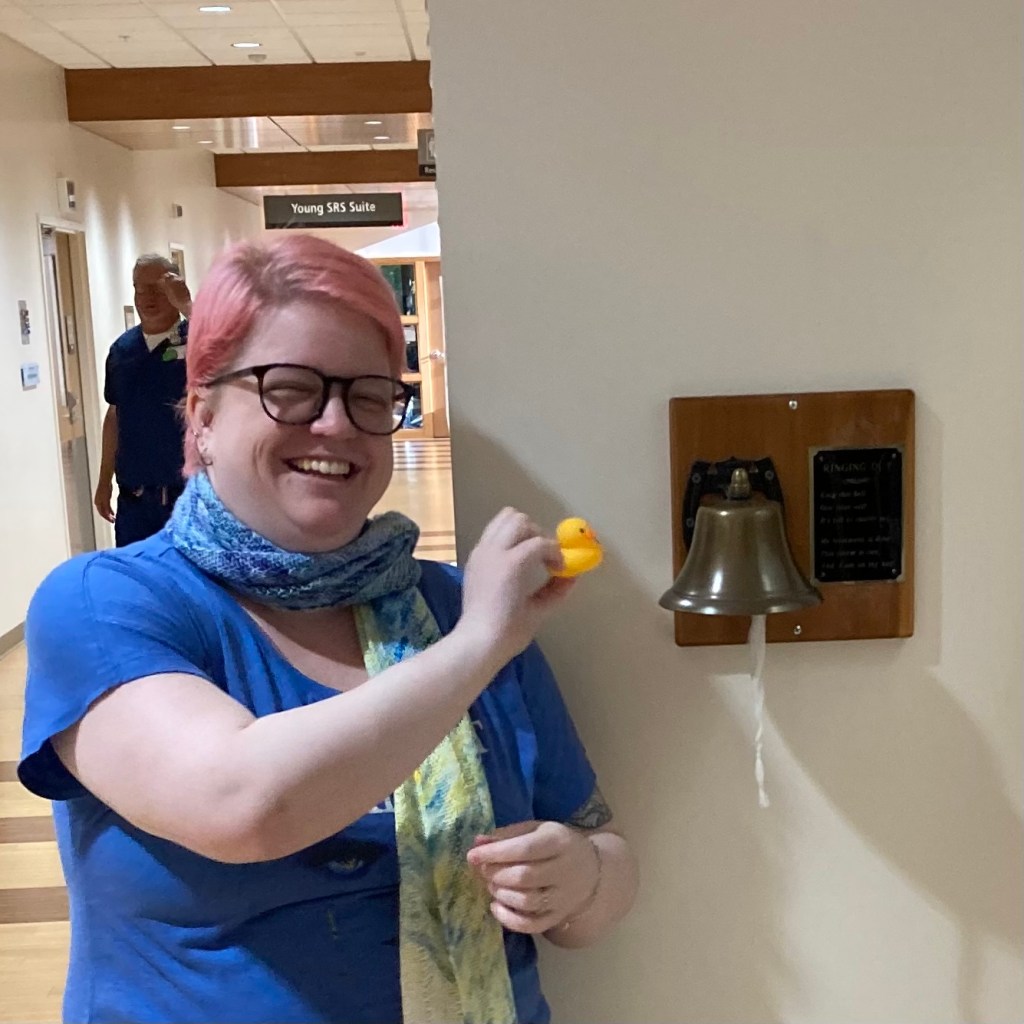
On the last day of radiation treatment, one of the techs asked me a very important question: was Duck with me? He’d met Duck on the first day, when I took the photo of the room, so Duck had to be there to ring the bell.

Duck Cancer ready to peck the bell.

Patients undergoing treatment like chemotherapy or radiation ring the bell on their last day to signify that it’s over. It’s apparently a fairly recent tradition, just under 30 years old, and has its roots in the Navy: one of the reasons to ring it is to celebrate a major accomplishment. Admiral Irve Charles LeMoyne is credited with being the first person to use a bell for cancer treatment.

Mark time

The last day of treatment is a very specific date and a very clear ending. It’s a day we look forward to because it means this part is going to be over. It’s the end of the active treatment, the flurry of appointments and procedures and hospital gowns that may or may not be missing some of their ties. At the end of radiation it means not having to come back tomorrow, even if tomorrow’s a weekday. Even knowing that side effects can still worsen after that last treatment, at least it is the last treatment. You won’t continue to actively do something to make it worse.

As humans we like stories, and what that really means is we like stories with endings. One of my three areas for comprehensive exams during my Ph.D. was narrative theory. Check out the initial definition from that page:

Narrative theory starts from the assumption that narrative is a basic human strategy for coming to terms with fundamental elements of our experience, such as time, process, and change.

There’s just no way to tell about our experiences except to put them into a narrative. Anything with cause and effect is a narrative: the app says it’s going to rain later, so I should take an umbrella. The bus was late, so I ended up walking to work. We use narratives to talk about real events and imagined events, and both of these are ways of making sense of the world.

Think about your favorite book. It’s divided in so many different ways. There are pages, which just happen because of how many words can fit on them, but there are also chapters, where parts of a page are purposefully left blank. You have to turn the page to see what happens next. There can also be scene breaks within a chapter, denoted by a blank line – blankness again, like a visual cue to rest – or maybe a cute little symbol. (Apparently that’s called a dinkus. I learned something today.) There’s also a beginning and end to the whole book. It has to start somewhere, and it ends somewhere. Even Stephen King’s heftiest tomes finally come to a close.

You see these choices when you’re watching movies, shows, or documentaries, too. These are the moments when, back in the day, the network would cut away for ads, or the points where viewers would have to wait a whole week to find out what happens next. Maybe there’s even a recap at the start of the next episode, in case you forgot what happened or you missed a week. Today we binge as we please, but our narratives are still set up with these various arcs and pausing points.

When “The End” isn’t the end

Ringing the bell at the end of treatment feels like the end of something. We’d absolutely love it to be the absolute end of us thinking about cancer, much less having to deal with it ever again. A lot of people in my life seemed to think of it that way, too: oh, that’s over. She had cancer, but it’s gone. Go back to your lives, citizens.

I’ve barely begun to scratch the surface of cancer’s emotional toll. This has all been the basic survival mode recitation. This happens, then this happens, then this. I’m still not going to get into the emotional (in this post, at least) but even with just the facts, I can tell you that ringing the bell isn’t the last part.

There is a short break where your focus is on recovering from treatment. Ringing the bell is an emotional day because of all the symbolism and expectations around it. My parents and husband came with me, and my husband made sure to film it because his parents and others wanted to see me ring the bell. It was honestly kind of stressful because of all of those expectations and I wasn’t sure what my emotions would be doing at that point. Even the techs came out to clap, but then I basically went to bed and collapsed.

This is the point where we have to remember a lot of what we’ve learned about breast cancer. One of the first tests tells us the hormone receptor status of the tumor: how many colors of cat food will my little old lady eat? And one of the later tests is the oncotype dx, which tells us how tenacious the cancer is, and how likely it is to return. Based on those results, your doctor might prescribe hormone therapy.

In my case, I was prescribed Tamoxifen, and right away I’ll suggest you don’t read about all the possible side effects. It’s a selective estrogen receptor modulator (SERM) which stops estrogen from interacting with any place, benign or cancerous, that’s receptive to estrogen. In other words, this stops Van Go from eating one of the colors of cat food. If there are any cancer cells left after treatment, they should starve.

I’ll be on Tamoxifen for 5-10 years, and that’s part of the reason why the list of potential side effects is so long. They have to list anything that happened to anyone while they were on the drug. Some of them are common, like hot flashes and irritability, and some are rare. My sister-in-law, for example, had a side effect seen in less than 1% of people who are on tamoxifen, so she’s an unlucky outlier.

What this means, though, is that breast cancer survivors still have to think about their cancer at least once a day. Some have to take Tamoxifen twice a day, and some have more medications depending on their doctors’ recommendations. It’s a conscious, daily act for me, and then the hot flashes come whenever they feel like, and they’re just another reminder of what I went through.

Then there are the follow-up appointments. The surgeon needs to check on you at least twice, and I’ve had two appointments with my medical oncologist to start the hormone therapy and then check in to see how well I’m handling it. I’ve got another follow-up scheduled with the radiation oncologist later this year, and there’ll be one early next year where I have to go for a mammogram again. Considering how my very first mammogram found cancer, I can’t say I’m entirely looking forward to that experience.

No Evidence of Disease

I didn’t know I had cancer until the scan showed it, so it’s hard for me to think that I flat-out don’t have cancer now. The pathology report says my lymph nodes were clear and the margins were good, and the oncotype dx gives me a very low chance of recurrence with radiation and hormone therapy, but it happened once. I already got the fuzzy end of the lollipop. There’s no guarantee I won’t get it again.

My next post will shift toward managing some of the emotions surrounding cancer, but in the meantime, I have a request. I’m committing to knitting every day in November to raise money for the American Cancer Society, and I’d love it if you donated to support this cause. Obviously this is a cause very important to me, and I’m just getting my energy back after treatment, so knitting every day will be both a joy and a triumph. The scarf I’m wearing to ring the bell is one I knit early on in my treatment, after my diagnosis.

Memento vivere, friends, and take a moment to do something good.


next post

A Millennial’s Guide to Breast Cancer – all posts

A Millennial’s Guide to Breast Cancer: Hulk Powers, Activate!

My mom is so not the kind of person you’d expect to have tattoos. We’re not entirely in agreement about how many she has. She says three, because there are three specific dots, but they’re all part of the same thing. I was going to count mine as one, except they don’t give you dots for radiation anymore. Honestly I was a bit disappointed, but I’m paying my tattoo dealer to give me my tenth one soon enough.

Once you get your oncotype dx score and know that radiation’s your next step, it doesn’t happen as quickly as you’d like. Seriously, don’t these people know you have cancer? I say that half-joking, but seriously, the waiting can be aggravating. You can try to reason with yourself that hey, the surgery’s over and your lymph nodes were clear, so technically you should be cancer-free at this point, or look, self, there are plenty of people at the cancer center who seem to be in more dire straits, but it doesn’t always work. You want things to go as quickly as possible so you can get back to normal, whatever that means for you now.

It’s not actually that simple.

Meet your radiation oncologist

The first step is to once again meet some new people. My radiation oncologist’s nurse started us off, and she told us she was going to talk like I’d already decided I’d do the radiation even though at that point apparently I hadn’t officially made that choice yet. I told her that I had, and I’d actually already scheduled the simulation, and then she got down to it.

There are a lot of risks with radiation. Some side effects are common and some are rare. Some are short-lived and some don’t show up for a while after. The nurse talked us through the usual culprits, including skin irritation and exhaustion, and the radiation oncologist covered some of the more serious possible outcomes.

They also talked us through what I should do to help prevent these side effects. They gave me an ointment to use twice a day, starting after my first radiation appointment and continuing until two weeks after my last one. Since I was a candidate for Accelerated Partial Breast Irradiation, I only needed five treatment sessions and the side effects might not show up until after they were over, or might worsen for a bit before they got better. I also got a prescription for a steroid cream to use once a day for the same time span.

Enter the simulation

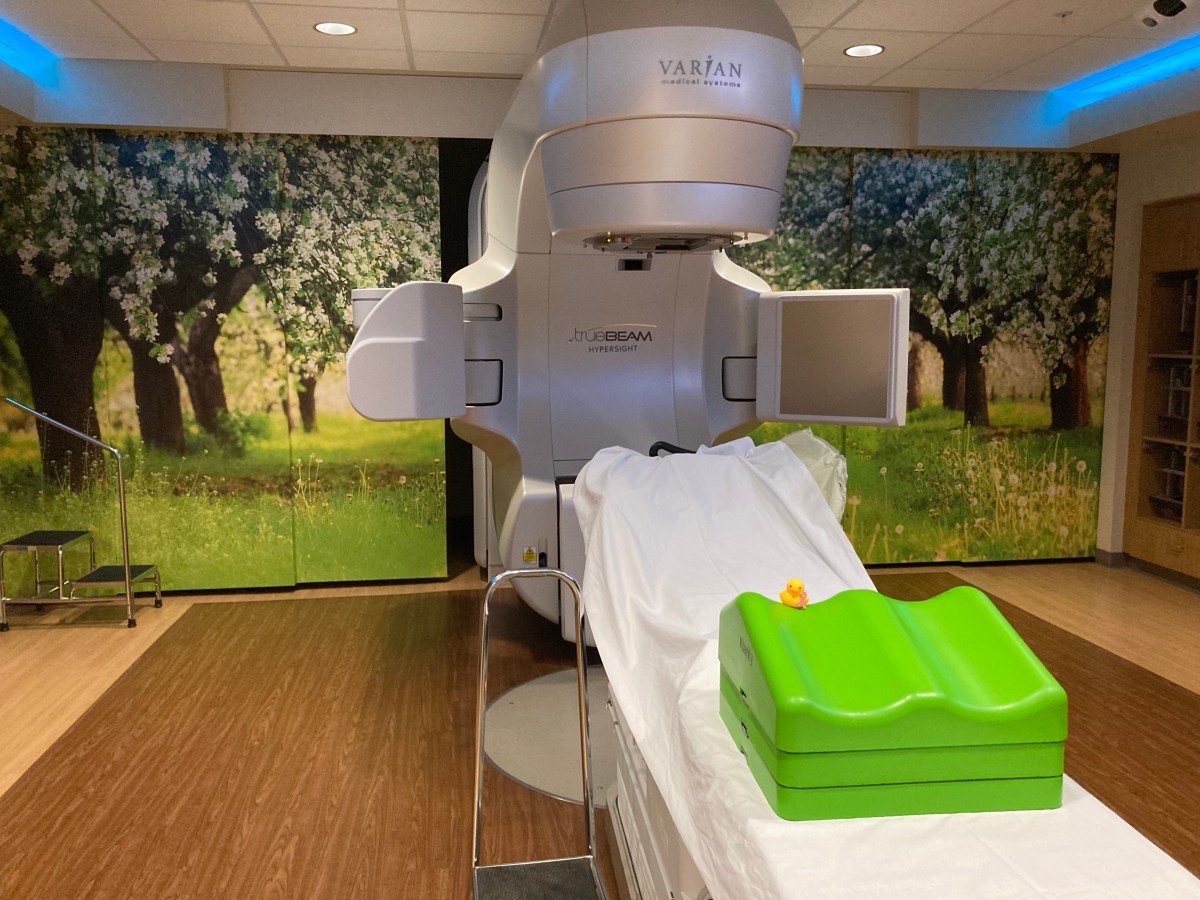
After the initial appointment, once you’ve officially decided to get radiation, you get an appointment for the simulation. This takes place with a CT scan instead of the radiation machine. Here’s Duck posing before my simulation:

Duck preparing to enter the holodeck. (He didn’t quite grasp what “simulation” means in this context.)

The green thing he’s sitting on is the knee rest. The table under that sheet is hard plastic, and part of the simulation is adding and subtracting various supports and things until you get a position that feels like you can handle it. Even though each radiation session is a matter of minutes, the schedule can be daily, and the repetition of the same position over and over can be rough on your body.

For breast cancer radiation, you’re posed with one hand over your head to give the machine the most direct access to the proper tissue. The tech adds wax and other indicators to the visible landmarks, which basically means using wax and BB stickers to your scar and whatever else they’re going to use to line you up. The CT won’t see your scar, but it can see the things they add. They want to make sure that you’re in exactly the same position every time you go for a scan, so the radiation hits exactly what they want it to hit and nothing else.

Back in 2009, this was where they gave my mom her three tattoo dots to help with alignment. These days there’s a sort of bean bag thing under the sheet and, once you’re in position, they suck the air out of it and mold it to your upper torso. This helped me get into exactly the same position for every treatment. I think it looked kind of like a potato chip. Once my treatment was over, they just open it back up and it’s good to go for the next patient. You can see the green lasers in this shot, too, since they’re another tool they use to get you properly lined up.

Medical potato chip. Do not eat.

The CT is very close to your face, much closer than the actual radiation machine, so if you can get through the stimulation without feeling claustrophobic, you’re good to go. Once they had me positioned on the table the way they liked, with me as comfortable as possible all things considered, they did two scans. The first was with me breathing normally, and the second had me holding my breath for the duration of the scan. Holding your breath lifts the tissue away from things like your heart and your lungs, which they want to avoid irradiating as much as possible.

Once the two scans were done, I got dressed again and waited to get my treatment schedule. The tech wanted to know my preferred schedule, so I asked to start as soon as possible and have my treatments early in the day to get them over with. She was able to get four of them at exactly the same time, just to help me remember when they were. Then, because the scans had to go to the dosimetrists who calculate exactly how the machine will move to make sure the proper area is targeted, there’s a gap of a week to twelve days.

To start, press any key

The Cowell Family Cancer Center schedules radiation appointments at 15-minute intervals, but the actual treatment doesn’t take that long. You quickly get into a routine: show up, check in, go to the gowned waiting room to get changed, and either wait or head right to the radiation room if they tell you they’re ready for you. It looks a little different from the simulation, but the table setup is exactly the same.

Duck trying to decide if he wants to be the Hulk or Spider-Man.

Each day there were three techs, but only one of them was there for all five of my treatments. They get you onto the table and make sure your hands, for example, are where they were during the simulation. Once you’re lined up as well as they can do it with the eye, they step out, the doors close, and the machine starts moving around you. Honestly it kept making me think of EVE in Wall-E, if her paddle-like arms were a lot bigger.

They traded off saying “When you’re ready, take a deep breath in” and “Breathe,” because they have to repeat it a lot during each session. The first couple times are when the machine checks your position, and the table shifts to put you in the exact position the dosimetrists calculated. Once the radiation starts, the machine rotates around you during the periods when you’re holding your breath. This keeps the former tumor location at the center of the arc while making sure that it’s not concentrating too long on any one patch of skin.

They keep an eye on you from the other room so if you need to breathe, you can, and they’ll stop the machine where it is. They’ll also tell you if you have to breathe in a little more, or let a little out, which honestly just convinces you that you’ve completely forgotten how to hold your breath. Seriously it gets really hard to judge how much you’ve sucked in. Did I hold it like this during the simulation, or like this?

The machine didn’t always move the same way for each appointment, or for the same about of time. The first couple days it seemed to make the same arc back and forth the same number of times, but it does change. Once the red lights go off and the door starts opening, though, today’s treatment is over. It’s time to get dressed and then use the Dermaphor as soon as you can, since you don’t want to use any kind of lotions or deodorants before the treatment—they can mess with the way the different scans and treatments react to your skin.

I’m a bit of a delicate flower, because I felt some of the side effects after my first treatment. My skin turned a bit red and it felt tight, like a sunburn, but the ointment and steroid helped. If it had gotten worse, they would have given me other measures to help calm it down. I met with my radiation oncologist after the fourth treatment, and she said that, if more sever skin reactions are going to happen, they usually show up by then. The Dermaphor is similar to Aquaphor and can be used as needed, so when I started to notice the tightness and irritation, I could apply some more and that took care of things. (Note, though, that you need to use both the ointment and the steroid over the entire quadrant of your torso, and it can stain the fabric that touches it.)

Ring-a-ding-ding

After your final radiation treatment, you get to participate in the tradition of ringing the bell. It’s officially over! The initial, most active, and most obvious phase of your cancer treatment is over. I rang the bell 95 days after my diagnosis, and man, those were a long 95 days. You want to celebrate—or maybe just go take a long, long nap—because hey, it’s a big moment, except … well. This whole thing sounds a bit ominous, doesn’t it?

Next time we’ll talk about what happens after the bell. For now, go do something kind for someone else, whether or not they know you’re the one who did it. Memento vivere.


next post

A Millennial’s Guide to Breast Cancer – all posts

A Millennial’s Guide to Breast Cancer: Translating Medicalese

Missed the first post? Read it here.

One of the things I learned this year (one of many I’d be fine not knowing, thanks) is that documents can hit your online patient portal hours before your primary care provider sees them. I knew that, if I logged in and saw the results there, I’d have to deal with them on my own without her input and guidance.

Of course I looked. Granted, I did have my parents to fall back on if there was information on the pathology report that I didn’t understand, but honestly that first “carcinoma” was enough. What else did I need to know?

The initial pathology report actually has a lot of information on it. It doesn’t have everything—people will want to know your stage as soon as you tell them you have cancer, but you don’t get that information until after the surgery—but it has a lot. Your doctors will go over what things mean specifically for you, tailored to your results, but this is a basic overview of the information available on the initial report.

Invasive vs. in situ

This designation is an either/or: if the cancer isn’t invasive, it’s in situ. The Latin means “in place,” so an in situ carcinoma hasn’t spread beyond where it started. “Invasive” means the cancer has spread beyond the original site into the surrounding tissue. It sounds scary, but most breast cancers found are invasive. (Okay, it’s still scary, but the fact that it’s common means the medical field knows how to treat it, and a cancer labeled “invasive” can still end up being a Stage 1 in the end.)

Ductal vs lobular

This one indicates where the cancer was found. If it’s ductal, then it’s in the milk ducts. Lobular cancer was found in the lobules, which produce breast milk. The location of the cancer helps guide treatment.

Histologic Grade

This section has a lot of data and a lot of numbers, but the final one—the cancer’s grade—indicates how quickly the cancer is spreading and how different the cancer cells look from normal cells. It’s like golf, so you’d like to see lower numbers here. A Grade 1 is slow-growing, less likely to spread, and has cells that look close to normal cells. Grade 3 looks very different from normal cells and has a potential to grow and spread faster. This information will also help guide your treatment.

Hormone Receptor Status

Breast cancer can be “receptive” to three main hormones. If it’s receptive, then that hormone acts like a key turning in a lock and starting an engine: that specific hormone causes the cancer to become active. My surgeon had a whole speech about it with hand gestures, but I’m going to make this into a metaphor about my cat.

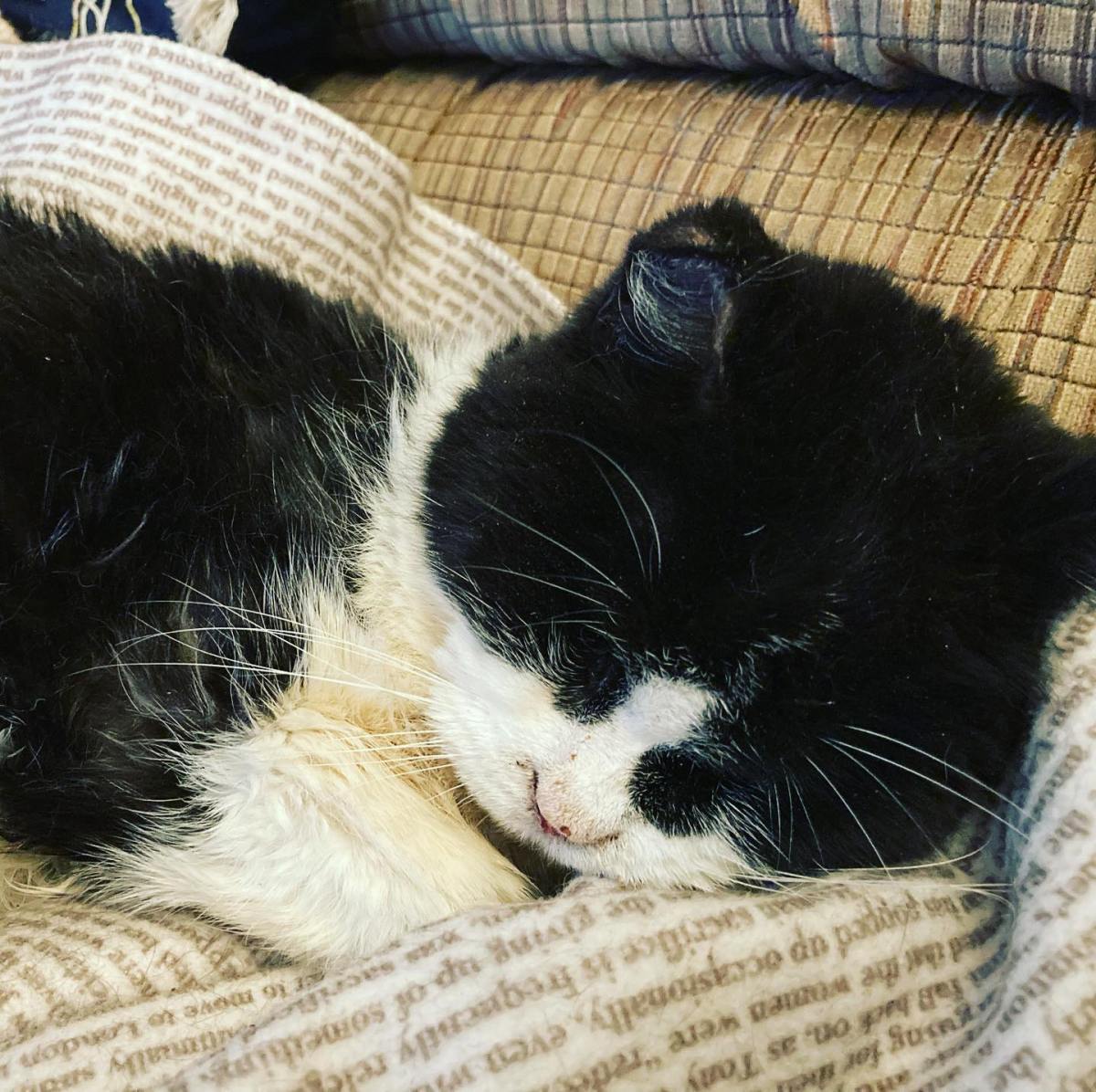
Van Go was a little old lady (she had a crumpled ear, which was why the Humane Society gave her that name) who was very particular about cat food. She preferred dry food to wet because she was a contrary cat, and she only ate specific colors of the dry. After Van Go was done eating, there’d be a little pile of the rejected color, separated out from the two colors she’d eaten. Van Go was receptive to two colors of cat food, but not the third.

The two colors she did eat fueled her for her little old lady adventures. If, for some reason, we’d decided to go through the bag and remove those two colors, she would have starved. Those were her food, and she ignored the third color. Van Go was a cat and not a tumor, but you get the picture. (In case you’re concerned, she lived a very long and happy life to an age the vet could only estimate as “19+” and she was always full of purrs and head bonks and her two favorite colors of crunchy food.)

If a tumor is receptive to a hormone, then part of the treatment can involve the reduction of that hormone. We’ll get to hormone therapy later, but yes, suppression of estrogen leads to hot flashes. This is your cue to send the cancer survivors in your life their favorite chocolates.

And finally, a note on the size estimate: the report will include an estimate of the largest size in all three dimensions, but it is only an estimate. It’s not uncommon for the final measurements after surgery to be slightly larger than this initial report. In my case the estimates different from the final by 2mm, so it’s not a huge difference, but it was something more than one friend warned me about, so I’m passing that along, too.

Information overload

Already we can see that even just this initial pathology report is full of data and overwhelming. The diagnosis is already individualized at these different levels, depending on where the cancer started, how much it’s already spread, how different the cells are, how likely it will continue to grow and spread, and what fuels it. All of these answers helps the team of doctors make their plan of attack so they can remove the cancer and take the most efficient steps to decrease the chances of it ever coming back.

At this point, though, right at the diagnosis, it can feel like those are all just tiny details. The main point is that, after all those scans and the core needle biopsy, you can’t just breathe a sign of relief because it was a false alarm. You have to shift your plans and, at some level, even your perception of self. You’re not a healthy person anymore. You have cancer.

This is also the moment where you start having to decide what to tell other people, or even if you want to tell them anything at all. That’s a very personal decision, and I’ve known people who’ve made choices all the way across the gradient from making it public to only informing those who absolutely need to know. My next post will discuss information, both getting and disseminating, in more detail. For now, though, fix yourself your favorite drink—make it a pumpkin spice if that’s your pleasure—and memento vivere.


next post

all posts in A Millennial’s Guide to Breast Cancer