
Part of the absolute deluge of information I received from my first meeting with my nurse navigator came in the form of a coaster-sized disk on her desk. This was before I had Duck Cancer, so I pulled out my usual little Instagram star, secret kitten, and took a photo of it so I could share it with other people. This is the sample of the SCOUT, the reflector device put in place before a lumpectomy.

I realize that “secret kitten for scale” really only works if you know how big secret kitten is to start with. Most of my other photos of secret kitten have to do with knitting, museums, or zoos, so here she is next to a full-size lion skull.

Now that you know the basic size of a SCOUT … what the heck is it?
Hide and seek
Once your tumor has been found, each successive tech or doctor needs to find it again. Depending on how you’re lying or standing, and how the tissue’s being manipulated at the time (squished in a mammogram, for example) it can seem to be in a different spot. This also depends on the size of your breast and the depth of the tumor. I have large breasts, and with my tumor in the bottom third of the tissue, various techs had to figure out the notes left by previous techs in order to find it again.
After the core needle biopsy, the radiologist inserted a clip into the suspicious site. If they’d known it was a tumor at the time, they would’ve just left the SCOUT instead, but the reflector can’t be left in for the rest of your life. The clip shows up on x-rays and ultrasounds just fine, but it won’t react to the magnets in an MRI, so it can remain. The best-case scenario means having a clip for the rest of your life, showing that this suspicious spot has been checked and was fine.
The difficulty comes in locating the tumor in the operating room. Back in the day—which wasn’t actually all that long ago; my mom had breast cancer in 2009 and this was what she had—you’d go get an ultrasound on the morning of your surgery and have a wire placed in your breast with the end sticking out. Honestly the mental image makes me cringe, but she said it wasn’t such a big deal. I think they gave her Valium beforehand, so maybe that had something to do with it. Then Dad drove her to the hospital where they continued with the rest of preparation. Because the wire does stick out, it has to be done the morning of surgery.
The SCOUT, which I honestly just called boob radar when I explained it to people, gets put into the tumor sometime before surgery. Mine was a little less than a week before. It’s quite similar to the core needle biopsy procedure, except it’s just leaving something behind instead of taking tissue samples out. The samples themselves are small, but honestly I felt such a difference between the two procedures.
The ultrasound tech first locates the clip, and the radiologist preps you for the insertion. You’re awake and it’s just there in the room with the ultrasound, but it’s still pretty intense as far as cleaning and draping. Since something’s piercing your skin, they want to make sure they’re not introducing an infection. The only thing they want to leave behind is the SCOUT.
Full disclosure: I did not look at the size of the needle. I kept my eyes on the ceiling and prattled on about Jack the Ripper. I don’t think they were actually interested in my research, but they keep track of how you’re handling it based on how you sound. You’re numbed, which happens in a sort of series of deeper and deeper shots, but there’s still a feeling of pressure and the idea that you’re waiting for it to hurt.
Once the SCOUT is inserted, you just put your top back on long enough to head over to the mammogram again. They don’t squish it as much as usual (I have a very active imagination, so I just asked them to reassure me even though they do this all the time) but they need to make sure the SCOUT is in the right spot. It’s a sort of sleeper agent, though, and won’t be activated until you’re in the operating room, so your cyborg dreams might have to be curtailed. Then you go about the rest of your day.
Further preparations
When you get scheduled for surgery, you’re just given the day. They’ll tell you what number to call the day before (or the Friday before, if your surgery’s on a Monday) so you know when you actually have to show up at the hospital. Remember you’ll need at least one person with you, since you can’t drive yourself home after.
There are a few things you’ll be asked to do prior to surgery day. I was given a bottle of soap and told to use it for three showers before my surgery: the two days before, and the morning of. It comes with instructions on how much to use and how much to wash with it—in my case, everything from the neck down. You can’t shave during those showers, since they don’t want to risk nicks and infection. The soap is definitely not your usual skin-soothing, floral-scented body wash, but you want to make sure you use it following instructions. You’ll need fresh clean sheets and entirely clean clothes after each shower, too, because it’s all about limiting the chances of infection.
You’ll also be given instructions on when to stop eating and drinking prior to surgery. This is to make sure your stomach is empty so you don’t aspirate the contents during surgery. Anesthesia suppresses certain reflexes, like the gag reflex. Remember how you had to worry about your college roommate passing out drunk, vomiting, and choking on it? It’s the same basic principle here. Seriously, follow all the rules and restrictions you’re given, to the letter, even if they don’t make immediate sense. If you Google, there’s always a reason, and usually that reason is “So the patient doesn’t die.”
The big day
You’ll be asked to show up at the hospital quite a while before surgery because there’s even more prep. My instructions said that I might be limited to two people waiting for me, so we determined beforehand who’d leave the waiting room if the limit was enforced. I checked in at the front desk and was told where to go, and then again in the waiting room. The receptionist wrote down the names, relationships, and phone numbers of who I had with me. Then we waited for me to be called back.
The nurse asked if I’d followed the showering and eating instructions, and then explained that she had a set of six large medicated wipes for another sponge bath, just in case. She told me how to use them very specifically before I changed into the hospital gown, and then another nurse came in and used the last one on my back. (Weird, because your breasts aren’t on your back, right? But this is how serious they are about not introducing an infection.)
At this time I was also offered painkillers. I’d never had Valium before, so I opted to half of what she offered. Spoiler alert: take them all. Just go for it. You can be as sleepy and out of it as you like, because the moment that matters is when they come at you with four needles around your areola. She also put numbing cream on in preparation for those needles, since it had to be on for at least half an hour.
This was also when the nurse inserted an IV. She said she could move it if it wasn’t comfortable, and I did end up asking her to. I’d brought my knitting, because I knew there would be a lot of waiting, and the first position didn’t let me knit comfortably.
At this point, while we waited for my radioactive tracer appointment, she went to invite any of my guests to come back and sit with me. My husband and mom came back, and my dad and mother-in-law stayed in the waiting room. While I was taken down for the tracer injections, they just waited in my pre-op room.
The radioactive tracer injections don’t take long, but this is why I highly suggest you take all the painkillers they offer you. Obviously it’s not fun to have needles in your breast tissue, but it’s not the same numbing here was there was for the SCOUT placement. The tracer, along with blue dye, is used to help the surgeon find the sentinel lymph node during surgery. This is the lymph node that has the job of draining the breast and, if the cancer is trying to spread, then cancerous cells will be found in the lymph node. After the injection and an initial scan, it was back to my room.
If you’re not the first surgery of the day, then your surgery might not happen at the scheduled time. It can be frustrating, because it’s your one big thing happening that day, and you might be having all kinds of emotions waiting for it. On top of that, you’ll be hungry and thirsty. Remind yourself that everyone else wants you in that operating room just as much as you do, and they don’t like delays, either. This is why I brought my knitting and yeah, okay, having a clearer head maybe helped with passing the time.
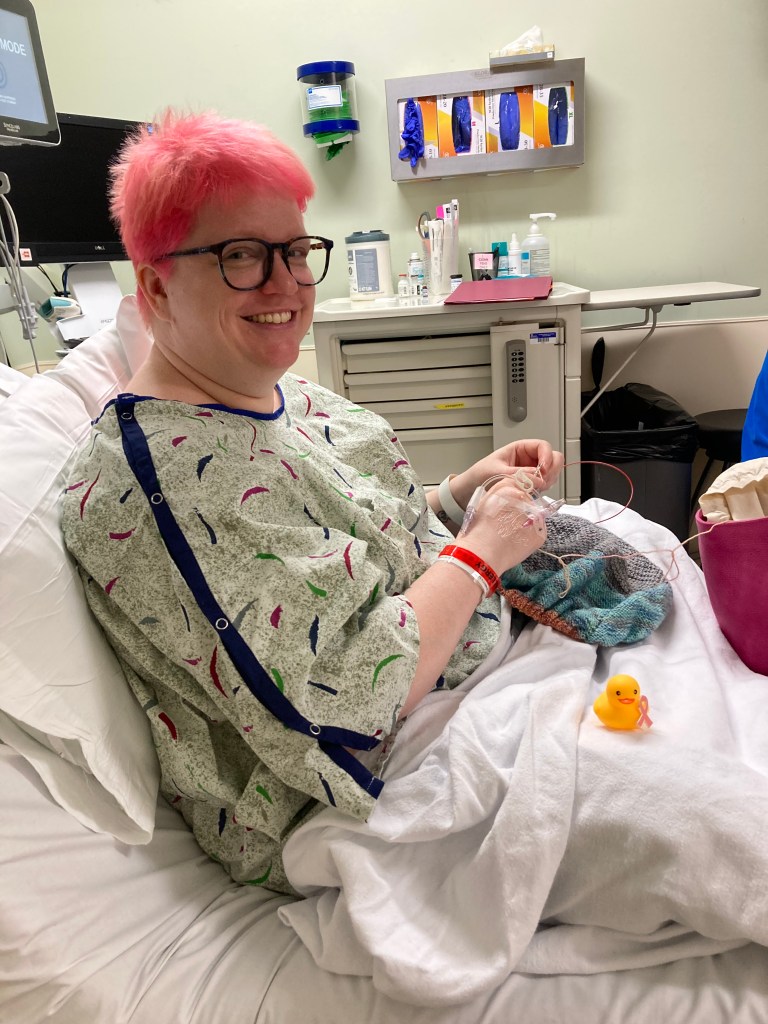
At some point your surgeon will stop in to check in with you and answer any last-minute questions. The anesthetist and anesthesiologist will stop by, too, and probably ask you a lot of the same questions you’ve already answered, just to be sure that they’re prepared. They’ll ask about smoking and drinking habits because of the negative impacts those can have on the anesthesia process, so answer truthfully.
Once they take you from the pre-op room to the operating room, things move fast. You’re basically swarmed with people getting you set up, but you take deep breaths of oxygen before the gas switches over and then you’re out.
Waking up
The two things I remember about coming around in the recovery room was how badly my throat hurt—it’s a common side effect of the breathing tube used during surgery—and how I just wanted to rub my face like I’d had a long nap. The nurse kept telling me not to, because apparently your blinking reflex doesn’t work so well right after surgery. There was a clock in my direct line of sight and it didn’t take me too long to feel more awake. She handed me my glasses and got me some juice, then asked if I was ready to get dressed. I honestly wasn’t sure if I was, but said I’d try.
I was able to dress just fine on my own. I wore loose clothes and a front-close bra. I’d picked the Lounge Bra from SheFit because I already had a couple different styles for working out. It turned out that it wasn’t the best choice because of where my incision ended up, but you won’t know where that’ll be until after it’s already done. I also had some bras from Yana Dee and I ended up buying a few more because the tenderness can last three to six months after surgery. They’re easy to step into and carefully pull up in the first few days after surgery.
Real talk here: it was shocking to look at my breast right after. The swelling made the divot all the more pronounced, and the scar was bigger than I thought. When you hear lumpectomy you think oh, just a tiny little bit gets removed, only enough to make sure the margins are clear, but that’s not the case. The pathology report you get after tells you exactly how much tissue was removed, but seeing it for the first time was a surprise.
I didn’t want to move my shoulder very much because the incision for the lymph node was in the armpit, but I was surprised at how not-terrible I felt physically. I did wonder if maybe I should’ve had them drive my Equinox instead of my dad’s giant truck when I had to get up into it, but I made it. I don’t remember much about the rest of that day, but I was awake for a long stretch in the middle of the night (anesthesia can affect your sleep schedule for a while after surgery) and felt okay enough to sit up and read for a while.
Tom Petty knows what’s up
After the surgery comes more waiting. There’s another pathology report, and something called an oncotype dx, but we’ll get to those next time. Even all these months later it’s exhausting to try to remember everything that happened on the day of my surgery, because so much goes on, with so many people. It’s all such a rush, but then … there’s more waiting. You may have heard that it’s the hardest part.
Try to spend some time with nature today. Touch grass or watch a rainstorm while you’re cozy inside with a hot drink. Memento vivere.
 Rebecca Frost