
A Millennial’s Guide to Breast Cancer: Write What You Know

I didn’t start reading Stephen King until the summer after college. I’ve always been a voracious reader, and I can only remember one time when my parents intervened. I wanted to read Pet Sematary (it had a kitty on the cover!) but I was in second grade, so they suggested that maybe I put that one off for a while. There’s no real reason I put it off for so long, but it generally surprises people that I got such a late start.

In ‘Salem’s Lot, Catholic priest Father Callahan visits another character in the hospital and spends some time musing about how his parishioners usually react to sudden medical news like cancer, a heart attack, or stroke. Father Callahan’s experience tells him that these hospital visits are usually with someone who feels betrayed by their own body, but they can’t get away from the betrayer like they could if it was a backstabbing friend. It’s a dark assessment from a priest who’s losing his faith but who, at that point, has only really observed such things from the outside.

King was 28 when it ‘Salem’s Lot was published, and although he had personal experience with Callahan’s alcoholic, he was still decades way from the car accident that turned him into the patient. Characters like Edgar Freemantle in Duma Key (one of my favorites, and sadly not as well known) clearly come from his own lived experience, but Callahan’s dour assessment comes as an outsider.

Even though I was in my early twenties when I read it, though, it stuck with me. You can bet that scene ran through my mind after my own diagnosis.

Callahan’s not my favorite character

At least, not in ‘Salem’s Lot. He shows up again in The Dark Tower series, and although he’s not exactly young in ‘Salem’s Lot, this second appearance gives him more depth and complexity. The original Callahan is a bit whiny, wishing he had a true battle to fight for his faith. It’s one of those “Be careful what you ask for” situations, and Callahan’s one of King’s tragic characters in his initial arc. When he goes to visit the sick character in the hospital, he hasn’t really been tested himself. He means well, but he doesn’t know what he’s talking about. Callahan’s looking from the outside in.

Even though I didn’t start reading King until I was older than most fans, his works are still a major component of my life. I’m the co-chair for the Stephen King area of the National Popular Culture Association conference, and I’ve written multiple chapters and two books about his works. I’ve got all his books in paper, digital, and audio formats. I’m most definitely a Constant Reader (but do not claim to be his number-one fan). Granted, King’s brand of horror isn’t exactly what you want to relate to in your daily life, anyway, but my mind automatically goes to make connections, not just from one of his books to the next, but between what he writes and what I experience.

To be fair, it’s not just King. When I was very young I read Eighty-Eight Steps to September and cried my eyes out when the main character’s little brother died from leukemia. Jan Marino just kind of paved the way for a Lurlene McDaniel phase later on. If you’ve never read one of her young adult novels, they’re full of teens going through incredibly traumatic medical diagnoses. Lots of her characters die. If the main character isn’t diagnosed with something, then their love interest is.

As we’re growing up, that’s our usual experience with intense medical issues: whatever we see or read in the media. And, let’s face it, a lot of those stories end with death. I remember my mom explaining to me that Eighty-Eight Steps to September was set far in the past (okay I think it was the fifties, but I’m trying to remember something I read in like 1991, so maybe that just felt like the far past to me at the time) and little kids don’t die from cancer like that anymore. That’s not quite true, but she had to say something to a six-year-old crying over a fictional character.

But that’s what fiction has taught me: that kind of diagnosis is an utter betrayal, once you can’t get away from, and one that’s going to end tragically.

Life imitates art?

At this point I think the most unrealistic thing about Father Callahan’s assessment is that it means his parishioners had to speed-run the stages of grief. I still have times when the thought “I had cancer” just doesn’t make sense. One of my friends said he mother-in-law sometimes gets hit with it, and her diagnosis was five years ago: “Huh. That happened. I lived through all that.” If I’m going to feel betrayed by my body, then I need to actually internalize what happened to my body.

And I also get that it’s weird to think that I should feel something just because some author somewhere put it in one of his character’s heads. It doesn’t even have to be what King himself thought back then, because he usually writes about entire towns and has plenty of opportunities to explore different points of view. It’s just a scene that was so vivid, something Callahan dwelt on in his own mind for quite a while, that it stuck. When you have cancer or a heart attack or a stroke, you feel like your body’s betrayed you.

I’ve actually spent a lot of time thinking about it. To my mind, the cancer isn’t a betrayal by my body, because it’s not me. It’s like a little mutant invasion. (Now y’all might also need to reassess how well you think I’m coping. The journey’s a long one.)

The other side of things—the Lurlene McDaniel side of things—means trying to work the whole “It’s statistically unlikely I’m going to die from this” thing into any initial announcement. Cancer is a big scary word, and the people who care about you want to know how bad it is. If caught early, invasive ductal carcinoma has a 5-year survival rate of 99%. I’m too old to be a Lurlene McDaniel heroine, anyway, but the odds were in my favor.

That doesn’t mean nobody asked if I was going to die. You can kind of guess how the age of the person in question factors into things, because hey, the younger you are, the more likely it is that your only association is cancer equals death. But even calling it “breast cancer” means there are so many possibilities for how things are going to unfold. People who’ve watched loved ones on their own journeys had more questions, and maybe more worries, than others. They had a better, more personal understanding.

Wait, so should authors stop writing outside their own lived experience?

Okay, that’s a whole can of worms and there are no easy answers. When it comes to the experience of cancer patients, though … yeah, it’s still complicated. Stephen King, writing before I was born, had no idea how much that scene would stick in my head when I read it later, or how it would come back after my diagnosis. Lurlene McDaniel started writing to deal with her son’s medical diagnosis, and honestly I think she can be credited for teaching a lot of us about the different conditions she gave her characters. That’s not something the average teen can just sit down with their parents for an in-depth discussion.

I also think that these approaches come from a place of empathy. Authors can’t always write characters who are only like themselves, so they have to try to imagine all kinds of different people whose experiences and thought processes aren’t the same. Cancer and other major medical events happen in the real world, so leaving them out completely, especially over as many books as King has written, would be unrealistic. And honestly, if I’m struggling to understand my own experience, then I can’t really fault someone who’s never gone through it for writing something different than what I’m feeling. Heck, other survivors have entirely different experiences, and that doesn’t make them wrong.

In the spirit of books and scenes that maybe stuck with you longer than they should, recommend your favorite book to a friend or post about it online. Share the love for your favorite author. Read new stories, expand your horizons, and memento vivere.

A Millennial’s Guide to Breast Cancer – all posts

A Millennial’s Guide to Breast Cancer: Can I Get the Final Answer?

I received my cancer diagnosis on a Friday near the end of the school year. I teach at a small rural high school, and they do something different from my own high school: the seniors finish before the rest of the grades. It ended up being the day the seniors took their last final exams, less than a week before graduation. Maybe it was denial or the minute-by-minute coping you enter into after such a diagnosis, but graduation was the first thing that I real felt cancer take from me. Because we’re in such a rural area, and because my parents live near a larger hospital downstate, I ended up meeting my surgeon on graduation day and watching the ceremony streamed on Facebook.

The timing meant that my surgery and at least a chunk of the following treatment would take place during summer break. On the one hand, this was good because it meant I wasn’t missing class and didn’t have to worry about sub plans and all the rest. On the other, I didn’t get either a summer or a break. But, back in May, I had no idea exactly how long treatment would take.

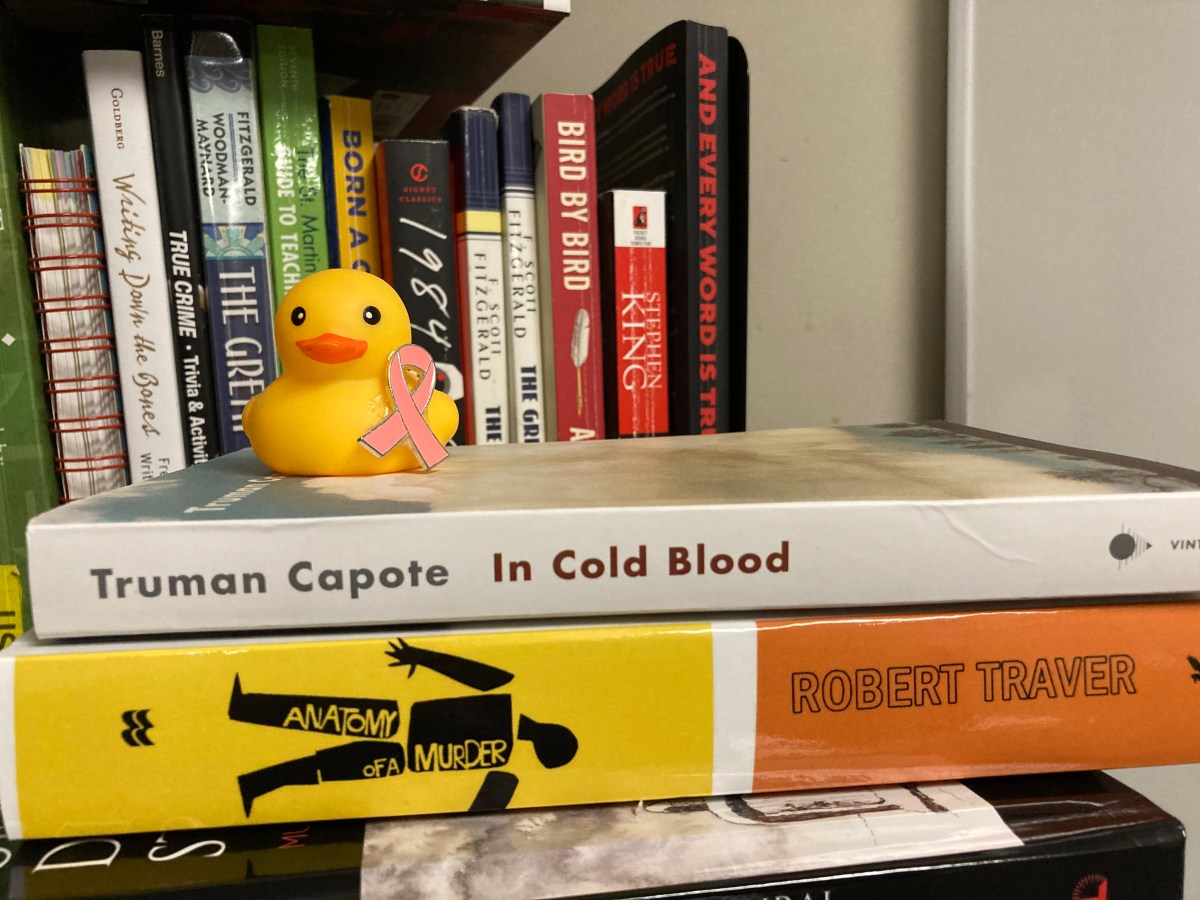
Duck Cancer overseeing my high school English classroom

Because of others’ experience, I knew that the bare minimum would be surgery and radiation. Another reason to transfer all of my care downstate was because there’s no local radiation. The individual treatments are short, only a matter of minutes, but they can be daily, and the closest center is still more than 60 miles from where I live. Practically moving back in with my parents for the summer wasn’t really top on my list of things to do, but they used to work at the hospital. Their house is less than a mile from the cancer treatment center. I just had no idea how long I’d be there.

A (very brief history) of breast cancer treatment

Back in the day, but still recent enough to be in living memory, patients went in for breast cancer surgery without knowing what the procedure would be. They could tell their diagnosis as soon as they woke up from the anesthesia: if both breasts were still present, the lump was benign. Cancer meant an immediate mastectomy.

It might have been effective as far as making sure the cancer didn’t spread, but this had a negative effect on the patients. It’s jarring enough waking up to see how much a lumpectomy has changed the body you’ve known for years. One of the items I was given at the hospital is a recovery camisole which not only had pockets for drains in case I had those after surgery, but comes with two breast forms that can be put in the top pockets. The drain pockets can be medically necessary; the breast forms can be mentally or emotionally necessary.

When they started doing lumpectomies, though, the recurrence rate was too high for comfort. It seemed like it should have been a good compromise between the 0 and 100 end points of doing nothing and doing a full mastectomy, but it wasn’t until they added in radiation treatments that the recurrence rates lowered enough to be acceptable. Even patients who have a double mastectomy can benefit from radiation treatment, so, from the get-go, I knew that there’d be radiation. What I didn’t know, and what you don’t find out until after surgery, is whether I needed chemo first.

Another pathology report

The first thing that helps say one way or another is the post-surgery pathology report. There were two things my mom and I skimmed for as soon as I got it: whether both the margins and the sentinel nodes were clean.

Margins refer to the tissue that’s been removed during surgery. Ideally the tumor is in the middle, surrounded on all sides by healthy tissue. If this is the case, the margins are clean, or noncancerous. If margins aren’t clean, that means some of the tumor is left inside and needs to be removed with further surgery. The goal is to eliminate every possible cancer cell, because even one can start the whole thing up again.

The sentinel node biopsy is a check to see if the cancer was trying to spread. The lymphatic systems deals with filtering and draining bodily fluids, so they’d catch any cancer that comes their way. My surgeon said the standard procedure is to biopsy the lymph nodes first before moving to the lumpectomy with the idea of moving from a non-cancerous area to a cancerous. He also shrugged and said he wasn’t entirely sure it mattered, but it’s better to be safe than sorry.

It was about two weeks after my surgery that my dad pointed out some of the information we’d skimmed over: exactly how much tissue had been removed, both by size and weight. Remember he’s a gynecologist, so he had some more insight than most. Hot tip: maybe just skim your pathology report for your margins and biopsy results at first. A lumpectomy sounds like it should be nice and small, but once you start actually picturing the size of the wound left inside … let’s just say there’s a reason tenderness and swelling can last 3-6 months.

Clean lymph nodes are a good indication, but they’re not the final say. For that, your oncologist needs the results of another test.

Another number

I spent almost two months wondering if I’d need chemotherapy which, for me, meant the specific “Will I make it back for the first day of school?” question. That was my mental and emotional touch point. If I could do that, then cancer wouldn’t have ruined my life. It might—and did—suck, and I knew I’d have to eventually deal with the various consequences of my lost summer, but being back for “my kids” was the important part. The will-I-or-won’t-I chemo question was answered when I finally got the results of a test called the oncotype dx.

The result itself comes in a number from 0 to 100. It’s called a recurrence score, and even though it looks like it might be a percentage, it’s not. Your percentage of recurrence is different from your oncotype dx, but it’s included on the same document. Mine told me my recurrence chances if I only did hormone therapy, and if I did hormone therapy plus radiation.

The number you’re hoping for is different if you’re pre- or post-menopausal. Since I’m pre-menopausal, my oncologist said we wanted a number of 18 or lower. That indicates that chemotherapy would not be helpful in treating my cancer. If the number is 26 or higher, then a more aggressive form of treatment is recommended, including chemotherapy. If it’s in the middle, then there are charts to say how likely it is for chemo to help, and that’s more of a discussion with your doctor.

I should note that every treatment plan was presented to be as a suggestion, from the lumpectomy to radiation to hormone therapy. At one point when talking about how to proceed, my surgeon said “We discussed the lumpectomy.” I nodded, which prompted him to say, “No, I was asking you if that’s what we’re doing.” The pendulum’s swung a long way from being wheeled into the operating room and having no idea—and no say—in what’s going to happen to you.

The oncotype dx results provide a lot of information to help you and your doctor decide what treatment comes next. When mine came back as 11, we all breathed a sigh of relief. It was clearly low enough that I wouldn’t need chemo. (If any readers did go through chemotherapy and would like to write a guest blog post on the experience, please reach out.)

The end of the beginning

My oncotype dx result meant my next appointment was with the radiation oncologist to determine exactly what my treatment course would look like. I’ll go over radiation in my next post, but for now, do something to relax. Maybe take a nap. You deserve it. Memento vivere.

A Millennial’s Guide to Breast Cancer: Tumor Eviction Day

Part of the absolute deluge of information I received from my first meeting with my nurse navigator came in the form of a coaster-sized disk on her desk. This was before I had Duck Cancer, so I pulled out my usual little Instagram star, secret kitten, and took a photo of it so I could share it with other people. This is the sample of the SCOUT, the reflector device put in place before a lumpectomy.

Savi SCOUT with secret kitten for scale.

I realize that “secret kitten for scale” really only works if you know how big secret kitten is to start with. Most of my other photos of secret kitten have to do with knitting, museums, or zoos, so here she is next to a full-size lion skull.

Cute but deadly Instagram star.

Now that you know the basic size of a SCOUT … what the heck is it?

Hide and seek

Once your tumor has been found, each successive tech or doctor needs to find it again. Depending on how you’re lying or standing, and how the tissue’s being manipulated at the time (squished in a mammogram, for example) it can seem to be in a different spot. This also depends on the size of your breast and the depth of the tumor. I have large breasts, and with my tumor in the bottom third of the tissue, various techs had to figure out the notes left by previous techs in order to find it again.

After the core needle biopsy, the radiologist inserted a clip into the suspicious site. If they’d known it was a tumor at the time, they would’ve just left the SCOUT instead, but the reflector can’t be left in for the rest of your life. The clip shows up on x-rays and ultrasounds just fine, but it won’t react to the magnets in an MRI, so it can remain. The best-case scenario means having a clip for the rest of your life, showing that this suspicious spot has been checked and was fine.

The difficulty comes in locating the tumor in the operating room. Back in the day—which wasn’t actually all that long ago; my mom had breast cancer in 2009 and this was what she had—you’d go get an ultrasound on the morning of your surgery and have a wire placed in your breast with the end sticking out. Honestly the mental image makes me cringe, but she said it wasn’t such a big deal. I think they gave her Valium beforehand, so maybe that had something to do with it. Then Dad drove her to the hospital where they continued with the rest of preparation. Because the wire does stick out, it has to be done the morning of surgery.

The SCOUT, which I honestly just called boob radar when I explained it to people, gets put into the tumor sometime before surgery. Mine was a little less than a week before. It’s quite similar to the core needle biopsy procedure, except it’s just leaving something behind instead of taking tissue samples out. The samples themselves are small, but honestly I felt such a difference between the two procedures.

The ultrasound tech first locates the clip, and the radiologist preps you for the insertion. You’re awake and it’s just there in the room with the ultrasound, but it’s still pretty intense as far as cleaning and draping. Since something’s piercing your skin, they want to make sure they’re not introducing an infection. The only thing they want to leave behind is the SCOUT.

Full disclosure: I did not look at the size of the needle. I kept my eyes on the ceiling and prattled on about Jack the Ripper. I don’t think they were actually interested in my research, but they keep track of how you’re handling it based on how you sound. You’re numbed, which happens in a sort of series of deeper and deeper shots, but there’s still a feeling of pressure and the idea that you’re waiting for it to hurt.

Once the SCOUT is inserted, you just put your top back on long enough to head over to the mammogram again. They don’t squish it as much as usual (I have a very active imagination, so I just asked them to reassure me even though they do this all the time) but they need to make sure the SCOUT is in the right spot. It’s a sort of sleeper agent, though, and won’t be activated until you’re in the operating room, so your cyborg dreams might have to be curtailed. Then you go about the rest of your day.

Further preparations

When you get scheduled for surgery, you’re just given the day. They’ll tell you what number to call the day before (or the Friday before, if your surgery’s on a Monday) so you know when you actually have to show up at the hospital. Remember you’ll need at least one person with you, since you can’t drive yourself home after.

There are a few things you’ll be asked to do prior to surgery day. I was given a bottle of soap and told to use it for three showers before my surgery: the two days before, and the morning of. It comes with instructions on how much to use and how much to wash with it—in my case, everything from the neck down. You can’t shave during those showers, since they don’t want to risk nicks and infection. The soap is definitely not your usual skin-soothing, floral-scented body wash, but you want to make sure you use it following instructions. You’ll need fresh clean sheets and entirely clean clothes after each shower, too, because it’s all about limiting the chances of infection.

You’ll also be given instructions on when to stop eating and drinking prior to surgery. This is to make sure your stomach is empty so you don’t aspirate the contents during surgery. Anesthesia suppresses certain reflexes, like the gag reflex. Remember how you had to worry about your college roommate passing out drunk, vomiting, and choking on it? It’s the same basic principle here. Seriously, follow all the rules and restrictions you’re given, to the letter, even if they don’t make immediate sense. If you Google, there’s always a reason, and usually that reason is “So the patient doesn’t die.”

The big day

You’ll be asked to show up at the hospital quite a while before surgery because there’s even more prep. My instructions said that I might be limited to two people waiting for me, so we determined beforehand who’d leave the waiting room if the limit was enforced. I checked in at the front desk and was told where to go, and then again in the waiting room. The receptionist wrote down the names, relationships, and phone numbers of who I had with me. Then we waited for me to be called back.

The nurse asked if I’d followed the showering and eating instructions, and then explained that she had a set of six large medicated wipes for another sponge bath, just in case. She told me how to use them very specifically before I changed into the hospital gown, and then another nurse came in and used the last one on my back. (Weird, because your breasts aren’t on your back, right? But this is how serious they are about not introducing an infection.)

At this time I was also offered painkillers. I’d never had Valium before, so I opted to half of what she offered. Spoiler alert: take them all. Just go for it. You can be as sleepy and out of it as you like, because the moment that matters is when they come at you with four needles around your areola. She also put numbing cream on in preparation for those needles, since it had to be on for at least half an hour.

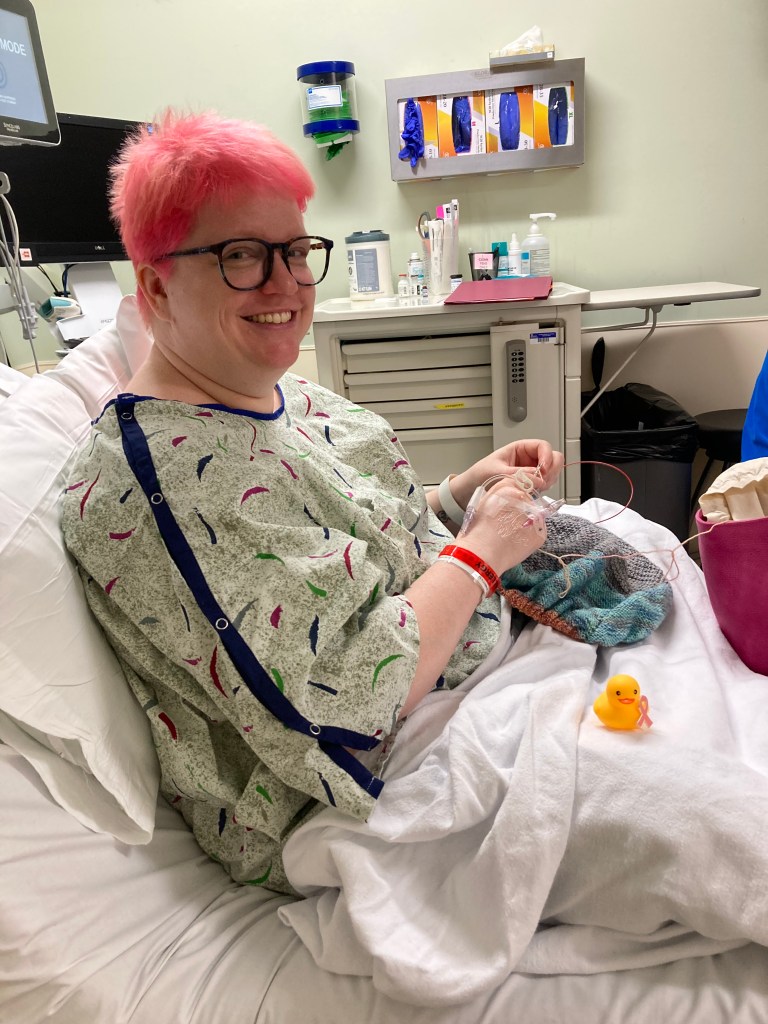
This was also when the nurse inserted an IV. She said she could move it if it wasn’t comfortable, and I did end up asking her to. I’d brought my knitting, because I knew there would be a lot of waiting, and the first position didn’t let me knit comfortably.

At this point, while we waited for my radioactive tracer appointment, she went to invite any of my guests to come back and sit with me. My husband and mom came back, and my dad and mother-in-law stayed in the waiting room. While I was taken down for the tracer injections, they just waited in my pre-op room.

The radioactive tracer injections don’t take long, but this is why I highly suggest you take all the painkillers they offer you. Obviously it’s not fun to have needles in your breast tissue, but it’s not the same numbing here was there was for the SCOUT placement. The tracer, along with blue dye, is used to help the surgeon find the sentinel lymph node during surgery. This is the lymph node that has the job of draining the breast and, if the cancer is trying to spread, then cancerous cells will be found in the lymph node. After the injection and an initial scan, it was back to my room.

If you’re not the first surgery of the day, then your surgery might not happen at the scheduled time. It can be frustrating, because it’s your one big thing happening that day, and you might be having all kinds of emotions waiting for it. On top of that, you’ll be hungry and thirsty. Remind yourself that everyone else wants you in that operating room just as much as you do, and they don’t like delays, either. This is why I brought my knitting and yeah, okay, having a clearer head maybe helped with passing the time.

Duck Cancer supervising my pre-op knitting

At some point your surgeon will stop in to check in with you and answer any last-minute questions. The anesthetist and anesthesiologist will stop by, too, and probably ask you a lot of the same questions you’ve already answered, just to be sure that they’re prepared. They’ll ask about smoking and drinking habits because of the negative impacts those can have on the anesthesia process, so answer truthfully.

Once they take you from the pre-op room to the operating room, things move fast. You’re basically swarmed with people getting you set up, but you take deep breaths of oxygen before the gas switches over and then you’re out.

Waking up

The two things I remember about coming around in the recovery room was how badly my throat hurt—it’s a common side effect of the breathing tube used during surgery—and how I just wanted to rub my face like I’d had a long nap. The nurse kept telling me not to, because apparently your blinking reflex doesn’t work so well right after surgery. There was a clock in my direct line of sight and it didn’t take me too long to feel more awake. She handed me my glasses and got me some juice, then asked if I was ready to get dressed. I honestly wasn’t sure if I was, but said I’d try.

I was able to dress just fine on my own. I wore loose clothes and a front-close bra. I’d picked the Lounge Bra from SheFit because I already had a couple different styles for working out. It turned out that it wasn’t the best choice because of where my incision ended up, but you won’t know where that’ll be until after it’s already done. I also had some bras from Yana Dee and I ended up buying a few more because the tenderness can last three to six months after surgery. They’re easy to step into and carefully pull up in the first few days after surgery.

Real talk here: it was shocking to look at my breast right after. The swelling made the divot all the more pronounced, and the scar was bigger than I thought. When you hear lumpectomy you think oh, just a tiny little bit gets removed, only enough to make sure the margins are clear, but that’s not the case. The pathology report you get after tells you exactly how much tissue was removed, but seeing it for the first time was a surprise.

I didn’t want to move my shoulder very much because the incision for the lymph node was in the armpit, but I was surprised at how not-terrible I felt physically. I did wonder if maybe I should’ve had them drive my Equinox instead of my dad’s giant truck when I had to get up into it, but I made it. I don’t remember much about the rest of that day, but I was awake for a long stretch in the middle of the night (anesthesia can affect your sleep schedule for a while after surgery) and felt okay enough to sit up and read for a while.

Tom Petty knows what’s up

After the surgery comes more waiting. There’s another pathology report, and something called an oncotype dx, but we’ll get to those next time. Even all these months later it’s exhausting to try to remember everything that happened on the day of my surgery, because so much goes on, with so many people. It’s all such a rush, but then … there’s more waiting. You may have heard that it’s the hardest part.

Try to spend some time with nature today. Touch grass or watch a rainstorm while you’re cozy inside with a hot drink. Memento vivere.


all A Millennial’s Guide to Breast Cancer posts

A Millennial’s Guide to Breast Cancer: The Beginning

I turned 40 earlier this year and decided to go ahead and get a mammogram. The American Cancer Society says women can start annual screening at 40, but should definitely start at 45. Considering my family history, I opted to start just to be sure. Unfortunately, we were quickly sure that I had breast cancer.

On the plus side, I was surrounded by all kinds of support. My parents are both retired ob-gyns, so they could answer a lot of my questions about my results and various reports. I also know a number of people who were diagnosed with breast cancer themselves, at different times in their lives. But then another friend of mine was diagnosed with cancer, and as we were talking about it she said that she doesn’t actually know anyone else who went through it.

Every patient’s cancer journey is different, in large part because of how customized treatment has become. Even when others shared their side effects from, say, radiation, it didn’t line up with my experience. (Okay, even the techs said they don’t usually see side effects as quickly as mine cropped up.) But there are still a number of things that I think would be useful for recently-diagnosed people—or their support crews—to have access to.

“I hope I never have to know as much about this as you do”

Any cancer journey comes with an overload of information. Earlier this summer I was talking to one of my colleagues and explaining the process so far when she pointed out exactly how much information I had handy that most people (thankfully) don’t. Pamphlets binders, reports, prescriptions … it’s a lot of information and can be difficult to take in. At least one person came with me to every appointment (only one appointment specifically limited it to one) and listened along with me. At times we disagreed over some of the details, but we were able to write down or remember enough to feel like we knew what was next, and why, and so I could keep everyone else updated. Yeah, there’ll be a whole post of its own about “keeping everyone else updated,” but for starters:

You want to get the mammogram before you have any idea that you might have cancer. Not every lump you can feel is cancer, and you won’t be able to feel every cancerous lump. It depends not just on how big the tumor is, but the depth in your breast. Mine ended up being 1.3 cm along the longest measurement, but it was in the bottom third of my breast tissue, and even my surgeon couldn’t feel it. At the time the mammogram flagged a mass, there was no way for me to know it existed.

There are signs that mean you should get things checked out, though. You should be performing monthly self-examinations (and if you haven’t been, now’s a good time to start). Breast tissue isn’t uniform, so you’re acquainting yourself with your own personal normal. Tissue can be dense and perfectly normal. You’re really looking for any changes month to month. If you notice a change, that’s when you want to get checked out.

Other signs of breast cancer might not be so immediately obvious as a lump. Changes in the skin, including dimpling, or drainage from the nipples should be checked out. Part of the monthly self-exam that doesn’t always initially make sense is checking for swelling or tenderness in the armpits. This could be a sign that the lymph nodes are working hard to filter out harmful substances or cells. Later on we’ll discuss why lymph nodes are tested as part of cancer treatment.

During my first appointment with my surgeon, he not only checked to see if he could feel the mass, but also spent time looking for swelling or tenderness at the lymph nodes in my armpit on that side. The lack of either was a good sign that we’d caught the cancer early, but of course we still wanted to go through all the proper medical steps to be sure.

Begin at the beginning

It’s not abnormal to get called back for a second scan after a first mammogram. There are no prior images for the radiologist to compare them to, so your own personal normal hasn’t been established yet. Different parts of the breast can be a different density, and sometimes the image is just unclear. A mammogram uses x-rays to examine the tissue, and the way you’re positioned during the procedure can affect how clearly the images can be read. No, it’s not comfortable, but it doesn’t take very long. I know a lot of people who’d been putting off getting their first one … and who have since texted me their own all-clear results because my diagnosis made them finally schedule it.

A mammogram isn’t the only way for doctors to see inside our bodies, though, so my next step was an ultrasound of the questionable spot. An ultrasound uses high-frequency sound waves for a different look at the soft tissues involved. Different scans can give doctors different looks, and sometimes these looks clear things up and allow them to agree that the spot is a harmless cyst. Friends of mine have also had MRI scans for yet another level of noninvasive imaging. Doctors really, really don’t want to move to invasive procedures unless absolutely necessary.

My ultrasound indicated that the next step for me was an ultrasound-guided biopsy. This meant going back to the same room, with the same tech, but this time with a radiologist, too. (You meet a lot of specialists on this journey. Some of them show up for a single appointment and are never seen again.) Yes, you’re awake for the needle biopsy, which involves numbing the tissue at different depths before inserting a needle and taking samples of the tissue. There’s no pain, but I wasn’t expecting the weird amount of pressure. This is totally a time when they told me I handled the procedure well and I think they were just being nice—I definitely felt faint until they adjusted the head of the table. The radiologist took two samples and had them sent off for a diagnosis.

Each of those samples means a small piece of tissue was taken from the tumor. The ultrasound meant he could guide the needle right to it and make sure the samples were, in fact, the questionable part. After those are taken—it makes a loud click, so you know exactly when it happens—they insert something called a clip. This is a non-magnetic marker that stays in the breast (and won’t be a problem if you need an MRI in the future). If the results come back as benign, the clip indicates to all future techs and radiologists that this questionable mass has already been checked.

The tissue samples taken are small, but you’ll still probably have discomfort. I was told to ice the area pretty drastically for the first few hours, and although I did it, the ice just seemed to make it hurt worse. It’s better for the long-term, though, so I obeyed my orders to the letter even though I was grumpy about it.

This was the part where things could have diverged. I was told a range of dates for when to expect the results, so of course I updated my online patient portal on a regular basis, just in case the report had posted and the system failed to email me an alert. My biopsy was on a Monday, and my results were in that Friday.

“ORDER_RESULTS_PATHOLOGY”

My results were in my patient portal hours before my primary care provider was alerted to them. I could read them enough to see the word “carcinoma” and honestly, at that point, that was enough. That was the answer: it was cancer. Anything else on the report was just going to have to wait.

In my next post I’ll walk through all the information that is—and what isn’t—on that initial report. In the meantime, do something for your health today … and something for fun. Memento vivere.


Next post

All posts in A Millennial’s Guide to Breast Cancer