
My mom is so not the kind of person you’d expect to have tattoos. We’re not entirely in agreement about how many she has. She says three, because there are three specific dots, but they’re all part of the same thing. I was going to count mine as one, except they don’t give you dots for radiation anymore. Honestly I was a bit disappointed, but I’m paying my tattoo dealer to give me my tenth one soon enough.
Once you get your oncotype dx score and know that radiation’s your next step, it doesn’t happen as quickly as you’d like. Seriously, don’t these people know you have cancer? I say that half-joking, but seriously, the waiting can be aggravating. You can try to reason with yourself that hey, the surgery’s over and your lymph nodes were clear, so technically you should be cancer-free at this point, or look, self, there are plenty of people at the cancer center who seem to be in more dire straits, but it doesn’t always work. You want things to go as quickly as possible so you can get back to normal, whatever that means for you now.
It’s not actually that simple.
Meet your radiation oncologist
The first step is to once again meet some new people. My radiation oncologist’s nurse started us off, and she told us she was going to talk like I’d already decided I’d do the radiation even though at that point apparently I hadn’t officially made that choice yet. I told her that I had, and I’d actually already scheduled the simulation, and then she got down to it.
There are a lot of risks with radiation. Some side effects are common and some are rare. Some are short-lived and some don’t show up for a while after. The nurse talked us through the usual culprits, including skin irritation and exhaustion, and the radiation oncologist covered some of the more serious possible outcomes.
They also talked us through what I should do to help prevent these side effects. They gave me an ointment to use twice a day, starting after my first radiation appointment and continuing until two weeks after my last one. Since I was a candidate for Accelerated Partial Breast Irradiation, I only needed five treatment sessions and the side effects might not show up until after they were over, or might worsen for a bit before they got better. I also got a prescription for a steroid cream to use once a day for the same time span.
Enter the simulation
After the initial appointment, once you’ve officially decided to get radiation, you get an appointment for the simulation. This takes place with a CT scan instead of the radiation machine. Here’s Duck posing before my simulation:

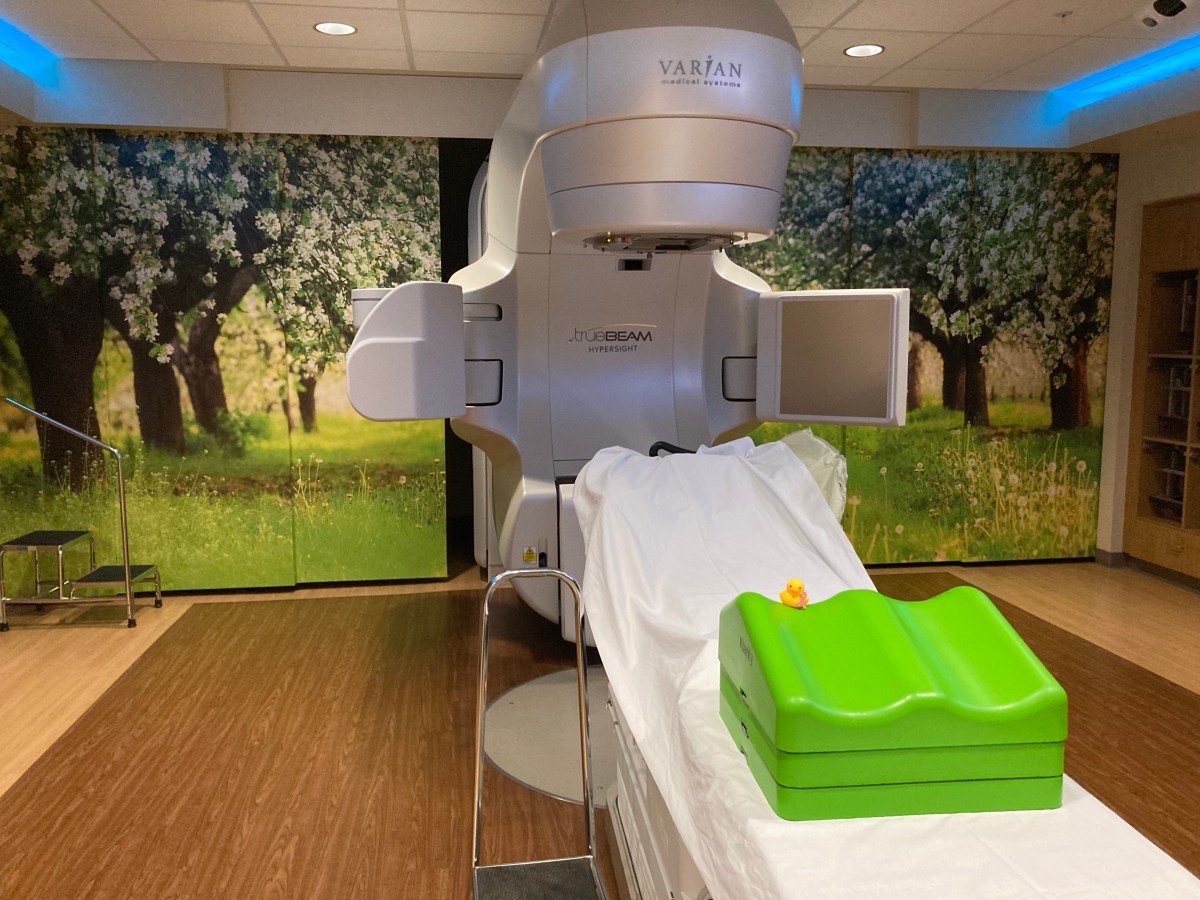
The green thing he’s sitting on is the knee rest. The table under that sheet is hard plastic, and part of the simulation is adding and subtracting various supports and things until you get a position that feels like you can handle it. Even though each radiation session is a matter of minutes, the schedule can be daily, and the repetition of the same position over and over can be rough on your body.
For breast cancer radiation, you’re posed with one hand over your head to give the machine the most direct access to the proper tissue. The tech adds wax and other indicators to the visible landmarks, which basically means using wax and BB stickers to your scar and whatever else they’re going to use to line you up. The CT won’t see your scar, but it can see the things they add. They want to make sure that you’re in exactly the same position every time you go for a scan, so the radiation hits exactly what they want it to hit and nothing else.
Back in 2009, this was where they gave my mom her three tattoo dots to help with alignment. These days there’s a sort of bean bag thing under the sheet and, once you’re in position, they suck the air out of it and mold it to your upper torso. This helped me get into exactly the same position for every treatment. I think it looked kind of like a potato chip. Once my treatment was over, they just open it back up and it’s good to go for the next patient. You can see the green lasers in this shot, too, since they’re another tool they use to get you properly lined up.

The CT is very close to your face, much closer than the actual radiation machine, so if you can get through the stimulation without feeling claustrophobic, you’re good to go. Once they had me positioned on the table the way they liked, with me as comfortable as possible all things considered, they did two scans. The first was with me breathing normally, and the second had me holding my breath for the duration of the scan. Holding your breath lifts the tissue away from things like your heart and your lungs, which they want to avoid irradiating as much as possible.
Once the two scans were done, I got dressed again and waited to get my treatment schedule. The tech wanted to know my preferred schedule, so I asked to start as soon as possible and have my treatments early in the day to get them over with. She was able to get four of them at exactly the same time, just to help me remember when they were. Then, because the scans had to go to the dosimetrists who calculate exactly how the machine will move to make sure the proper area is targeted, there’s a gap of a week to twelve days.
To start, press any key
The Cowell Family Cancer Center schedules radiation appointments at 15-minute intervals, but the actual treatment doesn’t take that long. You quickly get into a routine: show up, check in, go to the gowned waiting room to get changed, and either wait or head right to the radiation room if they tell you they’re ready for you. It looks a little different from the simulation, but the table setup is exactly the same.

Each day there were three techs, but only one of them was there for all five of my treatments. They get you onto the table and make sure your hands, for example, are where they were during the simulation. Once you’re lined up as well as they can do it with the eye, they step out, the doors close, and the machine starts moving around you. Honestly it kept making me think of EVE in Wall-E, if her paddle-like arms were a lot bigger.
They traded off saying “When you’re ready, take a deep breath in” and “Breathe,” because they have to repeat it a lot during each session. The first couple times are when the machine checks your position, and the table shifts to put you in the exact position the dosimetrists calculated. Once the radiation starts, the machine rotates around you during the periods when you’re holding your breath. This keeps the former tumor location at the center of the arc while making sure that it’s not concentrating too long on any one patch of skin.
They keep an eye on you from the other room so if you need to breathe, you can, and they’ll stop the machine where it is. They’ll also tell you if you have to breathe in a little more, or let a little out, which honestly just convinces you that you’ve completely forgotten how to hold your breath. Seriously it gets really hard to judge how much you’ve sucked in. Did I hold it like this during the simulation, or like this?
The machine didn’t always move the same way for each appointment, or for the same about of time. The first couple days it seemed to make the same arc back and forth the same number of times, but it does change. Once the red lights go off and the door starts opening, though, today’s treatment is over. It’s time to get dressed and then use the Dermaphor as soon as you can, since you don’t want to use any kind of lotions or deodorants before the treatment—they can mess with the way the different scans and treatments react to your skin.
I’m a bit of a delicate flower, because I felt some of the side effects after my first treatment. My skin turned a bit red and it felt tight, like a sunburn, but the ointment and steroid helped. If it had gotten worse, they would have given me other measures to help calm it down. I met with my radiation oncologist after the fourth treatment, and she said that, if more sever skin reactions are going to happen, they usually show up by then. The Dermaphor is similar to Aquaphor and can be used as needed, so when I started to notice the tightness and irritation, I could apply some more and that took care of things. (Note, though, that you need to use both the ointment and the steroid over the entire quadrant of your torso, and it can stain the fabric that touches it.)
Ring-a-ding-ding
After your final radiation treatment, you get to participate in the tradition of ringing the bell. It’s officially over! The initial, most active, and most obvious phase of your cancer treatment is over. I rang the bell 95 days after my diagnosis, and man, those were a long 95 days. You want to celebrate—or maybe just go take a long, long nap—because hey, it’s a big moment, except … well. This whole thing sounds a bit ominous, doesn’t it?
Next time we’ll talk about what happens after the bell. For now, go do something kind for someone else, whether or not they know you’re the one who did it. Memento vivere.
 Rebecca Frost