
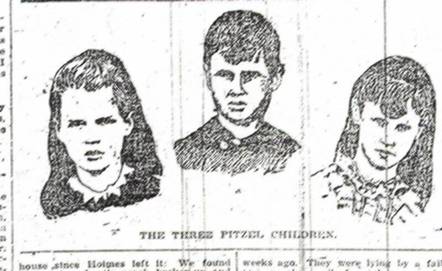
H. H. Holmes’ victims: Alice and Nellie Pitezel

We have come to Holmes’ final two confessed victims. After he murdered father Benjamin Pitezel in Philadelphia, and younger brother Howard near Indianapolis, Holmes still had five family members under his control: mother Carrie, with her eldest and youngest child; and sisters Alice and Nellie.

It’s unclear how Holmes might have explained Howard’s absence to his sisters, but he didn’t intend for that to be an issue for long. After leaving Irvington, Indiana, he rented a house in Detroit and followed his already-established MO of looking for a house to rent. Presumably he meant to kill Alice and Nellie in Detroit, but that didn’t happen. Instead, he took all of his traveling companions – remember he kept them separated from each other into three groups: Carrie and her two children; Alice and Nellie; and Holmes’ own third wife – across the border into Canada.

Alice and Nellie arrived in Toronto on October 19, and Holmes rented a house on the 20th. He once again rented a stove and furnished the house, as though he were going to stay there for a while with the children. On October 25th, he took the girls to the house for the last time, but not before another strange event: Holmes took the girls shopping for clothes that they would never wear.

This was also the day when Carrie Pitezel, sick of staying in the rooms Holmes rented for her, also went out shopping. She crossed paths with Holmes in the clothing store. At some points it was reported that he happened to be holding underwear for Howard when they met – even though Howard had been dead for over a week at the time. In all their strange travels, this seems to be the closest Carrie came to being reunited with her children.

Holmes put Carrie on a train for New York that very night, even though he must have known he wouldn’t have to worry about her running across her children again. He killed the girls that night by locking them in a trunk and filling it with gas.

In his confession, Holmes really takes pleasure in exactly how malicious an act this was. For example:

consider for eight years before their death I had been almost as much a father as though they had been my own children

although he’d already contradicted this earlier when writing about Alice and saying that

her death was the least of the wrongs suffered at my hands.

Not content to simply confess to murder, Holmes also strongly suggests that he also raped Alice – an accusation that he at other times had stridently denied. Apparently since he was making a “full” confession, he thought he should add that in and show the world exactly how monstrous he was.

But, having killed Alice and Nellie, buried their bodies, and burned their clothes, Holmes wasn’t quite finished. He confesses to three more attempted murders: that of the remaining Pitezels. Apparently Carrie was meant to carry “a bottle of dynamite” from the basement of a rented house up to the third story, and Holmes hoped she would drop it, killing herself and her two remaining children.

On the one hand, since he’d already killed four Pitezels, it makes sense for him to want to clear the slate and make sure Carrie especially couldn’t testify against him. On the other … if he even actually did this, did he actually think it would work? It’s very hands-off compared to his other confessions, and although he didn’t have a scheme in place that would mean Carrie’s death would be profitable to him, surely preventing her from testifying would have been enough of a motive to actually making sure she was dead.

In fact, after murdering Benjamin Pitezel, Holmes honestly seems to have lost the plot. He needed Alice to help identify her father’s remains, but why didn’t he then send her back to her mother and simply disappear with the money? Why make so many trips to new towns with so many different people, knowing that none of them could even know the others were there? Even bringing Georgiana Yoke (Holmes’ third wife) was a risk, because she might turn on him and testify to the various cities and help construct the timeline of his movements.

It turns out that Holmes’ strange travels did, in fact, play in his favor for months. While he was arrested under other charges and then charged with Benjamin Pitezel’s murder, the whereabouts of Alice, Nellie, and Howard remained a mystery for months. It was only the following summer that Philadelphia city detective Frank Geyer started retracing Holmes’ winding steps.

H. H. Holmes’ victims: Howard Pitezel

Family patriarch Benjamin wasn’t the only Pitezel family member H. H. Holmes murdered. The story of Benjamin’s murder is confusing because of all the various explanations Holmes offered afterward at different points between his arrest and his date with the gallows. The story of the three murdered Pitezel children is confusing simply because it seems inexplicable.

The time shortly after Benjamin’s death was confusing in and of itself. Pitezel had been living in Philadelphia under the name Perry, but the large life insurance policy was for Pitezel. In order to see that money, new widow Carrie Pitezel had to prove that the man who had been buried was indeed her husband. Because she wasn’t in the best of health at the time, and she needed her eldest daughter to help her look after the baby, Carrie sent fourteen-year-old Alice to make the identification.

Imagine that for a moment: sending a fourteen-year-old girl to look at the body of a man who had been for a while, and who may or may not have been her father. The man discovered in the patent office had been burned around the face, just to make matters worse. Think about how ill Carrie must have been, and how desperately the family needed the insurance money.

Young Alice made the identification in the cemetery alongside Holmes, who had traveled separately. This was where Holmes used a knife from his own pocket to remove the identifiable growth on the back of Pitezel’s neck – a move that apparently even the men charged with the disinterment couldn’t bring themselves to do. And then young Alice was placed in Holmes’ care, joined shortly by her next two younger siblings. Nellie and Howard.

When Holmes and Carrie Pitezel were eventually tracked down and both arrested in Boston on November 17, 1894, the authorities couldn’t believe that Carrie had no idea where those three children were. Holmes had convinced Carrie to send the other two along while she visited her parents, so she wouldn’t be overburdened, and then kept moving Carrie and her two children from city to city around the Midwest states and even into Canada. Holmes kept promising that they would meet up with Benjamin after the next train ride, at the next hotel, but each and every time it seemed that the authorities were hot on his tail. If Pitezel were found alive, then they would all be in trouble for the insurance scam, and that money was gone – most of it given to Holmes.

During the weeks between the identification of Benjamin Pitezel’s body and the Pinkerton National Detective Agency finally catching up with Holmes, he kept up these strange travels by negotiating three separate groups of people from city to city. Holmes needed to keep Carrie and her two children separate from Alice, Nellie, and Howard so that they wouldn’t cross paths and start sharing information that would prove he was a liar. On top of them, he also took along his wife, Georgiana Yoke, who believed herself to legally be Mrs. Howard. Holmes already had two wives – a Mrs. Holmes and a Mrs. Mudgett, his first and therefore only legal marriage – but Miss Yoke was not aware of this at the time. Nor was she aware of any of the Pitezels.

It was only in April 1896 that Holmes finally addressed these strange activities, albeit to a limited degree. Although his newspaper confession admits to 27 murders, the first 23 were really only a lead-up to the discussion of the Pitezels. Here, Holmes finally confesses that his 25th victim was young Howard Pitezel.

All three Pitezel children had been delivered to the Circle House in Indianapolis on October 1.This seemed to be Holmes’ usual MO: meeting the children’s train, finding them a place to stay, and giving the proprietor some sort of story about orphans before leaving the children largely alone. He had other trains to meet, and other people to install in other hotels. On top of this, he had to intimidate the various Pitezels to make sure they stayed indoors and didn’t accidentally meet up with each other.

Holmes’ description of what happened in Indiana also lays the foundation for his usual actions in a new city. After taking some time away to deal with lawyers and the insurance money, he returned to Indiana and started looking for a house to rent. He found a suitable place in Irvington and paid the rent on October 6. This meant multiple interactions with locals: paying the rent, picking up the keys from a former occupant, and dealing with a repairman. Then, on the 7th, he interacted with yet another local, stopping by the Irvington drug store not once, but twice, to pick up lethal drugs. Even though he was a physician, Holmes apparently believed he hadn’t picked up the proper dosage on his first trip.

It perhaps makes sense that Holmes would want a house for the planned murder, since it would lessen the chance of being overheard, but hiring someone to make repairs to the house and then getting furniture for it don’t seem to make much sense. He might have wanted a stove delivered with some idea of using it to help get rid of remains, but all his other activities just left him open to being seen by more people, neighbors included. Then, once Holmes left, it would simply drive up their curiosity: why had this man paid so much money and taken so many steps with a house he barely lived in?

It seems that Howard, the youngest of the three Pitezels in that group, was too much for Holmes to handle. He of course missed his parents, and had been continually left alone with his sisters in strange places before being moved along to the next room. Holmes apparently decided to murder Howard first because the boy annoyed him. He brought Howard to the rented house, poisoned him, cut up his body, and “proceeded to burn it with as little feeling as ‘tho it had been an inanimate object.” What Holmes could not burn, he buried in the basement. Then he went back to pick up the girls and begin moving them all to the next city.

There are so many unanswered questions about Holmes’ actions and his motives throughout the autumn of 1894. So many of his other murders, confessed or real, centered around more understandable circumstances: Holmes killed his mistresses when they became tiresome, and other people for their money. He had something very clear to gain from each of those deaths, Benjamin Pitezel’s included. But why take three of the children away from newly widowed Carrie and keep them alive for so long, having to pay for them and worry that they might see their mother? If Holmes had planned on killing them from the beginning, then surely there was an easier way for him to have done it.

After Howard’s death, Holmes explained the boy’s absence to his sisters in some way before moving them to Detroit, where he secured another house. This one was not used for murder. He next moved his various captives along to Toronto and the site of his final murders.

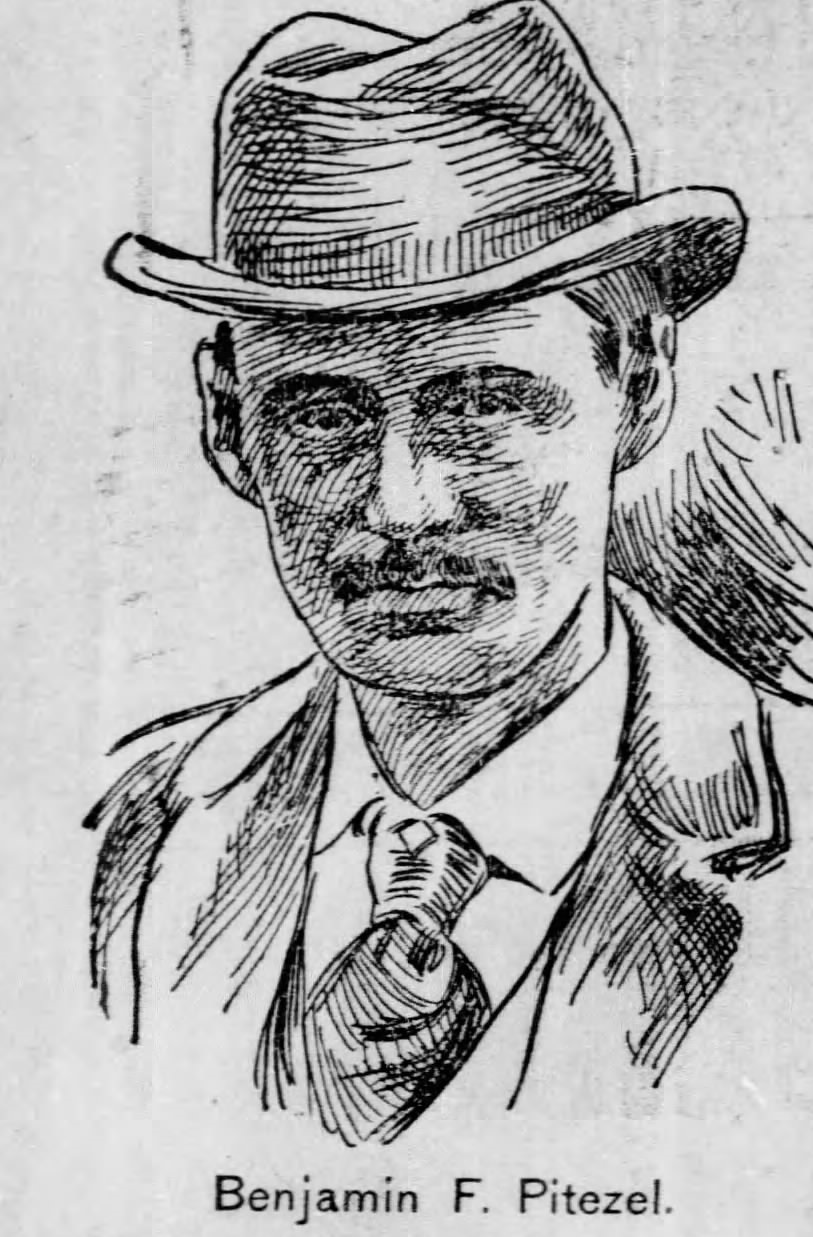
H. H. Holmes’ victims: Benjamin Pitezel

It’s time to finally address the one murder for which Holmes was tried and hung: that of Benjamin Pitezel. It’s confusing and complicated because of the number of versions of the tale that Holmes ended up telling. On the day of his execution, he even claimed that he had nothing to do with Pitezel’s death, and that the real killer was still out there. Let’s see if we can keep things straight.

When Holmes was in jail in July 1894, he had a conversation with a fellow inmate, Marion Hedgepeth, about a plan to defraud a life insurance company for $10,000. Hedgepeth put Holmes in contact with a lawyer named Jeptha Howe who could help him in this venture. Both Hedgepeth and Howe were supposed to profit from Holmes’ scheme.

Benjamin Pitezel moved to Philadelphia – conveniently where the life insurance offices were located, for a quick payout – and opened a patent office under the name B. F. Perry. He even made a last-minute payment on his plan shortly before a body was discovered above B. F. Perry’s patent office. The life insurance company payed Mrs. Pitezel, since they could hardly withhold money from a widow and her five children, but … was the dead man actually Benjamin Pitezel?

At this point, it very nearly turns into a choose your own adventure tale.

Option 1

The dead man, whose features were distorted by an apparent explosion, was not in fact Benjamin Pitezel. Pitezel, working with Holmes, disfigured and staged a corpse in order to fake his own death. He was in on the plan completely, and it went off exactly as Holmes had described it to Hedgepeth. Mrs. Pitezel collected the live insurance, and Benjamin had to make himself scarce. He couldn’t turn up after he’d been declared dead, after all.

In this version, the three middle Pitezel children – Alice, Nellie, and Howard – were with their father someplace abroad. We’ll get into the children more in future posts, but remember that weird cross-country trip? Holmes had Mrs. Pitezel with both her eldest and youngest; the three middle children; and his wife, moving from city to city, always in separate groups. Georgiana Yoke, who thought she was Mrs. Georgiana Howard – one of Holmes’ pseudonyms – had no idea about either group of Pitezels, and Carrie Pitezel had no idea where her children were. She also believed Benjamin was dead.

If the body in Philadelphia was a plant, then Holmes’ first explanation could hold true: that Benjamin and his children had accidentally crossed paths during this strange journey, and therefore the children were with their father. They couldn’t be trusted to keep such a big secret, so they’d left the country with him. Everything’s fine, and all Pitezels are totally still alive.

Which doesn’t explain why the disinterred body happened to have Pitezel’s wart or why Holmes – or Carrie Pitezel – can’t get in touch with either Benjamin or the three children.

Option 2

Rewind back to Philadelphia, where Pitezel is living as Perry, away from his wife and children, and has become increasingly depressed. Holmes knows about the life insurance policy, and how it has been paid up at the last minute. Still, he arrives at the patent office to make a horrific discovery: Pitezel has taken his own life. Worried that the insurance won’t be paid if it’s deemed a suicide, Holmes stages his friend’s accidental death.

This solves two disinterment issues: first, how the body could be dug up and determined to be Pitezel; and second, it prevented a second disinterment meant to answer just this question. (Holmes was allowed to get newspapers in prison, so he could keep up with what was going on concerning his own case.) It also allows Holmes to admit to insurance fraud, but keeps him from being a murderer. Except … the three middle Pitezel children are still missing. If their father isn’t alive to care for them …

Remember Minnie Williams? This is where Holmes takes her story and twists it for his own devices. The children are with Miss Williams, once again abroad. Holmes left them in her competent care, handing them off to her and her new fiancé, Edward Hatch, who looks very much like Holmes (and could therefore have been mistaken for him if seen on the street). When Holmes read in the headlines that the children’s bodies were found, he placed all the blame on Miss Williams and his lookalike, Hatch.

Even before Detective Frank Geyer found the children, this story broke down. Holmes argued that Minnie Williams was hiding because she had murdered her own sister – in a jealous rage over Holmes himself, no less – but that he could place a coded message in the paper and have her resurface, with all three children happy and healthy. Holmes could not produce any proof that Minnie Williams or the children were alive, or that Hatch existed.

And then his trial happened, and he was convicted of murdering Benjamin Pitezel, so we have …

Option 3

Holmes had always intended to kill Benjamin Pitezel, from the first day they met. He’d just been biding his time and waiting for the right opportunity. The previous tale of Pitezel’s depression is apparently the truth, but Holmes himself manufactured it, first isolating Pitezel from his family and then writing letters supposedly from Carrie to feed into his depression and increase his reliance on alcohol.

Holmes protests that, because he was a doctor, he was able to kill Pitezel quickly and, because Pitezel had been drunk at the time, he felt nothing. (Kind of a weird flex with the medical degree, don’t you think?) Unfortunately, Pitezel was found much more quickly than Holmes had anticipated, but he’d already gathered his things and left Philadelphia. He had to be there for Carrie Pitezel long enough to get the money from her, although he forgot to pay off Hedgepeth, who read the story in the paper, considered for a moment, and informed authorities what Holmes had told him months previously.

In his confession, Holmes also admits something he’d been accused of in the papers: taking malicious pleasure in mutilating Pitezel’s body during the disinterment, using his own knife – which he had on hand – to remove the identifying wart from the back of his dead friend’s neck. In front of Alice Pitezel, no less, who had been sent to properly identify her father. But we haven’t even gotten to Alice’s story yet. This is still their father’s story.

And the winner is …

In spite of his gallows retraction, Holmes is believed to have murdered Benjamin Pitezel. He first lured his longtime companion to Philadelphia, even choosing the location of his shop as being close to a mortuary so the smell of a rotting body would be dismissed, if not unnoticed. Holmes did all this with the full intention of murdering Pitezel and taking as much of the insurance money as he could get his hands on. He fooled Pitezel into thinking it would be a scam, and then did not have to lie either to Carrie or in his identification of Pitezel’s body.

And this is, after all, the only murder for which Holmes was put on trial. In spite of his various confessions, he was hanged solely for the murder of Benjamin Pitezel.

But he wasn’t done, and his most confusing actions were still to come.

H. H. Holmes’ victims: Baldwin Williams

Do you remember Minnie and Nannie Williams? They’re sisters whom Holmes counts among his victims in his newspaper confession of 27 murders, but previously – in Holmes’ Own Story – he had claimed that Minnie had not only killed her own sister (out of jealousy over Holmes himself, no less) but that Miss Minnie Williams had been involved with the murders of the Pitezel children. Baldwin Williams is their brother and, coming in at victim 23 of 27, is the final victim prior to members of the Pitezel family.

Supposedly, after murdering the Williams sisters, Holmes found an insurance policy “made in her favor by her brother, Baldwin Williams.” He doesn’t clarify which sister he meant, and it doesn’t matter. Holmes simply wanted that money, so he traveled to Leadville, Colorado, in early 1894 and shot Baldwin. Apparently Holmes made it look like self-defense. He then details how he ended up with thousands of dollars from the Williams estate. But …

Well. Let’s start with “Baldwin Williams.” There was a man by that name who came from Leadville and died in early 1893, but no cause of death was given. The timing is off by a year – we know Holmes was rather awful about dates and timelines – which matters in this case because February 1893 is before he can be proven to have met, or murdered, Minnie Williams. The narrative doesn’t play out.

In Holmes’ Own Story Holmes reports Minnie as telling him about the death of her brother by railway accident, and that she moved from Colorado to Chicago shortly afterward. So it seems Holmes knew that there had indeed been a man named Baldwin Williams, and that he had died. In Holmes’ Own Story, Holmes himself was innocent of all charges. Benjamin Pitezel had committed suicide and his three children were murdered by Minnie Williams and her new fiancé (or possibly husband) Edward Hatch, who looked very much like Holmes and could have been mistaken for him. Baldwin’s death was part of Minnie’s tragic backstory that she confessed to Holmes shortly after they had met, and it certainly wasn’t a murder.

So did Holmes add Baldwin’s name purely to up his body count, assuming that readers wouldn’t connect the name back to either Holmes’ Own Story or to the real Baldwin Williams’ death? This wasn’t a victim made up completely, but the adoption of a man’s death for his own story. Holmes himself observed in his autobiography that he seemed to be accused of any unsolved crime that had occurred while he was a free man, wryly observing that he was glad to be in prison when the Murder Castle burned down so he couldn’t be suspected of that, too. Was this Holmes simply bowing to public perception and adapting the technique of making more headlines for himself?

Baldwin Williams merits, however, only a short mention, since Holmes’ grand finale is up next. Two weeks away from his date with the gallows for the murder of Benjamin Pitezel, Holmes moves into his confessions of murder of four members of the Pitezel family, which is the real draw for those who purchased the newspaper with his confession on the front page.

H. H. Holmes’ victims: a man … whose name I cannot recall

You might recall – although Holmes could not entirely – that he previously confessed to murdering a woman “whose name has passed from my memory.” It seems to be a solid technique for adding to his body count in a way that cannot entirely be denied, as it could in cases such as Miss Kate Durkee, who made her continued existence known after the publication of Holmes’ confession. Being an equal-opportunity murderer, Holmes declares that his twenty-second victim was a man “whose name I cannot recall.”

The story itself is fairly simple: the man came to Chicago to attend the Exposition – if you’re a Devil in the White City fan, that’s the White City; if not, that’s the World’s Columbian Exposition of 1893. Holmes met the man somehow, perhaps because he roomed at his Murder Castle, and used him for a while. However, the nameless young man wasn’t nearly as talented as Holmes had originally thought, so – in a technique apparently useful for both assistants and mistresses who have outlived their usefulness – he decided to murder the man.

Holmes then decided to bury the body, since he hadn’t sold any cadavers to his “‘stiff’ dealer” for a while, in the basement of a house he used to own. (Presumably the “used to” refers to the time of the written confession and not the time of the murder, because then Holmes would have had to break into a house he no longer owned in order to bury a body in the basement.) The body was not discovered at the time of publication, although we have to wonder how the current owners of the house felt (if there indeed was a house at the intersection Holmes mentions).

Here’s the weird part: Holmes can’t remember the man’s name, but he gives a list of all the peoples the police should check if they want to discover it. Seriously a list:

… the Hartford Insurance Company, a Mr. Lasher, of the Stock Exchange Building; D. F. Duncombe, Metropolitan Building; all of Chicago; a sash and door manufacturing company opposite the Deering, Illinois, Station, or F. L. Jones, a notary public at Indianapolis …

By making inquiries there, Holmes suggests that authorities might discover that “his name or handwriting may have been preserved.”

Uh.

Okay, so let’s take a peek in the middle for a second: “all of Chicago.” If the authorities question all of Chicago, they might discover the man’s identity. In the 1890s, Chicago was home to over a million people, and the Exposition brought in so many travelers. But sure, question all of Chicago.

But then he lists three very specific names, with locations where those men can apparently be found. If Lasher, Duncombe, and Jones are indeed real people, still alive and in those locations … what, exactly, does Holmes think the police should ask them? They’re meant to remember a man from three years previously, at a time when Chicago would have been busier than usual? Or in the case of Mr. Jones in Indianapolis, someone from further back? Was the unnamed man meant to have seen each of these explicitly named men in the company of Holmes, which might aid in his identification? Or … what, exactly?

Holmes has a lot in common with Ted Bundy, who came along almost a century later. Both were highly educated men who, for a time at least, served as their own lawyers during their murder trials. When his execution date was approaching and it seemed he would no longer receive a stay, Bundy started confessing in the hope that he could leverage his unidentified – or undiscovered – victims into a longer life. Is that what Holmes is doing here?

Remember that Holmes was ever only convicted of a single murder. Bundy was convicted of more – in case the death penalty from one trial was overturned – but Holmes only went to trial for the murder of Benjamin Pitezel. He was certainly suspected of more, although that number has skyrocketed in the decades since his execution, but according the law, Holmes had only murdered a single person. He was sentenced to execution on a date that was quickly approaching when he wrote this confession, and he did not write it for free. Holmes in fact sold it for thousands of dollars.

So: is this unnamed man real? Are any of the men whose names and locations Holmes somehow managed to remember? Or is this just more manipulation from a silver-tongued devil?

H. H. Holmes’ victims: a woman, whose name has passed from my memory

So we’ve already established a few different things about Holmes: he likes to write. He was very willing to change his story when it suited him. And he was a con man who made use of all available resources. He certainly wasn’t above lying, or making up victims when it suited him, or “forgetting” what those victims’ names were.

His nineteenth confessed victim, known only as “a woman, whose name has passed from my memory,” certainly qualifies as this last. And, since she can’t be identified, her existence cannot be proven. But, like in his description of his eighteenth victim, Holmes once again introduces the idea of a likewise anonymous accomplice.

Both the woman and the male accomplice were Holmes’ tenants. When the first arrived at his Castle, the second quickly became smitten. However, the man was already married, and apparently his wife knew of his infatuation with the other women. The married couple was already fighting, and seeing her husband make eyes at another woman did not increase marital bliss. The man, in his distress, turned to Holmes for help.

It seems that the man and his wife were tenants elsewhere, and that the wife could be convinced that her husband had gone off on a trip of some kind, because Holmes suggested that the man come live in the Castle with the other woman as though they were already married. (The very same way, you may recall, Holmes said he moved in with Minnie Williams.)

Apparently Holmes even presented the idea that, if the mistress didn’t satisfy the man, then she might be murdered and the man and Holmes would divide her wealth. It certainly seems like something Holmes might plan, considering how many people he claimed to murder for their money (whether or not they were actually dead) but just think about it for a moment: he’s supposed to have told an infatuated man not only to commit adultery in such a way that apparently his wife has no clue, but has also casually said that the two of them could murder the mistress.

The man agreed. On both points, apparently. He moved into the Castle with the woman, quickly grew tired of her, and called upon Holmes for that next step in the plan. Holmes administered chloroform while the man “controlled her violent struggles.” Then, apparently, they split up her money and the man … what, went back to his wife? Holmes isn’t exactly concerned with that particular outcome, but he admits that the murder occurred in 1893 and that a “long coffin-shaped box” had been seen being taken out of the Castle. It seems that the police had been notified of this event, and this is Holmes’ attempt to once again make use of previously-published headlines.

It’s really just a quick blurb, but think about it for a minute: a man unhappy in his marriage isn’t simply given the opportunity to live with a woman who has caught his eye, no strings attached. Holmes offered them the space to live as husband and wife, apparently without drawing attention from anyone who would have known the man – and realized that the woman wasn’t his wife – but that wasn’t all. The offer also came with the suggestion that, when the man eventually got sick of his mistress, as apparently all men do, Holmes had a ready response: murder. So apparently he said “Oh, come and live with her in the Castle for a while, then, and when you get tired of her, we’ll murder her. What do you say?”

So, uh … exactly how many men in the world do you think would have agreed to that prospect? Did Holmes actually find someone who did this, or is he trying to create a character even worse than himself?

H. H. Holmes’ victims: Rogers, a wealthy banker

The eighteenth murder in Holmes’ confession has a few more twists and turns than some of the others, but I think you’ll still recognize some of his preferred tropes.

Rogers himself is described as “a wealthy banker” from a Northern Wisconsin town, who had to be enticed to come to Chicago. But not by Holmes. In this murder, Holmes works with an accomplice.

This accomplice was a young Englishman who met Holmes in 1891. (Maybe. We already know Holmes isn’t that great at dates.) This Englishman was a fine partner in Holmes’ usual real estate scams, and apparently he was good at the patent scam, too. In fact, this Englishman was such a good criminal that Holmes, somehow, decides to withhold his name completely. He starts off coy, arguing that said Englishman couldn’t be arrested simply on his own say-so, and simply refuses to give the Englishman a name.

It was, however, the Englishman who convinced Rogers to come to Chicago, not Holmes. The Englishman must have been just about as clever as Holmes, because he made sure that none of Rogers’ friends or family would know why, exactly, Rogers had come to Chicago. Those back home in Wisconsin wouldn’t be able to say who Rogers had gone to meet.

Holmes and the Englishman got Rogers to go into the Castle by saying they had patents in there for him to see, and at first Rogers – wisely, you might think – refused to sign the “checks and drafts for seventy thousand dollars” that were there instead. Granted, either Holmes of his incredibly criminal English friend could have forged them once Rogers was dead, but that’s apparently not how Holmes worked.

You’re probably figured out which room Rogers had been led to.

Holmes used the gas hookups in the room to nauseate Rogers – which probably wasn’t much of a trick, since Rogers had been in there long enough to starve – to convince Rogers to sign.

Now, here’s another of those things that readers today might not swallow: Holmes writes that Rogers signed the securities, “all of which were converted into money and by my partner’s skill as a forger in such a manner as to leave no trace of their having passed through our hands.”

Yeah. His partner was a skilled forger, but they still lured Rogers into the gas chamber, starved him, and hit him with the gas in order to get him to sign them. Did Holmes and his friend not already have exemplars of Rogers’ signature? Why couldn’t they just have gotten Rogers to Chicago, killed him, and forged everything without the extended torture?

Once the signatures were obtained, Holmes and his English friend apparently had a standoff about what to do with Rogers who was, at that point, still alive. Each tried to wait the other out so he didn’t actually make the suggestion of murder himself – although clearly they couldn’t have followed through with getting all of the money and still let Rogers go – but it was only when Holmes started getting ready to let Rogers leave that the Englishman made the murder suggestion.

And, in spite of the fact that Rogers was in the sealed room with the gas, Holmes made the Englishman kill Rogers using chloroform. Granted, Holmes was an accessory to murder, but he makes it clear that he did not kill Rogers himself, even though Rogers is counted among his 27 victims. The Englishman then left Holmes to deal with the body and apparently gambled away much, if not all, of his money before dawn.

So what we have here is Holmes presenting his readers with an unnamed stranger who is an excellent forger, willing to commit murder, and who had regaled Holmes with tales of “all other forms of wrongdoing, save murder, and presumably that as well.” By the end of Holmes’ recounting of Rogers’ death, the Englishman clearly is guilty of murder. But, just as he does with all other mentions of accomplices, Holmes refuses to give a name.

He instead teases his readers with the story of a man who is worse than Holmes himself, and who apparently gambled away $35,000 in a single night. Not only was Rogers murdered, but half his wealth didn’t even go to the murderers. Instead the three other men playing cards with the Englishman apparently became the big winners, and they didn’t need chloroform, either.

Holmes is, however, as untrustworthy when it comes to large sums of money as he is when it comes to timelines. The far more likely explanation is that he didn’t name the Englishman because there simply wasn’t an Englishman. He was simply trying to spin a tale that incorporated some of the more interesting headlines about himself, and perhaps didn’t want to attach a real name to a fake murderer, the way he has to fake victims.

Really Holmes is trying to be Bundy a century before Bundy rose to infamy. Bundy wanted to threaten people with the fact that, as bad as he was, he wasn’t the only one out there. They could send him to the chair, but that wouldn’t really save anyone. And that’s what Holmes is doing here, too: taunting his readers with the idea that someone just as bad as he is currently still walks free. Holmes could tell the man’s name, but he simply refuses. And what could they tempt him with, anyway? His execution was two weeks away.

So Rogers from Wisconsin is likely another of Homes’ made-up victims, the way his Englishman seems to be a made-up accomplice. But it’s not an effort to remove his own guilt, because Holmes counts Rogers as one of his own victims. It’s simply Holmes proud to have manipulated someone else into doing his bidding, the way he lived his life as a con man.

What do you think? Could the Englishman be real? Did Holmes go to his death without revealing the names of other criminals just as bad as he was – or worse?

What makes you put a book down without finishing it?

The other day one of the writing discords I’m part of asked us what makes us stay up too late reading, and I had trouble actually answering that one. What is it, exactly, that makes me keep turning pages? Compelling characters and situations, yes, but I’ve finished plenty of books where I didn’t actually like the main character, especially not at the beginning. (Wally Lamb writes some very angry men, for example.) I’ve also finished things where the ending or ending explanation is disappointing. (Sorry, Stephen King, but we know you know.)

A screenshot of Stephen King’s cameo in It: Chapter Two where he insults the author character’s endings.

But those are all books I’ve finished in spite of not loving them completely, not books I DNF’d (did not finish). Looking back, though, it takes a lot for me to DNF.

Take We Need to Talk About Kevin, for example. It’s epistolary, for starters, which isn’t usually my thing, and the POV character’s voice really grated on me. She seemed snooty and just … who writes letters to her husband like that? I slogged my way through quite a bit of it before I made a strange (for me at that point, at least) decision: I went to Wikipedia for the plot summary. (Gasp! Who does that? Don’t all good readers finish everything they start, one page at a time?) And, in this case, knowing the ending meant it was worth finishing.

I can’t remember the title of another book I truly DNF’d after going through the same process: slogging through because everyone says it’s good, going to Wikipedia, and then …

Here’s my cardinal sin: when it’s the author screwing with you instead of the characters.

What I found in that Wikipedia search (and really it’s probably good I can’t name the title or the author) was that the jarring POV change I’d just hit was the author purposefully obscuring the truth. Making it seem like the POV in the first section was a specific character when in fact … it wasn’t that character at all. The author jerking you around and yanking your chain and (I imagine) feeling pretty darn clever about it. (Can you tell this is seriously my pet peeve?)

I love reading thrillers. Can’t get enough. And I love unreliable narrators. Gone Girl is awesome. It’s not Gillian Flynn playing the deception, though – it’s her characters, all working to deceive each other in-book, and therefore deceiving the reader. Gillian’s not the one feeling pretty darn clever about it – [character’s name redacted in case you haven’t read the book yet] is the one feeling pretty darn clever about it. Because [character] wants to fool everyone, and the reader just happens to be part of everyone.

I love thrillers with unexpected twists. I also read a lot of thrillers, so more often than not, I can guess the twists. The cool ones leave two or three options open so I’m still not sure. The awesome ones still manage to surprise me. But even when I can guess an ending, I can enjoy how the author takes us there and how they present the story … as long as they don’t get in their own way while doing it.

Clearly the answer to this one is incredibly personal and subjective. What about you? What’s the point where you mark a book as DNF and pick something else up? (Also: what are your favorite thrillers? I could stand to add a few to my TBR pile.)

H. H. Holmes’ victims: Mr. Warner

This one takes a little bit of explanation. Readers of Holmes’ confession, published in April 1896, had already likely followed the progression of his case. The strange circumstances of his arrest in November 1894 and the huge amount of publicity leading up to his murder trial – including the publication of his memoirs – meant that anyone picking up the Philadelphia Inquirer wouldn’t be coming to the case cold.

Part of what had been followed in the media after Holmes’ arrest and prior to his trial was the excavation of his “Murder Castle.” This was a building Holmes had had constructed by hiring and firing workers at such speed that he didn’t have to pay them. Popular legend says he also did this so nobody knew the entire layout of the Castle, leading to secret passages and the like, but Adam Selzer found sources where clerks in the first-floor shops admitted to sleeping in the secret passages, so … they weren’t exactly so secret.

But there were discoveries in the Castle’s basement – and some real ones to go along with the horrific headlines that ended up being retracted later, in fine print, buried somewhere deep inside the newspapers. Yes, there were human remains found (but not nearly as many as the legend suggests). And there was also a strange kiln.

It was, as reported, a glass-bending kiln, and therefore built for a specific purpose. Holmes is meant to have used it as a sort of personal crematorium to aid in the disposal of his victims, at times claimed to be over 250 in number. (That’s a Devil in the White City claim. Adam Selzer’s H. H. Holmes: The True History of the White City Devil blows it out of the water.) However, there was some sort of brick oven found in the Castle’s basement, and it did seem to be about the right size to fit a human body.

In his April 1896 confession, Holmes writes that it was in fact a glass-bending kiln, although it wasn’t his. It belonged instead to Mr. Warner, no first name given, “the originator of the Warner Glass Bending Company.” Holmes doesn’t explain how or why the kiln had been built in his own basement, although it was apparently meant for Mr. Warner to exhibit his patents. (As far as I know, nobody’s found any records of anyone going into the Castle basement in order to view any such thing.)

Also according to Holmes, the kiln was much bigger than initially published. It was, in fact, much like the room-sized, airtight (but not quite soundproof) safe he’d had installed in one of the Castle’s other rooms. On the day of Warner’s death, both men had gone inside the kiln, ostensibly so Warner could show Holmes something about its workings. Holmes left, shut the door, and turned on both the oil and steam that, Holmes writes, made the kiln “so intensely hot iron would be melted therein.” (For the curious, that’s approximately 2,800°F, around the temperature at which glass melts. Maybe he figured more people would be familiar with molten iron over molten glass. Standard cremation furnaces reach around 1,800°F so, if all claims were true, then yes, the kiln could have been used for body disposal.)

Holmes admits to having used the kiln this way just once, for Warner himself. Many of his other victims, as he wrote earlier, were sold for profit.

There’s another interesting point here that once again shows Holmes’ issues with keeping his own timelines straight: he writes that there had been a coat discovered outside the kiln during this excavation, and claims the coat belonged to Warner. So apparently this random coat had been in the basement for years, without being noticed, stolen, or moved – in spite of the fact that the kiln had been meant for exhibitions and that its inventor had gone missing.

Once again in keeping with Holmes’ usual motivations, he killed Warner in order to get at his money. Apparently Warner had written Holmes two checks, written apparently freely, but Holmes doctored them by adding the necessary zeroes and the word “thousand” so that, according to the man himself, he very nearly cleaned out two of Warner’s bank accounts. It seems that Holmes feels more regret about not quite getting all of the money than murdering 27 people.

It’s a good sort of scary story, making full use of what the newspapers had already published about the Castle and the discoveries underneath it, but Warner had something in common with Miss Kate Durkee: he was still alive at the time of the written confession. There might have been some sort of kiln discovered in the Castle’s basement, one that quickly found its way into Holmes Lore, but Warner wasn’t killed in it.

At this point, can we believe anything published in this confession? Why do you think Holmes told so many lies?

Nitty gritty: narrative timelines

So this post isn’t about how much time it takes to write something, or caring about a project for months, or about planning your writing schedule. It’s about the timeline within your writing. How much time passes from the first page to the last? How much in a chapter? And how can you make it clear?

I’ve read books where the chapter titles are dates or even, in the case of Rewind by Catherine Ryan Howard, timestamps. (This is especially useful for books that aren’t presented chronologically.) But of course you don’t have to do this to indicate how much time has passed. You can work it into the text via either the characters or the narrator – say, the way The Princess Bride uses “What with one thing and another, three years passed.”

We’re going to think about this one for a moment.

If you’ve never read or seen The Princess Bride, it’s a book-within-a-book scenario. William Goldman presents it as the book his father read out loud to him when he was sick, so he’s never actually read it himself. He tracks it down for his own son, who deems it boring, and that’s when Goldman finally picks it up … and decides to publish his own “good parts” edition because the book is boring. In the “original text,” for example, those three years of Buttercup’s life and her training to be a princess are explained in excruciating detail. Goldman, therefore, writes what his father said as he skipped over all those pages: “What with one thing and another, three years passed.”

S. Morgenstern, the “original author” of The Princess Bride, should probably have listened to Elmore Leonard:

I try to leave out the parts that people skip

Elmore Leonard

But the question is: what are those parts? How do authors know what to skip?

For Not Your Mary Sue, I have some Very Important Plot Points that happen in June, all close in a row. There’s pretty extensive coverage for a couple weeks, and then … well, the next part I really wanted to write was almost a year later. But it’s not as easy as just writing the parts we want to write. There had to be snapshots of what happened in between in order to set up the proper emotional situation for the almost-a-year-later section.

In my initial draft, I had a bunch of information there. New places, new relationships, new activities. And it was helped along by timeline cues: references to seasons or holidays, which is easiest in the fall and winter. Halloween, Thanksgiving, Christmas New Year’s, Valentine’s Day … they’re easy touchstones because I imagine most of the people interested in my writing would know when they happen, so I don’t have to explain.

Now here’s the tricky part: I actually edited out a bunch of that myself before sending out the full manuscript. Trying to leave out the parts I thought people would skip, you know? Keeping some of the timeline touch points and making it clear time was passing, but … not in as much detail as those first few weeks, or the days covered almost-a-year-later. Those, I figured, were the interesting things.

Well. On the plus side, I still have all those scenes hanging around for when I was asked to put more detail in that middle section. By leaving all of them out, I’d whacked off the opportunity for emotional investment and therefore weakened some of the things that happened almost-a-year-later.

So, if you’re sitting down to plot out or write a story, what are some things to consider about timelines?

  1. Sketch out a calendar. I’ll print out the months my story covers because I tend to use real time, but even giving yourself seasons works. This helps me see when things are happening that will be important to the plot or offer that emotional connections for readers, and what time can be skimmed over. It also helps me make sure I’ve put in all necessary clues and foreshadowing so nothing that happens later should feel like a trick – the seeds should be there.
  2. Use signposts for readers (and yourself). If real-world things like “It was almost Halloween” aren’t going to work, then consider opening a scene or chapter with “It had been three weeks since she’d seen him” – something to help your reader know that yep, there was a time skip. Nothing important happened. (Or, if something did, it’ll come out in the dialogue when she sees him again.)
  3. Don’t be afraid to add too many details to that first draft if you’re not sure. And, when you cut them for a new draft, keep your old draft intact, or cut-and-paste things to a separate file. Don’t ever fully delete your work or kill your darlings, just in case they’re going to be useful later. Go ahead and take your time with the important plot elements – those can expand to fill more pages. Take the time that needs to be taken during your first draft, because you can always massage it later.
  4. Have someone else read it. Get more eyes on the page than just your own. Can they follow what’s going on and when? Do they have enough to form the emotional attachments you’d like them to? Are there in fact parts your beta readers would like to have skipped? (Are there parts that need more emphasis earlier on?)
  5. If things still aren’t working, draw out the timeline again, this time based off what you’ve actually written (and not what you’d planned to write). I like color-coding these and tracing them across characters so that I know what all the important people are doing during a certain week or month, even if they’re not currently “onscreen” in the novel. It can especially help when considering characters’ motivations and their actions: did they just come off of an emotional moment? Or have they had weeks to adjust to something?
  6. And of course remember that your rough draft is a rough draft. It’s for you. Nobody else ever has to see it. This is where you can try to cram in as many clues as possible, or cover that “boring” day if you think it’s important to show changing character relationships, or meticulously explain that cool thing you know how to do just because it brings you joy. Then, when you’re revising, you might sigh and take those things out … or leave them in and see what your beta readers have to say about them.

We’re never going to get it right for everybody – there will be parts people skip, and parts people wish you’d said more about – but paying close attention to your timeline (and not just your plot outline) can help guide you, your characters, and your readers through the story.

Do you think about timelines during your writing process? Is it part of your planning, plotting, revision … or not even on your radar?