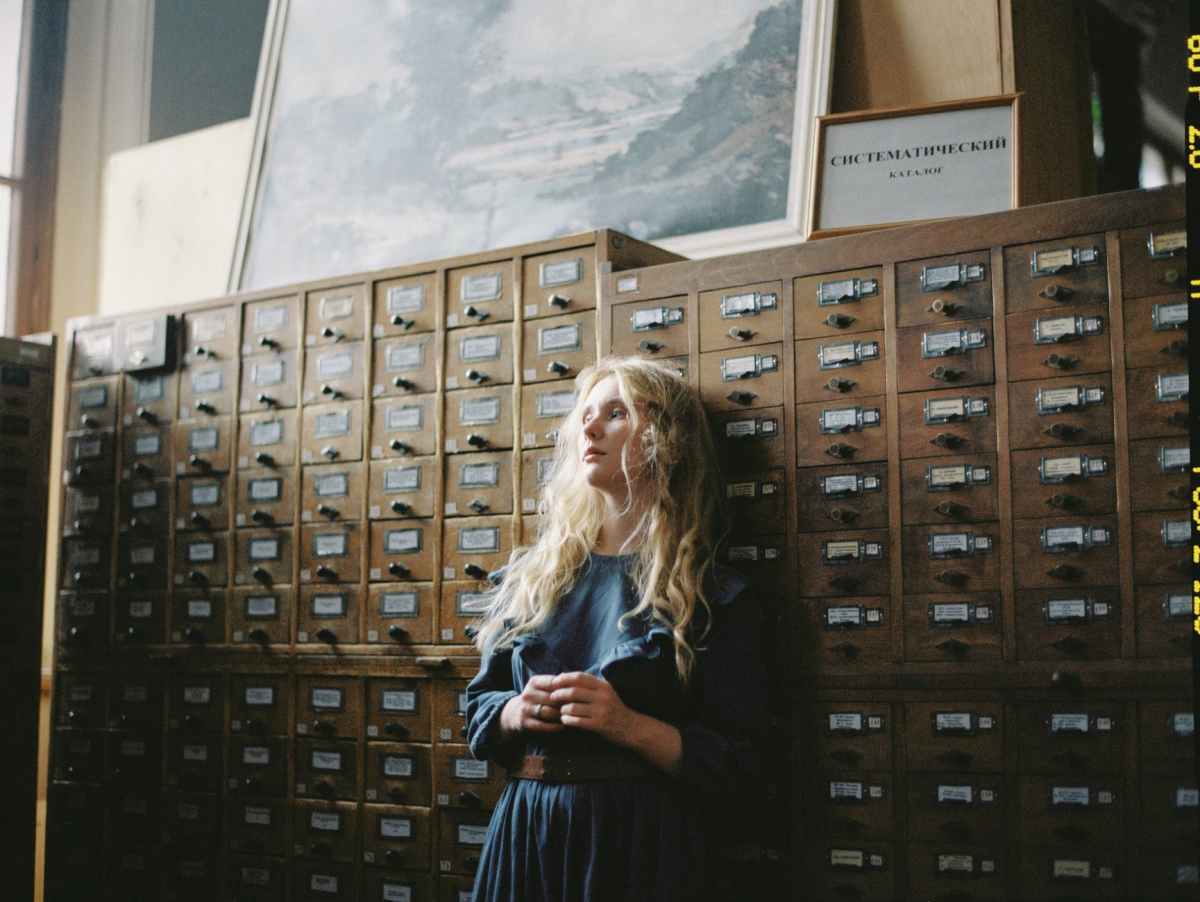
so you want to talk about flesh prisons (aka characters’ physical descriptions)

The other night at dinner, my husband was talking about Ready Player One. He read the book (in English) first shortly after it came out, then saw the movie, and now he’s reading the book in Italian. (Which he’s taught himself, because this is the guy I married.) He commented on how, since he’s seen the movie, he kept picturing the character Art3mis as her on-screen version and not the book version.

Which got me going about describing characters and using the phrase “flesh prisons” (yes, while we were eating) and he asked a) if I’d write it up, and b) if I’d use the phrase “flesh prisons” in my post.

So. Here we are.

I’m even going to throw in the asterisk that I gave him before going on my rant: this doesn’t work for all genres. If you’re writing romance, for example, you’re going to go right ahead and slow down while focusing on the love interest. There are times, be it in genres or just scenes, when more description matters. Just bear in mind that longer descriptions do slow down the action, so they’re more suited to certain places in your book than others.

Okay. Asterisk out of the way. When boiled down, my own personal decision on how much to describe my characters is this:

What do we decide to do with our meat prisons?

Bearing in mind that my characters are contemporary figures who get put into “basically today, usually Michigan” for their thriller settings, they’re humans. And human beings can be interesting, but part of what I’ve come to realize about myself is that physical appearance is most interesting to me when it ties into characterization.

Maybe also that I’m just not good at in-depth character descriptions. Anyway.

Let’s take Jay for a minute. I know, I know, only a handful of people have read Not Your Mary Sue so far since it’s not out until June, but you can meet him in the opening pages here. And most of the description comes when you first meet a character, right? So we can see some elements of Jay’s appearance: reddish hair (currently messy instead of purposefully tousled); blue eyes; tall; has a smile that lights up his entire face. I’ve even dropped in a clue about whether he’s right- or left-handed, but that’s not really a physical descriptor.

The thing is, in the first draft of the novel (from NaNoWriMo 2017) I did something that made me cringe a little when I went back over it: I described him based on which actor would play him in the movie version. It made sense within the book itself – Jay wants his story to be told and become a bestseller, so it’s not a stretch to imagine it then getting turned into a movie, the way both Mark Harmon and Zac Efron have played Ted Bundy – but I ended up cutting it.

Naming a well-known actor basically locks us all in to the same Jay, forever and ever, amen, the way my husband’s been picturing the Art3mis from the movie while reading the book. If I describe someone as “Avengers-era Chris Evans” (not my Jay model, in case you were trying to make it work), then we’re all stuck with Avengers-era Chris Evans in our head. We might not complain, but … we’re still all picturing the exact same thing.

I want to give you some leeway.

Pick whatever kind of nose you want for Jay. Imagine his eyebrows. Fill in the rest of his face.

You’ll learn later about why his smile maybe isn’t such a welcome thing, and Marcy has her own reasons to focus on his physique in the early pages of the book, but there’s enough to play with so that your Jay doesn’t have to be my Jay. And I’ve gone for sort of the low-hanging fruit: hair color, eye color, and height. Basically sketched in a roughly humanoid figure.

The rest of what you learn about Jay has to do with his character: who he is as a person. When Marcy describes his physique, it’s in comparison to what she associates with his favorite hobby. (Spoilers there, so that’s vague. No, it’s not serial killing.) His hair matters because it is messy instead of deliberately tousled, each of which says something different about a person.

What I like to describe about my characters’ physical selves are the things that tell us something about them as people.

It’s usually not something they had no control over – whatever genes blessed or didn’t bless them from birth – but the things they do: hair style. Tattoos or piercings. Hair dye. Clothing. Hobbies and learned skills that show themselves physically, like a guitar player’s calluses. Sometimes things they didn’t necessarily have control over, but tell us about their lives, like scars.

In the Ready Player One example, Art3mis is encountered first – and for the vast majority of the book – as an avatar. Cline spends a lot of time having his main character describe that avatar, in part for those romance novel reasons (Wade knows who Art3mis is before encountering her “in person” so he already knows she’s interesting) but also because the avatar was entirely created. Art3mis chose not only her screenname, but every element of her avatar. Everything about her appearance is therefore a deliberate choice that tells Wade something about her before he ever meets her.

And to be fair, I have wondered if character descriptions are one of my weakest points. (If you’re going to tell me I’m right, please be kind while you do so.) Maybe it’s something to do with being ace and just not looking at people the “usual” way. Or maybe I just think motivations and internal aspects of character are more interesting than flesh prisons.

How do you approach describing characters’ physical appearances? Do you have any favorite authors who seem to be really good at it?

Learning to write all over again

Writing can feel really isolating: just you and your computer as you stare at the blinking cursor and wonder when the document is going to have the desired word count. How you get from 0 to that word count is pretty much up to you. If you’ve got a deadline, you just have to be faster and figuring it out.

It’s also one of those things where you don’t always realize what you know or how valuable your own struggles – uh, experiences – might be until you’re talking to another writer and someone says “OMG, me too!” in clear tones of relief.

In grad school, we didn’t really talk about the writing process. It was like everyone assumed we already knew how to write and just had to be told the assignment parameters. When I submitted for my first conference, I felt like I was winging it. Same for my first chapter. We didn’t talk about writing, and it didn’t seem acceptable to ask anyone about writing. It was just this weird taboo.

So it was hard to tell if my own experience actually related to anyone else’s, or if mine was somehow … subpar. Like I’d missed a bunch of key information that everyone else somehow magically knew.

Part of my intent with this blog is to share the things that get me the “OMG, me too!” responses so I don’t play into the secret-keeping aspects. I’m (somehow) at a point in my career where people look up to me and think I’m a real writer (imposter syndrome what?) and there are so many things I wish I’d heard from someone when those positions were reversed, so …

Starting a new project can feel like learning how to write again from scratch.

There. It’s out.

You’d think, or maybe hope, that after you write one book, you’ve got it down. You’ve managed to go from 0 to 80k or so, get it passed editors and proofreaders and through the printing process, and you’ve learned a bunch of lessons along the way. All of which can be applied to Book #2. Right?

Uh. Well.

To be fair, at first I thought maybe I was just making things harder for myself by not approaching a new book project the same way I’d gone about the first. Like I was just reinventing the wheel to keep my stress level high for the fun of it. Except each book project is different, so why should the process look exactly the same?

For me, Book #1 was about Jack the Ripper. Book #2 was about H. H. Holmes. Two nineteenth century serial killers, right? Well, yes. But …

Ripper’s Victims came out in 2018, but I’d started reading about the Ripper in 2007. I’d already racked up a respectable number of books by the time I signed the contract, and bought even more in the process of researching it. But it wasn’t like I’d only looked into the Ripper from the moment of signing the contract. I’d already had a better part of a decade not only reading about the Ripper, but writing a paper on the women for a graduate independent study course and then presenting that paper for my first conference. I had this whole history with the Ripper, and there was such a huge bibliography to make my way through.

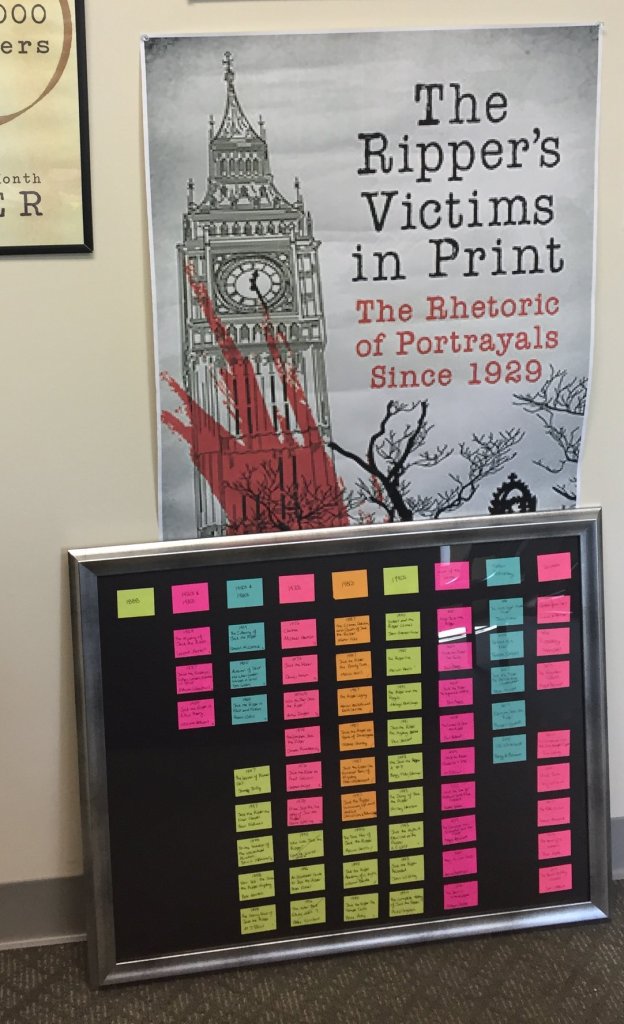
Take a look at this:

I know you can’t read it, but the framed poster board at the bottom with all the neon sticky notes is my outline for Ripper’s Victims. I went through and wrote down the titles of books about the Ripper and organized them chronologically. Which worked quite well until the 1990s, which spilled over, and then for the 2000s I ended up parsing out different themes because yowza. The Ripper was popular and still gaining.

Holmes isn’t that popular. I’ve had people hear I do true crime and name Holmes as their sort of “gotcha” killer, because apparently we’re gatekeeping true crime now. (Also apparently Erik Larson’s book, despite selling so many copies, hasn’t made Holmes mainstream. Who knew? Maybe everybody reads it for the architecture.)

But already straight off you can see I couldn’t start the same way with Holmes as I had with the Ripper. I’d read I think three books about Holmes when my editor asked if I’d be interested in writing my own, and three compared to my Ripper history seemed kind of pitiful. Except … there aren’t over 100 books about Holmes. My bibliography didn’t stay at three, but it certainly didn’t explode like my Ripper posterboard.

That’s just one major difference. Another is the subjects themselves: the Ripper was never named, but Holmes was. He’d been identified, put on trial, and even wrote both an autobiography and a confession before his execution. You can’t approach them the same way. It makes no sense to try.

And still I thought maybe I was just trying to make life difficult for myself.

Is this a case of form following function? (That’s for you architecture fans out there.) Granted, the final form – a book – looks very much like any other book. There’s a different cover, but … sentences and chapters and pages.

I think the biggest takeaway here is flexibility.

When you’ve written a book, you’ve learned one way to write a book, but it’s not the only way for anyone to write a book … and it’s not even the only way for you to write a book. The tips and tricks you’ve amassed are certainly there in your toolbox to be used as often as you need them, but they’re not the only tips and tricks in the world. And they might not always work on a new project. (I’d try for another architecture metaphor, but I personally read Devil in the White City for the serial killer.)

I’ll revert to Joseph Campbell and the hero’s journey: he says that the hero has to find his own path into the woods. If the journey’s easy, then you’re on a path someone else has made, and you’re not going to be a hero.

Writers have to find their own path into the woods … for each book. Maybe you can make some headway on a path you’ve made before, but not always. Sometimes you have to reassess your approach and start hacking away in a different direction, because this book isn’t the same as the last one. You’re not looking to end up in exactly the same place, and you’re probably not starting from the same place, either.

The woods are lovely, dark, and deep … and enormous. Starting a new book can feel like learning to write all over again, and that’s not a bad thing. It can be frustrating, but it can also be thrilling and rewarding.

What do you think? Do you find yourself still learning how to write, no matter how much you’ve written before?

“Do you ever get into a writing funk where you just can’t summon the energy to write?”

If you google “write every day,” you get over a million results. I mean, it’s Google, so there are usually tons of responses, but … it’s common advice. I don’t know if it’s the most common, exactly, but it’s out there enough that people who don’t write everyday are worried, or even convinced, that they’re doing it wrong. To the point where someone I know, who is in no way a slacker, asked me this question: do you ever get into a writing funk where you just can’t summon the energy to write? Because maybe she assumed that, being a “real” writer, my answer would be “no.”

How accepted is this idea? I wrote back “YES” and she responded “THANK GOD.” (We proceeded without shouting after that.)

The thing is, we get people like Stephen King telling us to write every day. And you’d think he knows what he’s talking about, right? World-famous bestselling author, and he says:

Once I start work on a project, I don’t stop, and I don’t slow down unless I absolutely have to. If I don’t write every day, the characters begin to stale off in my mind … I begin to lose my hold on the story’s plot and pace.

Stephen King

So … write every day. Right?

Not according to Cal Newport. Or Kristen Simental. Or Luke Eldredge.

I’d like to pick apart King’s quote, because even though it often gets repeated as the simple “Write every day,” he actually tells us more than that. In fact, he reveals a bit about his own writing pitfalls. Once he starts a project (so presumably not 365 days a year), he feels that he, personally, has to write everyday because otherwise he sees issues in characters, plotting, and pacing.

Remember how not all writing advice is universal? How there are so many books about writing out there, and they all have different advice? We call come from different backgrounds and have our own potential pitfalls. Not all advice is for every writer, and not all advice is shared in a way that’s actually helpful.

That’s why we need the full quote: to see what, exactly, “write every day” means to King, and why he stands by it. He’s noticed, in his own many decades of experience, that he, personally, has to write every day once he starts a project, or else these issues arise. He’s not “writing every day” because it’s been repeated so often, but because he knows what’s likely to happen if he doesn’t. For King, writing every day is the solution.

I’d say I more or less align with King here: once I get started on a project, I’m likely to write something in it every day until I hit my goal. Sometimes the goal is a completed draft; other times it’s a completed section of a draft. If I’m at the very beginning and I’m excited, then “every day” means 7 days a week. Other times it means 5 days a week, because even people with “real” jobs get weekends. (Mine aren’t always Saturday and Sunday, or two days in a row, but they’re still days when I don’t expect myself to write.)

The biggest argument I hear for “writing every day” is that writing is a job. If you’re serious about it, then of course you’ll do it every day.

Think for a moment about what you do every single day of your life. Breathe, eat, sleep. Take care of other humans or pets in our household. But even exercise plans have rest days built in. Work limits your hours if only because they don’t want to pay you overtime. We recognize the need for rest, recovery, and making space for other things when it’s not writing, so …

If writing every day burns you out, then it’s bad advice for you. Like all other writing advice, it’s something you need to consider for both practicality and personal adaptation. If you’ve never tried it, maybe it’s time to pick a project and adhere to the advice for a set amount of time – say, a month. Give yourself long enough to figure out if it’s working, and maybe long enough to become a habit. Maybe you’re a big don’t break the chain kind of person. But even then, remember that the true test of your chain is missing a day … and getting right back into it on the next.

You might mess around with expectations. Are you trying to write a specific number of words each day, or carve out a specific amount of time for writing? When you say “writing,” do you mean “putting words on the page” or will you count research, plotting, daydreaming, and so on? Are you willing to switch up your goals and your schedule to better match your actual daily output? Is this a 24/7/365 sort of goal, or a project-based goal?

So no, I don’t put words on the page every day. I don’t sit in front of my laptop for a set amount of time every day, either. When I’m working toward a deadline, it’s far more likely – but even then I remember that weekends are a thing. And, like King, I’ve been doing this for a while, so I have a pretty good idea of what works for me and how to avoid my worst pitfalls. But that doesn’t mean you have to do exactly what I do.

Sometimes I get into a funk and can’t summon the energy to write. It happens. I’ve barely worked on my book projects all month because so many other things have come up. Stress is real, and burnout is real. If writing every day adds to either of those, then it’s probably not your best solution right now. Because that’s what writing advice should be: a solution, not stress or shame.

How was your January? Were you more productive, word-wise, then I was?

Remember to look back

Sometimes things just come together for inspiration. Take this tweet from a friend of mine:

Dan’s clearly a skilled maker – he’s also a fiber artist as well as doing woodwork – and he’s got this striking visual example of his progress. We can see how intricate his work gets, even if we’ve never made spindles ourselves. And we can see it at a quick glance.

I’m connecting this back to writing. Of course I’m connecting this back to writing. Because lately I’ve been a lot more involved in communities of writers, which involves things like feedback and support and beta reading.

Beta reader (n.) A beta reader is a test reader of an unreleased work of literature or other writing (similar to beta testing in software), giving feedback with the angle of an average reader to the author about remaining issues.

definition from Cali Bird

For authors, beta readers are a sort of reality check. Is the piece doing what you think it’s doing? Is that loveable rapscallion of a character actually loveable? Does that tender scene between your main character and the love interest actually bog the plot down and make readers yawn instead of sigh with heart eyes? Betas help us figure out what’s working, what’s not, and which darlings need to be killed. (Sob!)

Now, not all beta readers are “right.” We’re all coming from our own backgrounds, with our own impressions and preconceived notions and references and all the rest. Just because I interpret something in a specific way doesn’t mean everybody will. That’s why there’s usually more than one beta reader in the process: if all of them say something’s not working, then it’s probably not working. Sorry. But if one says the darling needs to be murdered and the others don’t … author’s choice.

I’ve been writing all my life. I can’t remember not engaging in reading and writing. I do know that I wrote my first original “novel” (okay, it’s more the length of a novella) when I was 15, and that’s a couple decades ago by now. I’ve been writing more than half my life. I’ve had, and even taught, classes on writing. If you have to write a million words before you get to the good ones (who first said that? it’s complicated), I had them all down at quite a young age.

The thing about those first million is that you’re supposed to discard them, because they’re crap. Did I? Well, not all of them. Like Dan, I can look back over my work from bygone years and compare it to what I produce today. (Unlike Dan, I can’t convey this in a short video, since you’d actually have to read my stuff. Also unlike Dan, I don’t feel like sharing some of that past work, thanks.)

But I do have it. In fact, I have a lot of it on my Kindle right now, next to my current WIPs, so I can easily revisit them. It helps to remember where I am in my own journey especially when I’m volunteering to be a beta reader for someone who’s in a different place on theirs.

There’s a lot that goes into being a good beta reader, and I think part of it is the recognition that it’s not just the words on the page that’s a work in progress. I mean, that’s the whole point of sharing a piece with betas: to get feedback, because you know it’s not quite there yet, wherever “there” is. As authors we probably also feel like we’re not quite “there,” either. There’s always something to learn, and we only learn to write by writing. Hence the million words. You don’t have to count every single one, but the writing has to happen. There’s no shortcut there: to be a writer, you have to write. (But that’s also the only step: to be a writer, you have to write.)

I think it’s good for all of us to take a look back at something we’re good at doing (now) to remember when we weren’t. Especially if we’re remembering a time we totally thought we were good, until we revisited it at a later date and … well. It’s good to remember, and to help each other along our journeys the way other people helped us along our own.

It’s good to look back and recognize our progress, too, even if that might feel a bit more selfish. Maybe we want to get better, but there should still be room to measure the distance between where we were before, and where we are now.

What makes you put a book down without finishing it?

The other day one of the writing discords I’m part of asked us what makes us stay up too late reading, and I had trouble actually answering that one. What is it, exactly, that makes me keep turning pages? Compelling characters and situations, yes, but I’ve finished plenty of books where I didn’t actually like the main character, especially not at the beginning. (Wally Lamb writes some very angry men, for example.) I’ve also finished things where the ending or ending explanation is disappointing. (Sorry, Stephen King, but we know you know.)

A screenshot of Stephen King’s cameo in It: Chapter Two where he insults the author character’s endings.

But those are all books I’ve finished in spite of not loving them completely, not books I DNF’d (did not finish). Looking back, though, it takes a lot for me to DNF.

Take We Need to Talk About Kevin, for example. It’s epistolary, for starters, which isn’t usually my thing, and the POV character’s voice really grated on me. She seemed snooty and just … who writes letters to her husband like that? I slogged my way through quite a bit of it before I made a strange (for me at that point, at least) decision: I went to Wikipedia for the plot summary. (Gasp! Who does that? Don’t all good readers finish everything they start, one page at a time?) And, in this case, knowing the ending meant it was worth finishing.

I can’t remember the title of another book I truly DNF’d after going through the same process: slogging through because everyone says it’s good, going to Wikipedia, and then …

Here’s my cardinal sin: when it’s the author screwing with you instead of the characters.

What I found in that Wikipedia search (and really it’s probably good I can’t name the title or the author) was that the jarring POV change I’d just hit was the author purposefully obscuring the truth. Making it seem like the POV in the first section was a specific character when in fact … it wasn’t that character at all. The author jerking you around and yanking your chain and (I imagine) feeling pretty darn clever about it. (Can you tell this is seriously my pet peeve?)

I love reading thrillers. Can’t get enough. And I love unreliable narrators. Gone Girl is awesome. It’s not Gillian Flynn playing the deception, though – it’s her characters, all working to deceive each other in-book, and therefore deceiving the reader. Gillian’s not the one feeling pretty darn clever about it – [character’s name redacted in case you haven’t read the book yet] is the one feeling pretty darn clever about it. Because [character] wants to fool everyone, and the reader just happens to be part of everyone.

I love thrillers with unexpected twists. I also read a lot of thrillers, so more often than not, I can guess the twists. The cool ones leave two or three options open so I’m still not sure. The awesome ones still manage to surprise me. But even when I can guess an ending, I can enjoy how the author takes us there and how they present the story … as long as they don’t get in their own way while doing it.

Clearly the answer to this one is incredibly personal and subjective. What about you? What’s the point where you mark a book as DNF and pick something else up? (Also: what are your favorite thrillers? I could stand to add a few to my TBR pile.)

Nitty gritty: narrative timelines

So this post isn’t about how much time it takes to write something, or caring about a project for months, or about planning your writing schedule. It’s about the timeline within your writing. How much time passes from the first page to the last? How much in a chapter? And how can you make it clear?

I’ve read books where the chapter titles are dates or even, in the case of Rewind by Catherine Ryan Howard, timestamps. (This is especially useful for books that aren’t presented chronologically.) But of course you don’t have to do this to indicate how much time has passed. You can work it into the text via either the characters or the narrator – say, the way The Princess Bride uses “What with one thing and another, three years passed.”

We’re going to think about this one for a moment.

If you’ve never read or seen The Princess Bride, it’s a book-within-a-book scenario. William Goldman presents it as the book his father read out loud to him when he was sick, so he’s never actually read it himself. He tracks it down for his own son, who deems it boring, and that’s when Goldman finally picks it up … and decides to publish his own “good parts” edition because the book is boring. In the “original text,” for example, those three years of Buttercup’s life and her training to be a princess are explained in excruciating detail. Goldman, therefore, writes what his father said as he skipped over all those pages: “What with one thing and another, three years passed.”

S. Morgenstern, the “original author” of The Princess Bride, should probably have listened to Elmore Leonard:

I try to leave out the parts that people skip

Elmore Leonard

But the question is: what are those parts? How do authors know what to skip?

For Not Your Mary Sue, I have some Very Important Plot Points that happen in June, all close in a row. There’s pretty extensive coverage for a couple weeks, and then … well, the next part I really wanted to write was almost a year later. But it’s not as easy as just writing the parts we want to write. There had to be snapshots of what happened in between in order to set up the proper emotional situation for the almost-a-year-later section.

In my initial draft, I had a bunch of information there. New places, new relationships, new activities. And it was helped along by timeline cues: references to seasons or holidays, which is easiest in the fall and winter. Halloween, Thanksgiving, Christmas New Year’s, Valentine’s Day … they’re easy touchstones because I imagine most of the people interested in my writing would know when they happen, so I don’t have to explain.

Now here’s the tricky part: I actually edited out a bunch of that myself before sending out the full manuscript. Trying to leave out the parts I thought people would skip, you know? Keeping some of the timeline touch points and making it clear time was passing, but … not in as much detail as those first few weeks, or the days covered almost-a-year-later. Those, I figured, were the interesting things.

Well. On the plus side, I still have all those scenes hanging around for when I was asked to put more detail in that middle section. By leaving all of them out, I’d whacked off the opportunity for emotional investment and therefore weakened some of the things that happened almost-a-year-later.

So, if you’re sitting down to plot out or write a story, what are some things to consider about timelines?

  1. Sketch out a calendar. I’ll print out the months my story covers because I tend to use real time, but even giving yourself seasons works. This helps me see when things are happening that will be important to the plot or offer that emotional connections for readers, and what time can be skimmed over. It also helps me make sure I’ve put in all necessary clues and foreshadowing so nothing that happens later should feel like a trick – the seeds should be there.
  2. Use signposts for readers (and yourself). If real-world things like “It was almost Halloween” aren’t going to work, then consider opening a scene or chapter with “It had been three weeks since she’d seen him” – something to help your reader know that yep, there was a time skip. Nothing important happened. (Or, if something did, it’ll come out in the dialogue when she sees him again.)
  3. Don’t be afraid to add too many details to that first draft if you’re not sure. And, when you cut them for a new draft, keep your old draft intact, or cut-and-paste things to a separate file. Don’t ever fully delete your work or kill your darlings, just in case they’re going to be useful later. Go ahead and take your time with the important plot elements – those can expand to fill more pages. Take the time that needs to be taken during your first draft, because you can always massage it later.
  4. Have someone else read it. Get more eyes on the page than just your own. Can they follow what’s going on and when? Do they have enough to form the emotional attachments you’d like them to? Are there in fact parts your beta readers would like to have skipped? (Are there parts that need more emphasis earlier on?)
  5. If things still aren’t working, draw out the timeline again, this time based off what you’ve actually written (and not what you’d planned to write). I like color-coding these and tracing them across characters so that I know what all the important people are doing during a certain week or month, even if they’re not currently “onscreen” in the novel. It can especially help when considering characters’ motivations and their actions: did they just come off of an emotional moment? Or have they had weeks to adjust to something?
  6. And of course remember that your rough draft is a rough draft. It’s for you. Nobody else ever has to see it. This is where you can try to cram in as many clues as possible, or cover that “boring” day if you think it’s important to show changing character relationships, or meticulously explain that cool thing you know how to do just because it brings you joy. Then, when you’re revising, you might sigh and take those things out … or leave them in and see what your beta readers have to say about them.

We’re never going to get it right for everybody – there will be parts people skip, and parts people wish you’d said more about – but paying close attention to your timeline (and not just your plot outline) can help guide you, your characters, and your readers through the story.

Do you think about timelines during your writing process? Is it part of your planning, plotting, revision … or not even on your radar?

What role does the setting play in your plot?

It’s one of the requirements for writing a story: where it all happens. You can have amazingly detailed and dynamic characters but, unless they’re floating in the vacuum of space, they’re not enough. You need to know where they are, and what effect that “where” has on them and on your story. Your setting doesn’t necessarily have to be a character in and of itself, but choosing the right setting matters.

Setting matters for characterization

Think about how the places you’ve lived have affected your own life. They’re going to influence your way of speaking, even when you’re not aware of it. I’ve seen lists of things about the Midwest that other people find weird and of course aren’t strange to me, but it’s important to know all of those “natural” things you say, do, or expect aren’t universal. If your characters say “Ope,” drink pop, or look for a corn maze in the fall, then your setting is going to have to support all of that.

Setting matters for plot

Also think about the challenges you want your characters to face. Should they be able to run to Wal-Mart any hour of the day and buy things to solve their problems? Do they have access to Internet and cell service? Are they living on top of each other in an apartment block or way the heck out there in the middle of nowhere? If there’s a family emergency, how quickly can they be at their parents’ side? If they have a medical emergency, where’s the closest hospital? Your setting will have an effect on all of these plot elements.

Setting matters for believability

Yeah, I know we can argue about what, exactly, is meant by “Write what you know,” but if your story is set in the real world – even if you’ve made up your own town, like Derry, Maine – your familiarity with the wider setting can really help make things seem believable (even when a killer clown comes out of the sewers). Stephen King is from Maine, so his stories set in Maine have a certain verisimilitude because of his personal experience. When he mentions Yoopers, though – he’s done it twice so far, in 11/22/63 and Billy Summers – it’s … not quite right. (Look, I’m impressed he even knows what the UP is, but Traverse City isn’t in it.)

If you choose to mention real places and you’ve never been there, you run the risk of alienating readers who have. Take Traverse City, for example. I was born and raised there, so King’s reference to TC was cool, but … wrong. There’s also Broken Monsters by Lauren Beukes, which messes with the city’s geography in ways that (sorry, Lauren) could have been fixed with a simple google search. Granted, how many people in the world are going to know where there is (and isn’t) a Mailboxes Etc. in Traverse City? Well, say the 15,500 or so people who live there, but … if you don’t know TC, you probably don’t even remember it’s ever been mentioned.

Still. It’s something to think about.

So how do I bring this all together in my own writing?

Not Your Mary Sue opens on an island in Lake Superior. I don’t name it – it’s just … a private island. The actual location along the coast doesn’t really matter. What does is the fact of isolation. I wanted my two characters completely stuck with each other for the first half of the book.

I’ve lived in the UP since 2007, so I know the area. The way Superior looks when it’s the only thing on the horizon. How to warn people if you’re going through certain dead zones because no, your cell phone won’t work – you know you’ve come out the other size when you get a whole slew of notifications. I wanted my characters to have the isolation in Misery but to somehow make this happen in the 21st century, when cell phones and Wi-Fi make that difficult. It’s hard to be a kidnap victim for weeks on end when you can simply dial 911.

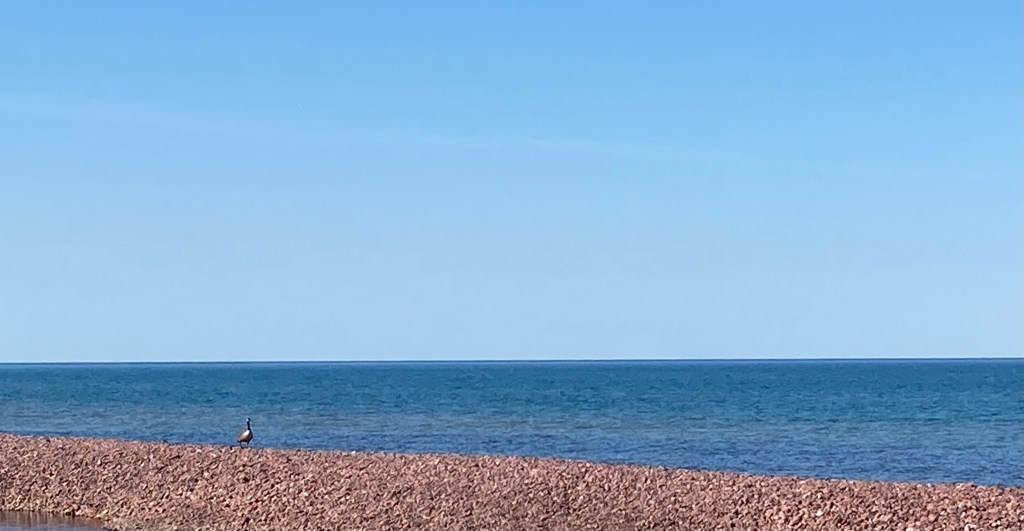
Lake Superior as seen from Eagle River

My male main character is from the UP, and my female main character grew up in the Midwest and has done a bunch of traveling, which means I can use either my normal speech patterns or the way my friends talk. I don’t have to try to make sure that someone’s always from Brooklyn, for example, because they’re from the places I know.

For me, the setting and initial situation – two characters in isolation – occurred together. I’ve never tried to put Jay and Marcy anywhere other than their rocky island out there in Superior. (Unnamed island, remember, so nobody can tell me I got the number of pine trees wrong.) It just made sense, based on my own life experience.

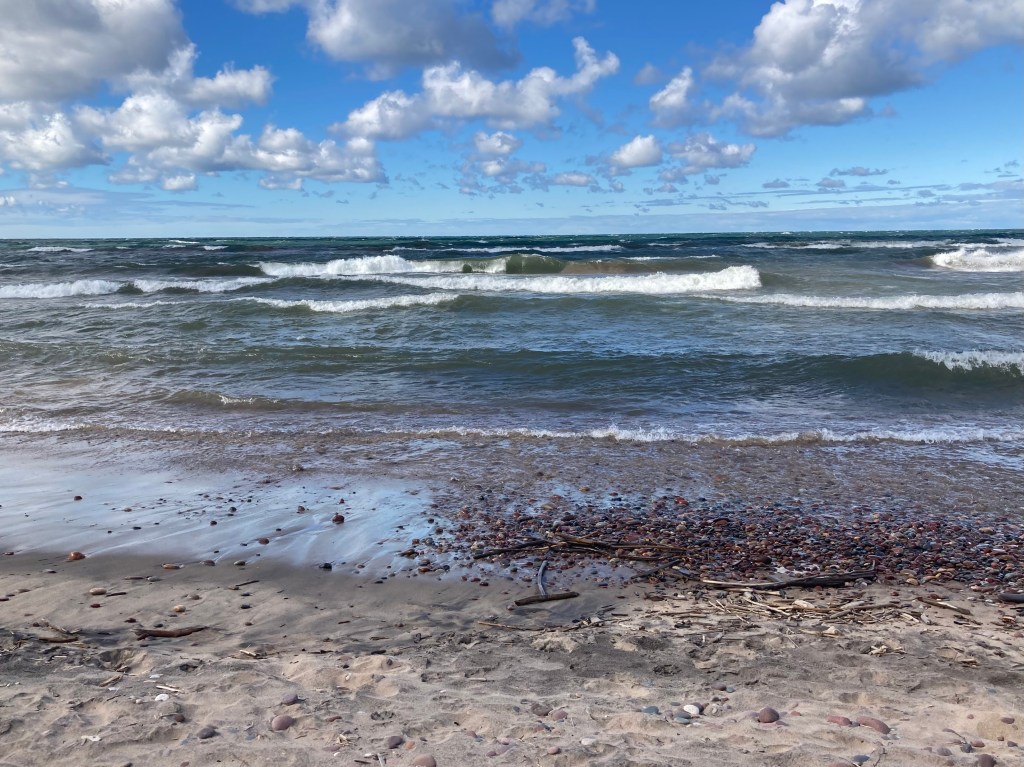
What’s been really interesting, though, for someone who’s lived in Michigan most of her life, is remember that not everyone knows what it’s like to look out over Superior. How that view can change drastically depending on the weather.

Lake Superior at Agate Beach

Superior isn’t a main character in the book, but she’s certainly a presence. They’re literally surrounded by the water, isolated because of it, and any thoughts of escaping have to take the lake into account. In Not Your Mary Sue, the setting plays such a major role in that first half of the story that it couldn’t be picked up and transplanted anywhere else.

How do you think about setting when you write? What makes your settings necessary to plot and characterization?

Do you “cast” your characters in your head?

It’s part of character building: figuring out their biographies and motivations, yes, but also their eye color and hairstyle. How they stand, sit, and speak. I spend more time on my characters than a plot outline because my usual strategy is “Put them together, give them an inciting incident, and chase after them.”

Sometimes I work up complete character sheets with all of this info actually written down, and then I do include a photo of a celebrity as a reference. At times it’s a specific screen shot from a specific role that celebrity has played, so my character is more cued in to that role than the person whose face I’m using. Other times it’s a specific expression that just captures what I’m going for. I can remember one specific character from 2012 where I just searched for “redheaded man” and found one perfect shot of an actor whose name I don’t know, with the exact expression that captured my character. Googling the actor at the time didn’t give me any other angles that really spoke of my character, but that one photo was just *chef’s kiss.*

Picking the photo – or the actor I associate with certain traits – can be key to helping me write the character consistently. In 2019, I had a character in my NaNoWriMo novel who was supposed to be calm. About everything. No matter what I threw at him. And I, myself, am not like this. So.

I picked Patrick Dempsey as my casting for that character even though they don’t really look alike. I’ve just seen Dempsey play a number of characters who are soft-spoken no matter what the situation. When things were getting exciting in the plot, I’d picture Dempsey in one of those roles saying my character’s lines, and it helped me focus on the character’s (almost unnatural) calm. It helped me get out of my own head and my own reactions and into the character who, being an immortal warlock, had little in common with me.

Or take my upcoming novel, which you’ll actually get to read. Not Your Mary Sue opens with two characters, Marcy and Jay. Marcy is a televangelist’s adult daughter, a white woman in her early 30’s. Jay happens to be the notorious Fresh Coast Killer. He’s also white and in his thirties, but … a male serial killer. That’s not within my personal realm of experience.

For Jay, I was playing with the idea of an actor who presents as someone absolutely horrible onscreen, but who is apparently a very nice person in real life. Jay is, of course, the opposite: the “nice person” is his act and the “absolutely horrible” is his real self, but it was a good jumping off point for me. I started thinking about that sort of character around the time when Sherlock and the Loki fandom were big, so you have Benedict Cumberbatch and Tom Hiddleston playing these characters who are, at best, jerks, and yet who have fans fawning over them because they’re apparently really nice people. I mean, you’ve got Loki killing 80 people in two days and Tom posing with kids for UNICEF. That contrast spoke to me.

I’ll say at this point that I haven’t done any looking into Benedict and Tom to actually confirm any of this. Their real lives, that is. Tumblr posts praising their public lives? Sure. Just this idea that they can have these two incredibly contrasting public faces, no matter what their private lives are actually like.

Jay is more Loki than Sherlock, and having that idea of someone who could present such a range of emotions – and inflict such a range of emotions on other people – helped me start sorting out his background, and his various reactions to things, and his view of himself. He had to be changeable, and secretive, and that’s got to take a toll on his mental health even before we add in the Fresh Coast Killer aspect.

I’m looking ahead to NaNo this year, and I haven’t cast my characters yet. I’m debating doing picrew versions, building them from the ground up instead of trying to find the absolute perfect actor and image. (I don’t draw, so that’s out.) I’ve got the basics – hair color, eye color, height differentials, that kind of thing – but sometimes being able to just look at a face really helps things fall into place for me and help me get into that headspace of who a character really is.

How about you? Do you cast your characters at any point in your writing process?

“Do you actually write every day?”

I’ve got a writing buddy who’s working on his dissertation, and his coach just told him that writing every other day isn’t enough – he’s never going to finish it. She wants him to write every day. Well, every weekday, at least. We’ve been meeting two hours a day, three days a week, so we’re going to start meeting every weekday morning. Which is fine, because whether or not we’re zooming, I set my mornings aside for my own work, but my dad asked “Wait, do you actually write every day?”

The snarky answer is “Define ‘writing.'”

As a process, writing isn’t solely “putting words on the page.” It’s a necessary step, but not the only one, and usually not the first one for me. There’s reading, both nonfiction research and fiction in various genres; outlining; planning; editing (and deleting); and so on. Do I try to do at least one of those steps each weekday? Yes. Does that mean I actually do them? Not always.

But I do set aside the time for it. I’ve got a two hour block open for it. Some days I know it’s not going to happen, and I ignore it. Sometimes I work on the weekends. And sometimes I put in more than one writing session in a day. For me, two hours is the optimal amount of time: long enough for me to get into it, but not so long that my concentration wanes.

The more you write, the more you’ll figure out what block of time works best for you – and whether you can trust yourself to give yourself “days off” or if you need to be sterner and make sure you sit down and do it. (I set my own writing deadlines for my dissertation and could make myself stick to them, but my office mate told her advisor that she needed someone to take a firm stand and not budge. If you know which one of us you are, you can negotiate the tools that you, personally, need so you can finish a project.)

One of the things it’s taken me a long time to accept is that there are some days when even sitting here in front of the laptop isn’t going to get me more words. Days when I need to take a break and do something else. Days when that means recharging instead of avoiding. Sometimes it’s a shorter break, and sometimes it’s an “until tomorrow” break, but the important thing is that it’s only ever a break, not quitting. I set the next writing time in my mind and let myself ignore all writing things until then.

I also do my best to write down ideas as soon as they hit, whether it’s in my little writers’ notebook or on my phone. “I’ll remember it later” doesn’t always work, no matter how big the idea seems – write it down. Make a note. On your break times, this helps you get back to whatever else you’re doing. If you’re working on one project and a lightbulb shows up for another project, you can write it down and then get back to what you were doing.

Does “getting one good idea and writing it down” count as writing for the day? I don’t know, but that’s just one place where “Do you write every day?” gets tricky.

The thing is, when I’m working on a project, or even when I’m between projects, I’m frequently thinking about it. Letting it churn over in the back of my mind. Coming up with these ideas and scrambling to write them down before I forget. Piecing things together or figuring out a way through the latest plot snarl. Sometimes this happens years later – I only finished my 2011 NaNoWriMo epic fantasy in 2018 after finally figuring out how to wrap everything up – but hopefully it’s faster when I’m on a deadline. I’ll think about characters and plot bunnies from ages ago, either to work them into a current project or to see if I can actually do something with them.

But that’s not as easy to track. It doesn’t fit neatly into my two-hour block of time, and I don’t have a word count increase to show for it. Some people might label it “useless daydreaming.” But it’s still a necessary part of the process.

If I’m going to wrap it up and try a concise answer, I guess I’d say “Yes, I write every day, but it doesn’t look the same every day.” That’s not my process. It’s changed over the years as I develop and grow as a writer, but that’s who I am now: writing every day, even if “writing” doesn’t always look like writing.

What about you? Do you have a writing schedule? What works best for you?

What we leave out when we talk about writing

I’m working on knitting a sweater right now. It’s far enough along that I tried it on to check for the sleeve length and posted a mirror selfie, and one of my friends commented that the body is a perfect fit. Which meant I made a list of all the steps I’d gone through to make sure of it. And then got me musing on knitting patterns and writing books.

Bear with me.

When you buy a knitting pattern, you get instructions on how to make the exact object in the photo, sometimes in different sizes. Let’s focus on a sweater. You choose your sweater size off the bust measurement – how big around you want to make it – and go, right? Because all the information is right there. Nyoom! Sweater!

Well.

When you walk into a store and can try on clothes, they’re sized. You know what one to start with and what generally fits, but if it’s more expensive, you’ll take it back and try it on and see how the standard measurements actually look on you. So yes, you can make a sweater following a pattern exactly – and that’s the easiest way to do it the first time – but … it’s not just about customization. It’s about apparently commonly-known tricks and hurdles that patterns often leave out.

If you’re just knitting on your own, without a community, you might wonder why the heck your armholes always end up holier than they should be. Maybe it’s just you. It takes communication with other people – people willing to show the mistakes and oopsies, even – to learn that hey, actually, lots of people have that issue with armholes, and here’s an easy trick to fix it.

Or, until you knit more than one sweater or talk to other people, you might not consider all the ways you can customize a sweater. Neck, sleeves, shaping, length … top down or bottom up … seamed or in one piece … you can adapt the things you like about a pattern and swap out the things you don’t like.

Patterns also use shorthand like “take time to check gauge” for things that actually take a lot of work. The sweater I’m knitting right now, for example: I’m not knitting the size of my actual measurements. I’ve got another sweater using the same yarn and needles (which, for the record, is very important when you’re using it to do the math) and I measured that, plus a couple other shirts I own that are similar in construction to the pattern I’m knitting (and which I like to wear), and I did a lot of math. Like … a lot. That’s before I even started knitting. But a normal knitting problem doesn’t tell you all that. It assumes you either know about checking gauge and substituting yarn, or you’ll google it on your own.

Non-knitters, you still with me?

Thinking how much gets left out of knitting patterns – how much knowledge you’re assumed to already have at the ready – started me thinking about writing advice. What do writers leave out when we’re talking about writing because it just seems so essential to us, so much like habit, that we forget we once had to learn it? Is there advice out there like “take time to check gauge” that tells you plenty if you already know what it means, but is confusing and overlookable if you don’t?

So much of writing is invisible to the reader, if the writing’s good. All of the stuff that goes behind “take time to check gauge” – measuring the already knit and washed garment in multiple places to calculate stitches and rows per inch, and then measuring clothes of a similar style that give me a good fit, and doing the math to figure out circumference, and then making sure things like armhole depth aren’t going to be completely out of whack, and remembering that my own gauge changes when I knit flat versus knitting in the round …

Do we always share all the stuff that we, personally, had to learn the hard way? (Pro tip: make the sweater that looks like the sweaters you’ve already got in your closet. You know you’ll wear it. And you won’t put in 50+ hours of work on something that looks different and you won’t actually wear.) Or do we just internalize it and think everyone else already knows it, too?

I’ve had some good conversations lately with my writing buddy and a friend of mine who asked me things about my writing, both the nonfiction and the fiction, and I’m compiling a list of those questions to answer in blog posts moving forward. Things that other people want to know, and not just the things I think other people want to know.

If you have any questions about the writing process, or things you’d like to hear me muse about, please share them! I love talking about my research, and I love talking about writing, so if there’s something you’ve always wondered or wanted to ask … now’s the time. Let’s de-mystify the writing shorthand.

(Oh, and the part about how you can change up a sweater pattern to add your favorite sleeves or preferred shaping? That also goes for writing advice. It’s not one size fits all. You pick what works for you, and maybe set some pieces aside to look at more later, and move on from the stuff that doesn’t. The more you read or talk about writing, the more options you’ll have.)