H. H. Holmes’ victims: Emeline Cigrand

Emeline Cigrand is the eleventh victim H. H. Holmes claims in the newspaper confession published two weeks before his execution. She is likely one of his real victims – not a lie created to bump up his body count.

She was also connected to Holmes long before his confession.

Emeline Cigrand was brought to Chicago to work as Holmes’ stenographer. Depending on the version of the story, Holmes either hired her through a Chicago typewriter firm, or Benjamin Pitezel met her while he was away on the “Gold Cure” for alcoholism and then informed Holmes of the beautiful secretary. Either way, it was known that Emeline Cigrand moved to Chicago in order to work for Holmes.

The story Holmes tells in his confession is the same one he sold her parents after her disappearance: that she had met a man and was going to leave him for her. The difference is that, in responding to Peter Cigrand in a letter, Holmes argued that Emeline had indeed married this unnamed man and had then moved away with him suddenly. In a second letter, sent a few weeks later, Holmes claims that the new “Mrs. Phelps” has been located and her unexplained absence satisfactorily clarified.

The Cigrands carefully examined the last letters they received from their daughter. One of them said she was going to get married, and the very last one lamented that she had in fact married a bad man and would leave him as soon as possible. Upon closer inspection, this last letter was determined to be a forgery.

The truth, at least as Holmes claims it in his confession, centers on the large vault he had installed inside his “Murder Castle.” Because Emeline had become his mistress as well as his indispensable secretary, he couldn’t let her go.

Holmes writes that Miss Cigrand stopped by on her way to her wedding and Holmes offered her a counter proposal: if she wrote a letter to her fiancé telling him that she decided, at the last moment, she could never be happy with him, Holmes would take her to another city and live there with her as husband and wife. The letter to the fiancé made it clear that it would be useless to look for her, thereby covering Holmes’ trail.

He says she was “very willing” to write the letter, except he also tells readers that, at the time he made this proposal, Emeline Cigrand was locked in the room-sized vault. The only way for her to escape it is to agree to write the letter, which she apparently did, before suffering a slow and lingering death.

It seems that, in spite of this turn of events, Emeline did not think to destroy the letter, or perhaps Holmes forged one to the fiancé the way he seems to have done with one to her family. Either way, Emeline disappeared at the end of 1892 and Holmes did not confess until 1896. He maintained that she had married and gone abroad with her new husband.

Emeline Cigrand is believed to be a “true” victim of Holmes, along with Julia Connor (and her daughter) and Minnie Williams because she was known to be his mistress. Holmes killed for money, the way it seems he killed Minnie’s sister, Nannie, but he also killed women once he had tired of them or they became annoying to him. It seems that Emeline Cigrand may have also known more of Holmes’ dealings than he felt comfortable and so, in his mind, the only way to ensure her silence was through her death.

Holmes’ bald statement that he locked Emeline Cigrand in the vault and left her there to die just increased the legend surrounding his Murder Castle and his own status as a heartless killer. While this confession may have allowed her family to gain some measure of closure, it would have also been terrible for them to read.

Breaking down the writing process

I was talking with my writing buddy last week a little bit about my process. He’s working on his dissertation proposal, I’m working on a book manuscript, and we Zoom together three days a week for two hours at a time. We chat, catch up, and then mute ourselves and get to work. It’s accountability in that I block out the time but, at the end, we can shrug at each other and say “Nope, today was awful, didn’t get it done,” and it’s fine. No consequences.

When we start, we ask each other what our goal is for that session. Mine’s usually not very specific – “I’m working on Chapter 8” – but on Friday I finished proofreading the main body of my manuscript. I rewarded myself with a gold star in my planner and, when we regrouped, the question came up: so, what’s next?

Let’s look at the gold star first: it says “editing done” because “editing done for the intro through Chapter 9 on the first pass of the draft” wouldn’t fit. But it still deserves a star because it’s necessary, and it’s finished. There are a lot – a lot – of little steps on the way to publishing a book, and if you don’t celebrate all of them, no one will.

The star also helps me visualize how I’m breaking things down into those steps. Right now I have two more on my immediate to-do list: move all the edits from the hard copy to the Word document, and write the conclusion. These can be done at the same time, jumping back and forth when one gets to be too annoying. (Usually making all the little changes, adding in the missing transitions, searching for quotes or citations, etc.)

But the point my writing partner took away from it is that not all of the steps can – or have to be – done at the same time.

Yes, reading and writing will overlap, but I don’t sit down at my computer thinking about the next seven steps. (This is something I’ve personally been working on because, if you know me, you know I’m always worried about the next seven steps.) When we Zoom for our sessions, my goal is specifically writing the next part of a given chapter.

Not researching it during those two hours. Not pausing to look something up and getting sucked down a black hole. Not even footnoting properly. Just … writing the next part.

Giving myself permission to write it imperfectly and come back to fix all that later.

I wasn’t thinking about the conclusion while I wrote each chapter. The chapter intros and conclusions come last during that step and, when I was proofreading, I was highlighting the points I need to include in my conclusion. And I haven’t even gotten around to formatting everything properly yet – I want it all there first before I worry whether my citation style is up to snuff or if my headings look right.

It’s okay – even necessary – to put blinders on while you’re focusing on a task. Setting a clear and manageable goal for your writing session (and a reasonable length for that session) is necessary and incredibly helpful. For one thing, it gives you the focus necessary to build up all the pieces you need to complete a big project. For another, it allows you to feel like you’ve accomplished things at different points along the way.

It’s not just gold stars for “They offered me a book contract!” and “I delivered the manuscript!” Those two moments are months apart, and you have to figure out a way to keep going to meet your deadline. A way to feel like you’re making progress.

I choose gold stars and a recognition of my accomplishments. How about you?

H. H. Holmes and the 27 body problem

There are many considerations that come along with being a serial killer, some of them more practical than others. One of these is “What do you do with the bodies?” In order to be labeled a serial killer in the first place, there have to be multiple victims. Serial killers therefore have to figure out what to do with the bodies so that they don’t get caught. But what are your options if you’re a nineteenth century physician living in Chicago?

One answer is, of course, H. H. Holmes’ “Murder Castle” … and that might offer up some actual solutions in the midst of all of the myth. There were at least some human remains discovered in the basement, but hardly enough to credit Holmes’ claim of 27 total victims, even if the final 4 were killed elsewhere. At times Holmes has also been suspected of buying a “glass-bending furnace” in order to cremate his victims, especially when authors like to multiply that number by a factor of 10. If Holmes used his “castle” as a hotel during the Columbian Exposition, then there are at least 250 bodies that have to be accounted for.

The bodies of his final victims – Benjamin, Alice, Nellie, and Howard Pitezel – were all found. So if Holmes didn’t bury or cremate the others, what happened to them?

  • sunk in a lake – in Holmes’ Own Story, after Holmes says Minnie Williams killed her sister, Nannie, he helped Minnie get Nannie’s body into a trunk and then rowed out into Lake Michigan and threw the trunk over.
  • sold – Holmes had, after all, been a medical student and would have known that medical schools had difficulty finding cadavers for practice. He claimed to have sold some of the bodies to “a party … whose name I withhold” and who paid him between $25 and $45 per body. (Even in his “confession,” Holmes refuses to reveal the names of anyone who supposedly helped him with the 27 murders. This mysterious party is likely still out there, buying corpses for either medical dissection or insurance scams, as Holmes wrote those words.)
  • used for insurance – Holmes claims he killed his first victim because he knew the man was insured for a large sum. He doesn’t explain how he got his hands on any of that money, especially since he gets confused in referencing his own previous stories, but presumably this man’s body had to be identified and returned to his loved ones.
  • left to be discovered – Holmes claims he killed one man after taking him out on a fishing trip. Holmes learned the man had money and presumably killed him in order to rob him. How he explained the absence of his fishing partner at the end of the day isn’t clarified.
  • self-defense – Holmes also says he shot at least one of his victims in self defense. In this case the body was quickly discovered and taken care of.

Even in his written confession to 27 murders, Holmes doesn’t always mention what, exactly, became of the bodies after he killed them. But remember, Holmes was writing in 1896. No one was watching CSI or reading true crime books. When he makes a casual mention of storing a body for months, nobody questions what state it would be in by the time he would have wanted to stage his insurance scam.

Holmes makes one nod to the realities of hiding a dead body when he admits that he selected the Pennsylvania office for Benjamin Pitezel because of its proximity to the city morgue. People in the area would be used to the smell of decomposition, so he hoped that Pitezel’s body would not be discovered until he was unidentifiable. But this raises a question: if he knew that a single dead body could alert the neighbors, how in the world was he supposed to kill over a dozen in one location without being discovered?

Holmes’ confession, lengthy as it is, still leaves numerous questions surrounding his supposed victims, and his reliability already falters because he named victims who were in fact still alive. There is no doubt that Holmes was a murderer, but not of 27 people.

Do your rough drafts ever get … less rough?

The more you write, the better you get at it – the same as practicing any other craft. And on top of writing, you can read (or watch YouTube videos, attend seminars, or buy master classes) about writing. You can get degrees and get published and all the rest, but … does there ever come a time when all the rules and practice mean that your first draft is going to come out perfectly? Well …

As my friend Bob Kubiak tweeted yesterday, “in the moment you’re working, most writing advice is forgettable.”

You can memorize all the rules – no adverbs, said is dead, pick your favorite – but, when it’s time to actually get the words on the page, that’s not what’s in your head. You’re just trying to get it down, to beat the blank space, and especially if the “rules” make you freeze … they go out the window.

Writing is hard. Even if you’re good at it and you enjoy it, it’s hard. How do you get this idea that’s here, in your own head, and turn it into words that will put the same idea into someone else’s head? How do you catch someone’s attention at the beginning and hold it all the way through? How do you make sure that there’s a clear purpose for every point, and it’s all connected with beautiful transitions?

You don’t. Not on the first round. It’s called a rough draft for a reason, and although maybe you get a little smoother the longer you write, they’re still … rough. It’s not supposed to be perfect, and if you really want to be a writer, you’ll have to learn that editing is just as important.

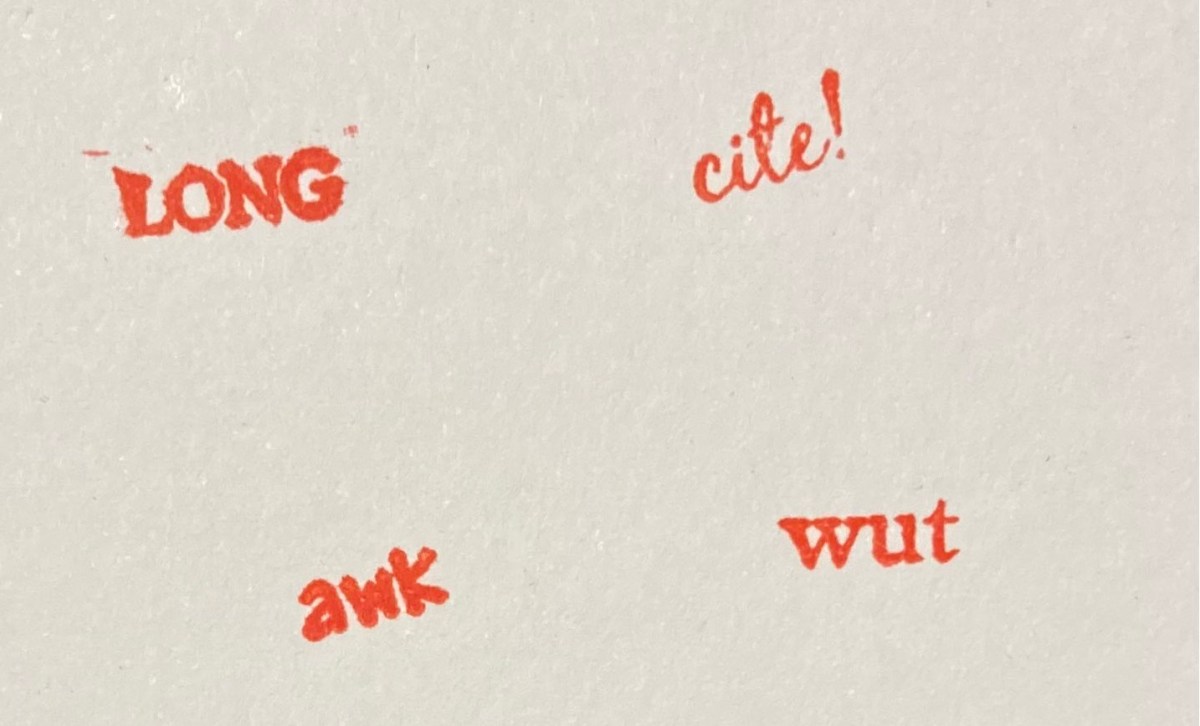
The more I write, the more I recognize my usual first-draft pitfalls. The header photo shows the self-inking stamps I bought for this round: LONG, cite!, awk, and wut. These are four things I find myself writing frequently on my first draft and correcting before anyone else even sees my writing. I’m a big fan of long, meandering sentences; saying things I don’t back up; awkward wording; and just … who even knows? In the moment, I wrote something just to keep the cursor moving so I could get the ideas down on the page, and it doesn’t make sense when I read it later.

But it’s okay. And it’s more than just okay – this is all part of the process. Writing isn’t “one and done.” You don’t bang it out and turn it in. You don’t even bang it out, skim it for spelling errors, and turn it in.

When I set a deadline for a book being due, I have to build all of this in to my personal timeline. I need the chapters drafted by this date, so I can do an initial pass and write the conclusion, but still have time to let it sit before a second pass at more of a distance. And it’s far more than just these four stamps – I’m looking for places where I latch onto a word and want to use it 20 times in a row, or places where transitions are rough (or missing), or places where I get off on a tangent and forget my point.

The function of the rough draft is, in fact, to be rough. There are going to be problems with it. The thing I’ve learned is that you can let it have problems – if you need to forget the rules long enough to get the first draft down, go for it. Give yourself permission to break every single writing rule you’ve ever heard.

Then, when you go back to edit, figure out which ones you really should adhere to.

Writing rules exist for reasons, and if you can understand why people hand out the edicts they do, you can also choose whether or not your work needs to follow it. Your edited work, of course – your rough draft doesn’t have to be readable to anyone but you, and every book or article you’ve ever read has been gone over time and again, usually by multiple people, to make sure the writing gets ideas across as clearly as possible.

Do rough drafts get a little less rough? Sometimes. But some days they’re just as messy as they’ve always been … and that’s okay. All writing has to be edited, but you can’t edit a blank page.

How do you know when it’s time to stop researching and start writing?

So you’ve got an idea and a stack of books. Whether or not your college composition class included They Say, I Say you know that writing an academic piece is stepping into a conversation, and you can’t do that without listening first. The plan is to work your way through the foundational texts and then pick up the more recent works, but how long does this part last? At what point can you stop worrying you’ve missed something important and just … start writing?

This is kind of a trick question. I’ve worded it the way a lot of people approach it: first research, then writing. Finish one line on your to-do list, and then move to the next. But, even though this is a wonderful method for procrastination that doesn’t feel like procrastination, it’s not actually the best way to approach your writing.

It’s a very good way to make sure you never start your writing.

And it’s completely understandable. Writing is hard enough without worrying that you’ve left out some piece of information that the critics will immediately grab and try to wave in your face. Before stepping into the conversation, you want to make sure that you’ve listened to all sides and you’ve got it all down. It’s a scary move, trying to make a point when you feel like you don’t have all the information.

Your first draft isn’t when you step into the conversation. In academics, as in fiction, the first draft is just you telling it to yourself. It doesn’t have to be perfect, because yours are the only eyes that will see it, until you decide otherwise. Your first draft is just for you, and you should start writing as soon as possible. It shouldn’t be research and then writing, but research and writing, happening alongside each other.

You also don’t have to pause in the middle of the page to stop and actually do that research. My first drafts include a number of things in brackets, highlighted, or both, telling me what I’m missing and what I’ll need to put in later. Sometimes it’s just tracking down a quote I know I have, but at the time I didn’t want to interrupt my writing flow to do it. Other times there’s a gap where I know I need more research, but for now I mark the hole so I know what to look for later.

Does this mean my first draft looks like swiss cheese? Sometimes. The further you get into a topic, the fewer holes you’ll have. But does it also mean I’ve beaten both the “blank page terror” and the “but when do I start writing” question? Yes, indeed

If you’re asking yourself if it’s time to start writing today, then “today” is the second-best time for you to start. The first is always in the past, so let it go, and get some words on the page. You won’t get anything published, or get anyone else’s eyes on it (the point at which you do start to join the conversation) until it’s written.

You’ll never be able to read everything on your subject. If someone catches an omission during the review process, excellent. (It also means you’ve got a finite number of pages to read to make your revisions, so don’t get tempted to fall down the rabbit hole again here.) If a critic comes back at you with this one apparently essential piece you missed, earmark that for later reading, too, but also note that this is apparently the only critique they could think of. (Is there personal experience speaking here? It seems likely.) A good review will address questions of your position and argument, and not some article the reviewer has read that you apparently haven’t.

As much sense as it seems to make to finish up your reading before you write, it’s really just a procrastination tactic. And people don’t really work like that, either: all in, and then all out. If you keep reading as you write, and keep exposing yourself to new ideas and new ways of writing, you’ll also be able to sustain longer projects without getting fatigued. (I often refer to reading as “putting words back in my brain,” which is useful, considering how many have to come out of it.)

How do you know when it’s time to stop researching and start writing? You don’t. You never will. So start writing.

The usual parts of an academic book proposal

So you’re thinking about getting an academic book published. Maybe you’re pretty confident about the writing process, but what about proposing it? There are a number of common elements in an academic book proposal, so it would help to take a moment and think about those just so you know what’s coming.

Although these are common, always (always, always) read the specific requirements of the agent or publisher you are querying. Make sure you include all the information they’re looking for, and in the format they request.

  • sample chapters – you’ll be asked to submit a number of sample chapters. It’s usually low – one to three – and, for the purposes of the proposal, the introduction doesn’t count. It’s helpful to include the intro, though, because it will show how you plan to catch readers’ attention and then how your entire book will be organized. Most academic proposals do not require the entire manuscript to be complete at the time of the proposal.

  • an index or outline – because of this, you’ll be asked to include either an index of chapter titles, or some sort of outline. Most recently I had to provide an abstract for each of the chapters I didn’t submit. This helps you really solidify what your book is going to be about, and shows them that you know enough about your subject to craft a throughline long enough to fill a book.

  • estimated length of the final manuscript – some will ask for word counts and others for page counts, so double-check before making your best guess. Contracts usually come with a range or a limit. The consideration here is writing enough to cover your subject, but not so much that the size of the book drives up printing costs toward something most people will consider to be too expensive. Your book doesn’t need to be long to be good, and you might have to narrow your focus a little if it looks like it might start to grow as you write it.

  • proposed delivery date – because you’re not submitting the entire book, you also get to tell them when, exactly, it will be in their hands. If you think this date is more than a year out, then it’s probably not the time to query. Many academic presses want to know that they’ll have your manuscript that quickly. This also shows them that you know there’s enough information out there, and that it’s accessible enough, for you to complete the manuscript.

  • proposed title – pick a good, informative title, but keep in mind that this will change. The title falls under marketing, and a lot of people will have input on it before your book is published. They factor in things like key words and where those words appear within the title, considering where a lot of internet searches cut off the display. So make it a good one, but don’t stress too much about making your proposed title perfect.

  • comp titles and your book’s nicheI mentioned this last week, but this is part of the marketing: what will be the competition for your book? Who publishes those other titles? What gap will your book fill? Basically, convince them that your book will actually sell and not simply crowd a shelf in the store. Those texts should be fairly easy to name, since you’ve been immersed in the literature as you plan writing your book, but it’s not something many people are used to writing.

  • ideal audience – who is going to want to read your book? Are there specific college classes that will reach for yours instead of whatever’s currently on their standard list? Not everyone in the world will want to buy your book (sorry), but they’ll want to know that the interested group will be large enough to make publishing worthwhile.

  • a list of possible peer readers – if you don’t need peer review, or the publisher doesn’t require it, you won’t have to do this step. If it is needed, then you’ll provide contact information for the requested number of possible peer reviewers. They need to be people with whom you don’t have a personal or professional relationship, in order to preserve the purpose of the peer review process.

  • whether this manuscript is under consideration by any other publisher – it is rare these days to see bans on simultaneous submission due to the length of the process and the fact that “publish or perish” means not being able to sit around and wait for each possible publisher, in turn, to get back to you. If you do already have someone interested, dropping that into the proposal might catch the attention of a publisher you think could be a better fit for the book. If this is the case, include the deadline by which you have to get back to the interested party.

  • any pertinent information about yourself – this is where you can name your credentials and past publications. It helps position you as the expert on your topic and shows that yes, you have experience working with getting feedback on your writing. This is especially useful if you’re querying an agent, who will want to know that you’re familiar with the process of revision and the idea that the document you deliver is not already perfect and can, in fact, be improved.

No matter which path you go with proposing your academic book, make sure to read the submission guidelines in full before delivering the requested documents. Chances are good you’ll have to provide all of the above information in form or another – the submissions page will tell you how many documents to submit and, if they prefer them to be labeled in a specific way.

The submission process itself is a long one and involves a lot of waiting to hear back to find out whether your proposal has been accepted. You want to make sure that the packet you send out is the best you can make it and addresses all the questions the publisher asks, so you’re not caught up in a back-and-forth as they request it again. Make sure you look over the submission requirements carefully and go down each publisher’s checklist, giving yourself enough time to think about the answers to each of these areas.

Writing the proposal is very different from writing the book, and you need to spend enough time thinking about it, too, the way you do with your manuscript.

So you want to write an academic book proposal

Academics are used to proposing things: special topics courses. Conference presentations. Chapters for edited collections. To an academic, “CFP” means “call for proposals.” We’re used to the idea that we need to sum up our ideas and present them to a group of peers for approval before moving forward.

A book proposal, though still a proposal, is a different genre.

Most of the proposals we write are short. The people reviewing it don’t want to read more than, say, 300 words. We’ve learned to summarize the main ideas while invoking the proper number of references and making ourselves sound both smart and intriguing given a small amount of space. It’s enough to prove to strangers that we can speak on a topic for 15 minutes or give them a 5-7,000 word chapter by the given due date.

A book is, of course, a much longer project, and the purpose of the proposal can be a shift, especially for academics not used to writing things like grant proposals. You’re no longer arguing solely that your research is relevant and interesting, or that you’re an expert able to coherently and intelligently discuss your topic. For a book proposal, you need to shift your thinking slightly and consider facets of marketing.

When I was in graduate school, one of my professors, Bob Johnson, was telling us about the process he went through to propose his book Romancing the Atom. The part he stressed was how it was up to him, the author, to show the niche his book would occupy in the market. He told us that he had to provide the titles and authors of books that were similar and could be seen as competitors to the one he was proposing.

Granted, this shouldn’t be too difficult for scholars who in fact do research in their own field, but it’s a shift from reading books to add to your own argument toward thinking of those books as competition. This is especially true if someone who’s a big name in your field, and whom you may have met, has recently come out with a book: now you have to say why your book, written by a newcomer, would be chosen over this other one by an established researcher.

The publisher wants to know why your book is unique. This means you need to be able to set your idea apart from the others – while still connecting to the field and remaining in conversation – and to tell them why, exactly, people will buy yours instead. What is it about your book that makes it special, aside from the fact that you’re the one writing it? What gaps do the others leave that yours might fill?

We’ll get more into the usual parts of an academic book proposal next week, but this tends to be the main sticking point and the biggest new thing. Market my work? No, no – I just write a short proposal and then go talk about it. Journals have subscribers who are already interested in the sort of content that will be selected to be included, but this is a step taken by the editors of a book collection, too: does this chapter idea fit with the others? Does it make the point we want to make?

Is it the sort of thing someone would see and then want to buy?

But, come on – can’t the publisher have someone do all that work? If it’s marketing, isn’t it their job instead of mine?

Sorry, no. As the expert in your field, you’re the one best positioned to argue for how your work will fit and what new things it offers. The publisher takes care of a lot of things, but making these points in the proposal is really an argument for them to take the risk on your and your book. If they offer you a contract, they’re committing to the costs and hours involved in publishing your book, and they want to know that it’s worth it to them.

So: if you’re thinking of proposing an academic book this year, start also thinking from the side of marketing. Who’s going to buy your book? What does your ideal audience member look like? What classes might want it on their required reading lists? And why should they reach for yours instead of others already out there, either by the same publisher or a competitor?

New Year, Same Me

So it’s the time of year when we’re all supposed to be setting new goals, and they really should be SMART ones: Specific, Measurable, Achievable, Relevant, and Time-bound. My husband is really good at this kind of thing and ends up with a whole list of proposed achievements for the new year, and he’ll check in on them and adjust as the months go by. Me? Eh …

Making up goals for a whole year gives me the same sort of feeling I get while looking at a syllabus: I’m supposed to do how much in how long? Even if I’ve taught the class before and I know it’s very much doable, it just seems ridiculous. Insurmountable. After all, how am I supposed to accomplish all this when I’ve never really done much of anything before?

With that attitude in mind, my only real goal for 2021 is to keep better track of what I do accomplish. My husband is better at this, too: he’s been keeping a journal of accomplishments for years at this point. I tried last year, in a blank book, but didn’t keep it up. I felt like maybe I was padding my days (I wasn’t) and worried I might forget something or leave things out (I probably did). But I also had a discussion with someone the other day that made me realize it’s important to at least keep track of my writing progress.

If you don’t have a mentor or someone in your life who’s done it and is therefore able to remind you of how far you’ve come, it’s easy enough to forget. When you’re living it, it doesn’t necessary seem easy, exactly, but come on. If I can do it, surely anybody could do it … right? So what you really need to do is remind yourself that this thought is in fact … wrong.

I’m using my planner as a place to keep track of how many words I write during a session (instead of random notebooks kept haphazardly to prove to myself I’m actually doing something) and to just … keep track of the things I do in fact accomplish. To remind myself that I’m not just a lump on the couch and that, on days when I am, it’s because I’m resting from everything I’ve already done.

How about you? What are your goals for 2021?

Taming the Inner Two-Year-Old

Sometimes trying to write feels like wrestling an angry two-year-old, except you’re the two-year-old. You’re cranky, and distracted, and you’d really probably like to have a snack right about now. The problem is, if you’re writing toward a deadline, you also have to be the adult.

The adult is the part that reminds you of your due dateand your daily goal. The part that points to the calendar and calculates what your new daily goal would be if you slacked off. The part that wheedles and begs … but also the part that can find ways to appeal to the two-year-old inside you.

The other day I was telling someone that things have to be Just So when I’m writing. It’s not a ritual, exactly, but an acknowledgement of my inner two-year-old. The toddler inside my head will take any reason to stop working and give up on something that’s too hard, or will just get distracted by anything else. So I’ve developed a number of things to keep myself focused so, as much as possible, the toddler has nothing to grab onto.

Instead of getting frustrated with myself for not being able to focus in a certain way, I’ve figured out a number of workarounds. It’s one thing to get frustrated with a kid who doesn’t want to do something, and another to try to figure out why the kid is being so stubborn. In these cases, I’ve chosen kindness toward myself and have purposefully organized my writing space and process to give myself the best chance. Weird, right?

Take these sheet protectors. I totally got them for Christmas and I am thrilled because I use them a lot. I like printing things off and having them in front of me so that my screen can be devoted just to the document I’m writing – fewer clicks and fewer distractions for the toddler – but I discovered a while back that I have this thing about writing on what I’ve printed. If it’s notes, I don’t want to do it. Making marks just messes things up.

Enter the sheet protectors. I don’t know why they work for me, but they do: the marks go on the sheet protectors, so I can still color-code to my heart’s content, but the original notes remain unsullied. It’s weird, sure, but it’s a step that I know happens to work for me.

Or how about this one: some days I start with a blank document, and it actually helps. Most days – and for a lot of people – the huge amount of white space is paralyzing. The flashing cursor just counts off all the seconds you should have been writing, but haven’t yet. But, on my worst days, I feel like adding to the original document would be like writing on my notes: sullying something that might not have been perfect, exactly, but isn’t going to be made any better by my current ramblings.

So, on those days, I open a blank document and release myself from any sort of expectations. They don’t even have to be titled properly. I’ve got one called “written doodles” that just worked for me because clearly it didn’t have to be great. They were just doodles, after all. Just me, trying to get my thoughts in order.

Other times it’s the room itself: the proper chair. Background noise, or silence. A better playlist. Turning on a space heater or opening a window. When I’m at my crankiest, I have to tend to all of these things first and make myself as physically comfortable as possible so that my thoughts can then focus on something other than “I’m hungry” or “The tag on this shirt itches.”

You don’t have to power through that kind of stuff. Writing is hard enough as it is without giving yourself more hurdles. The longer you work at it, the more you’ll discover your own little quirks and be able to tackle those straight off, building up your writing space and priming yourself to be as comfortable and distraction-free as possible.

Be nice to your inner two-year-old. Sometimes they really know what they’re doing.

H. H Holmes’ victims: Dr. Robert Leacock

Every serial killer has to start somewhere. The “serial” part means they had to keep going, eventually, but there’s always a first. For H. H. Holmes – at least in his newspaper confession – his first victim was a former medical school classmate, Dr. Robert Leacock.

Holmes attended the University of Michigan for medical school and did indeed graduate. Although “H. H. Holmes” wasn’t his real name, the MD was earned. Many sources trace his murderous intentions back to medical school, where he has also been accused of participating in grave robbing in order to have cadavers on which to learn. This also led to questions of whether enterprising medical students – or those looking to make money off a sale to a medical school – might murder in order to provide the students with learning material.

In his newspaper confession, Holmes actually says very little about Dr. Robert Leacock. He dismisses the murder because it “has been so often printed heretofore” and quickly moves on to the lament that, “like the man-eating tiger of the tropical jungle, whose appetite for bloodlust has once been aroused, I roamed about the world seeking whom I could destroy.” That’s all very dramatic, but it doesn’t tell us much about Leacock.

Earlier, in Holmes’ Own Story, Holmes had written of a previous insurance scam he had run in order to somehow prove that he could not, in fact, have murdered Benjamin Pitezel in a similar scam. The few details he gives about Dr. Robert Leacock’s murder do not quite line up with the information provided in Holmes’ Own Story but, since each is most likely a lie, that’s understandable.

But what’s the tale of the insurance scam he supposedly committed with his former schoolmate?

More than a decade before Pitezel’s death, Holmes supposedly decided to fake his own death using a lookalike cadaver in order to reap the insurance money. (He says that his wife would have been the one to inherit, but his third wife – the one he claimed at the time of the trial – hadn’t even met him yet. Apparently no one caught this inconsistency before his book went to press.) In this version, however, Holmes simply waited for someone to die who would look enough like him to count. He didn’t, according to the book, kill anyone for this scheme.

He also didn’t prepare very well. Holmes wanted to take the lookalike body north into Michigan and leave him, head crushed and with Holmes’ papers in his pockets, to be found and identified. Although Holmes should have had plenty of experience with both cadavers and decay during medical school, he planned poorly for transporting a body secretly by train.

It turns into a whole comedy of errors. The first trunk Holmes had specially made began leaking ice and odors, forcing him to stop and buy a new trunk. It couldn’t be seen to be empty, though, so while the shopkeeper prepared the trunk, Holmes walked back and forth with lengths of pipe he had also newly purchased in order to fill it. Then, when the new trunk was delivered to his hotel, he could pretend that it was full of his belongings.

It didn’t seem to occur to him that anyone involved in this various transactions might notice the oddity and remember him.

While apparently lost in a reverie, contemplating the lookalike corpse who was reclined on more ice in the room’s tub, Holmes’ room was invaded by detectives or secret service men or someone just that exciting. Using lies – common for Holmes – and threats (less common) he managed to get himself out of the initial situation, claiming the dead man was his brother. When Holmes left the hotel, though, he knew he was being pursued. (He was, of course, both interesting and cunning enough that any secret service agent would want to follow.)

Unfortunately for Holmes, the train he took ended up having an accident, delaying him just long enough for the secret service agent to catch up. Holmes did not flee the scene, leaving his suspicious luggage behind. No – instead he put his medical degree to use and cared for fellow passengers who were injured in the crash.

Perhaps since the secret service agent was alone this time, Holmes was able to bribe him, and therefore continue his way north with his smelly, sodden trunk. Holmes sums up the tale quickly by explaining that, a few weeks later, his plan went off exactly as he wished, and he walked away with the insurance money. (His wife, whose presence was never fully explained, is forgotten.)

Later he apparently gifted the trunk to friends who laughed with delight when he told them the tale, because they had always thought it was haunted.

Right. So.

Clearly there are a lot of problems with this story. For one thing, according to Holmes’ Own Story, it should have taken place in the early 1880s. Although he would have indeed been married to Clara (Lovering) Mudgett at that time, during the summer of 1895, when Holmes’ Own Story was published, Holmes was insisting that he was married to Georgiana Yoke and that he had never married another. This was because Georgiana was a witness in his murder trial and, if it were proven that the marriage were bigamous, she could indeed testify against him. Holmes married three women in his lifetime without ever divorcing any of them, and all three were still alive at the time of his death.

There is also the question of the insurance money. Different amounts are stated in Holmes’ Own Story and in his confession to the murder of Leacock. If, for example, Holmes had managed to get his hands on the $40,000 he said came with Leacock’s death, what happened to it? Where was it spent? Holmes never clarifies, and he never explains how he ended up with the money from his own apparent accidental death.

The story as originally told is meant to explain that Holmes, although a rogue, is not a murderer. He waited for a body that would look enough like him to be brought to the morgue rather than searching out his own double and then, even once he started to put his plan into practice, he made a mess of things. Far from being a slick and confident criminal, the Holmes in the original story made mistakes at every turn. He only managed to pull of the scam by bribing someone to look the other way.

It did make for a good story, though, so it also makes sense that Holmes’ confession would reference it. He dismisses a number of people in the same way, but arguing that much has already been written about them, without ever actually clarifying what happened, or how much of what has already been written is true.

Did Holmes actually murder a man named Dr. Robert Leacock in order to fake his own death and reap the insurance benefits? No. This is one of his false confessions, albeit one that may have helped boost sales of his book if by chance some curious reader had missed the adventurous corpse, trunk, and secret service man story.