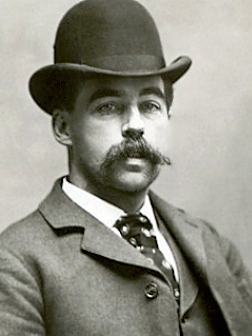
H. H. Holmes’ victims: Minnie and Nannie Williams

H. H. Holmes – born Herman Webster Mudgett – was hanged after being found guilty of a single murder: that of Benjamin Pitezel. But, as we have seen before, Holmes himself confessed to 27 different murders. (At least, for one newspaper publication.) Who, then, did he confess to murdering?

Minnie Williams plays a large role in most variations of Holmes’ stories. As far as anyone can tell, the truth is that she met Holmes and was convinced to come to Chicago with them and then sign her inheritance over to him before he murdered her. Holmes also used her to lure her sister, Nannie, to the big city around the time of the Columbian Exposition, and Nannie also disappeared. The real Minnie was rather naïve and fell under the spell of a clever con man.

Holmes, though, tells us multiple different stories about her.

In Holmes’ Own Story, his autobiography published before his murder trial, Holmes takes a lot of the accusations that have been leveled at him and turns them to Minnie. Rather than an innocent, Minnie comes to Holmes already having had lovers. In this version, she is the one to pursue him, even getting an apartment where the two of them can live together apparently as husband and wife. This was, according to Holmes, all Minnie’s idea.

When Nannie came to visit, she stayed in the guest bedroom of this apartment. Minnie had to be away for one night and asked her “husband” to keep Nannie company. Nannie, however, insisted that she was fine, so Holmes spent the night elsewhere. When he returned the next day it was to find Minnie already there, standing over Nannie’s dead body. She had come home, seen that the only bed slept in was Nannie’s and assumed her husband had spent the night there, as well. According to Holmes, Minnie killed her sister with a single hot-blooded blow.

Holmes helped Minnie get rid of her sister’s body – by putting it in a trunk and sinking it in Lake Michigan – and then told Minnie he never wanted to see her again.

For her part, Minnie left to seek treatment for her mental health, which explained why her relatives were not able to contact her. She was, of course, ashamed of what she had done.

Luckily for Holmes, though, Minnie seemed to gather herself together enough to be schoolmistress to the three Pitezel children he had collected. (You remember the strange journey he took them on.) In Holme’s Own Story, Minnie Williams was a member of one of the groups, traveling with the children and eventually taking them out of Holmes’ care and away with her to England. She, of course, had to hide because she’d murdered her sister. At one point Holmes ordered a coded message to be put in the newspaper, asking Minnie to reveal herself and the still-living children.

Most of the way through the book, however, Holmes comes to a different conclusion. It seems that Minnie returned to him with a new lover, a Mr. Edward Hatch, who looked very much like Holmes himself. Hatch was the one who in fact murdered the children, but, according to Holmes in this instance, it was done at Minnie Williams’ own bidding.

Holmes speculates that Minnie Williams, a woman he had apparently rightfully scorned, was madly jealous of Holmes’ recent marriage. In order to destroy Holmes’ life, she plotted with her lookalike lover to get Holmes framed for the murder of the children. (Why she had Hatch hide the children’s bodies so well if she wanted Holmes to be clearly known as a murderer is not exactly explained.)

Minnie Williams, therefore, becomes not only a loose woman and guilty of her sister’s murder, but is now the mastermind behind the deaths of the Pitezel children.

In his newspaper confession, when Minnie and Nannie Williams become two of Holmes’ 27 murders, he does at least attempt to undo the damage he has done to Minnie’s reputation. He wronged her not only through murder, but through all the lies he told about her afterward.

Minnie and Nannie Williams become murders 20 and 21 in this recitation, and Holmes heaps on the emotion when he does what he can to clear Minnie’s name. Now she was a “virtuous woman” before he met her, and she was never once “temporarily insane,” especially since it was Holmes, and not Minnie, who had killed Nannie. Once Holmes had various signed documents, he killed her, although he does not specify how. Nannie Williams, according to this version, died locked in the giant safe in Holmes’ murder castle.

Although not all 27 victims Holmes listed in this confession were in fact dead – and some were likely made up completely – Minnie and Nannie Williams are two who very likely died because of Holmes and his greed. Holmes had the habit of using people for all he could get from them, and then disposing them so they could not reveal what he had done. Once the Williams sisters had given Holmes what he wanted, he very likely did murder them

How do you get back to a writing project you haven’t worked on in a while?

November is National Novel Writing Month, and I’ve participated every year since 2010. The goal is to write 50,000 words during 30 days, and it’s geared toward fiction. By the end of the month you should have a large chunk of a first draft of a novel. Which is awesome, and I love the community and everything that comes with it, but … academic work? What academic work?

It hasn’t been a whole month since I’ve worked on this project, but it’s been a good couple of weeks. So now I have to pick it back up, and recalibrate my brain to academic writing instead of fictional fantasy, and remind myself of what, exactly, I said I’d write in the first place.

So the good part: Past Rebecca wrote up a book proposal. Academic book proposals don’t usually include a full manuscript – it’s “just” the intro and a sample chapter or two – but they do include a full outline. It’s something I really don’t like doing at the time, but I rely on it a ton as I’m working on the book. For this project, I not only had to submit chapter titles, but also a quick summary of what each chapter is about. The framework is there.

Before this break, I’d also compiled my notes for each chapter. I like to print them out so I have have them next to my laptop while I’m writing. They’re not entirely organized the way I need them for each chapter, but they’re all present and accounted for, so I can highlight the most important things and then cross them off as I use them.

I’ve even got my little tabs so I can switch to a different chapter if the muse is being difficult. (That’s a good way to get your words in for the day – switch to a different section. You paint yourself into a corner by the end and have to write the more difficult bits, but by then you’ve got so much of the project done that it looks like such a small hurdle. Or so I tell myself.)

But then the new problem I give myself is that I have various files for various chapters but, especially after a break, I don’t remember what chapter is in what step of the process.

So I started off my day with arts and crafts. I figure I’ll use this again, so I’ve got my foam board divided into sections with labels across the top: not started; notes exist; barely begun; mostly there; needs another look; integrated (into the whole book and not just as a stand-alone file); and ready for a final read. These are all chosen based on what I know about myself and my writing process, so you could easily have more or fewer, depending on how you work. 

The chapter numbers, plus a quick reference word or two, are on sticky notes that can be moved from column to column. (I’ve made all the sticky notes one color because there are times I’m working on multiple projects, so … there might need to be another color added if, for example, my chapter proposal for an edited collection gets accepted in January.)

This helps me step back and take a look at the forest instead of my trees (or, in the case of paragraphs, individual pine needles). Nine chapters, plus intro and conclusion, feels a lot more manageable than “Okay in this chapter I need to discuss three books, but this one has fourteen, and this other one over here …” It also helps me remember which chapters have been completely abandoned in search of inspiration and which still need just a little something before they get integrated.

Some days it’s also easier to focus on the small thing: today, I’m going to move this chapter from “notes exist” to “barely begun.” (That’s actually my goal, although I’ve already put Chapter 5’s sticky note into the other column. It’s only jumping the gun if I finish this blog post and then don’t work on chapter five.)

It may look a bit like silly arts and crafts, but it helps remind me of the scope of the whole project, and how much I’ve already done – and, perhaps most importantly, it reminds me of all these cool ideas I’ve had that are worth the struggle to actually write down.

What does it look like when you come back to an older project?

Why I write about serial killers

“How did you get interested in serial killers?” Let’s face it – that’s probably the most common question I get asked once people learn what I do. At least it’s one I actually have an answer to. And even a specific date for.

I was in London in July 2007. My mom was helping me plan the trip and I told her that I had to be there on July 20, because Harry Potter and the Deathly Hallows came out at 12:01am on the 21st. I stood in line, got my book, and made sure to read all of it before leaving my hotel room in the morning, just to make sure I wouldn’t run into any spoilers. Except then I didn’t have anything to read.

I took the underground to the zoo but for some reason on my way back the station I’d used was closed. There was a sign directing people to the next station, and that street took me past a bookshop. (Not there one where I got Harry Potter – that was at King’s Cross Station.) I went in and decided to look for a book about Jack the Ripper, since there were advertisements everywhere for Ripper walks and the like, but they all started after dark. I didn’t feel like trying to find my way back to the hotel that late, all by myself, so I figured hey, let’s see if they have a book.

I ended up asking if they had any books about Jack the Ripper – silly question – and I got directed to an entire bookshelf. I’d been hoping for, I don’t know, a couple books to choose from, instead of a couple dozen, and was honestly stumped. I’d already been given a bit of a long-suffering look when I’d asked if they had any books, so I decided not to ask again. I pulled out the two thickest books and arbitrarily chose Philip Sugden’s The Complete History of Jack the Ripper.

It’s not a small book, and not quick reading. I had it done in a matter of days. And I’d bought my second Ripper book before leaving London. By the time I’d signed the contract to write Ripper’s Victims, I owned around 40. That book cites about 80. At last count, thanks to an app on my phone that helps me keep from buying doubles, I own 120. And those numbers are just for single-subject book-length accounts of the Ripper crimes. (For comparison, in that same app, my general “true crime” bookshelf has 187 titles listed.)

Almost every bookstore has a true crime shelf. It’s the one genre I routinely seek out when I go into them, and the one genre where I still prefer to have paper copies instead of eBooks – it makes citations easier, and it’s easier to scribble notes in the margins or flip back to find that one special quote. When I start organizing an idea I’ll pull books out and reorganize them, grouping certain ones together as a visual representation of my ideas. Plus it’s just cool to have so many bookshelves full of my research.

So how did I get interested in serial killers? I was in London for the ending of Harry Potter, and it turned out that the next book I picked up marked a new beginning.

Ripper suspect: Lizzie Williams

Most serial killers are expected to be men. Female serial killers, the FBI lectures us, tend to use bloodless methods of murder, such as poison or strangulation. Jack the Ripper, therefore, is highly unlikely to have been a women. although the idea was indeed around at the time of the murders. More recently, John Morris has accused not just a woman, but the wife of a man who has himself been named as a Ripper suspect.

Born Mary Elizabeth Ann Hughes, Lizzie married Dr. (later Sir) John Williams in 1872. John became a private doctor to the royal family in 1886 and was named as a Ripper suspect in 2005 by one of his own descendants. Tony Williams and Humphrey Price claimed that John’s missing diaries from the time surrounding the murders meant that he, personally, had been the Ripper and did not want to leave a record of his activities.

In 2012, however, John Morris decided to take things a step further: the diaries are missing, he argues, because they contain John’s worries about his wife, Lizzie, who later confessed to him that she had in fact been the murderer.

The argument here is that, after a childhood of being spoiled and given everything she ever wanted, Lizzie found herself in a childless marriage. Sir John is meant to have decided that the problem lay with his wife, so he sought out another woman to provide him with an heir. He happened upon Mary Jane Kelly, a poor East End sex worker who had at least proven herself fertile because she already had a son, and John embarked on an affair.

Lizzie, having discovered this, flew into such a fit of rage and jealousy that she embarked on an entire murder spree. She’s supposed to have killed the first three of the Canonical Five victims in order to simply prove to herself that she could indeed murder a woman – although why she’d want to practice on women who had done nothing to her isn’t entirely clear. Really, to make this work, there needs to be some sort of explanation as to why she didn’t just go murder her husband’s mistress, since other women died prior to Mary Jane Kelly.

Morris argues that Lizzie, having made certain that she could wield a weapon – perhaps her husband’s own scalpels – somehow tracked down Catherine Eddowes, heard her give the name “Kate Kelly,” and mistook her for Mary Jane Kelly. This is Morris’ explanation for why Catherine Eddowes was so horribly mutilated following her murder: Lizzie used a knife in a fit of feminine pique and wanted to ensure that her husband would never find his mistress attractive ever again.

It also explains the long pause between the murder of Catherine Eddowes and Mary Jane Kelly: Lizzie, upon discovering that she had murdered and mutilated yet another innocent woman, was taken aback and needed some time to regroup. Was she steeling herself for yet another murder? Upset that somehow she was now a multiple murderer and hadn’t yet even worked her way up to her true target? Whatever the reason, Lizzie was still able to take herself in hand in order to murder and mutilate the woman who might have, in time, given her husband the child he wished for.

After which Lizzie did in fact have a mental breakdown, confess the murders to her husband, and throw herself on his mercy (while perhaps blaming him for a bit that she was forced to become a murderer in the first place). John destroyed his diaries, saw that his wife got a rest cure, and the Williamses were safe from suspicion until the early 2000s.

We all know about hell’s fury and women scorned, and Rudyard Kipling would like to inform us that the female of the species is indeed more deadly than the male, but what do you think? Are the Ripper murders really the result of a woman seeking revenge against her husband’s mistress?

But what does it actually mean to “kill your darlings”?

It’s a common piece of writing advice that is frequently attributed to William Faulkner: “In writing you must kill all your darlings.” And it sounds cool – a little bit of murder, a little bit of love. But … what does it really mean? Is it just for novelists who need to off their favorite character somewhere within the story?

That’s the most common misinterpretation of the advice: that it calls for a literal – or at least literary – death. That aspiring authors need to read up on fight scenes or medical terminology and autopsy reports. That well-loved characters need to be offed and then mourned, perhaps in the spirit of reaching a word count goal. It’s actually a bit more brutal than that.

Your darlings are the things that make you not want to hand over your work to an editor. The parts you know you’ll resist changing, even if the comments come back and make it clear that no, this won’t be publishable until you do. The words, phrases, or ideas you’ll cling to because yes, this does indeed seem like a fine hill to die on, thank you very much.

Sometimes the comments you get back tell you about other people’s darlings. I had a manuscript returned that asked me to get rid of every single instance of “Therefore.” There were only two, but someone, somewhere, had killed this person’s darlings in the past and it was a lesson he remembered. Therefore (I know, I know) he had to make sure no one else allowed his darlings to live.

Other times it’s a lot harder than searching your document for a single word and finding substitutes. Your entire proposal can be a darling, and it can be rejected outright. Or, of course, there’s “revise and resubmit” in which you’re confronted with a list of changes, and you have to get out your ax. Or at least your red pen.

It’s a balancing act. Clearly whatever you wrote will not be published at this venue exactly as it is, but presumably you want to see it in print there, since you submitted it. Usually, upon first read-through of the comments, some of them even seem reasonable. They might feel like easy changes. Yes, of course I can do A, B, and C. A change here, a tweak there, and you’re working your way down the list exactly like you’re supposed to. Until …

Your darling.

Now, you don’t always have to accept and implement the comments and suggestions with 100% agreement. There is space for a conversation here: I understand where you’re coming from, but I made these choices for this reason. But, more often than not, there’s still some sort of issue that has to be changed. The sticking points where you’ll just be told to revise and resubmit again – or take it elsewhere because clearly you’re refusing to play the game according to the rules – unless you do something about it.

That. That’s your darling.

I, for one, am a fan of copying and pasting my darlings into a separate document where I can pretend they live out a happy life. On a farm in the country, perhaps. Where I could totally visit, if I really wanted to. And where they can live on, unchanged, while I negotiate the feedback and do my best to keep my ego in check (because just look at how darling my darlings are!).

Kill off your characters if you have to, but they’re not your only darlings.

What about you? Do you know your own darlings? Are any of them absolute sticking points?

Ripper Suspect: Charles Allen Lechmere

Last week we talked about one of the oldest named Ripper suspects, Montague John Druitt, who died via an apparent suicide in late 1888. Named by one of the men involved in the Ripper case, and refuted by another, Druitt is frequently mentioned but not often actually accused of having been the famous murderer. Charles Allen Lechmere’s name is a more recent contribution to the hundreds of Ripper suspects, and although he might be a better choice than Druitt, his guilt is impossible to prove.

Lechmere enters Ripper lore under the name Charles Cross, a meat cart driver who discovered Mary Ann “Polly” Nichols after her murder. According to recorded testimony, Lechmere was passing Buck’s Row on his way yo work around 3:40 am on August 31, 1888, when he saw a woman lying on the ground. Another man, Robert Paul, also on his way to work, saw Lechmere, who immediately called Paul over. The two men didn’t see any blood or mutilations and left Polly Nichols where she lay, reporting an apparently drunk or unconscious woman to a constable they found on the way.

At the inquest, Lechmere gave his name as Charles Cross, using the surname of one of his stepfathers, and that seemed to be the end of it. The testimony of “Charles Cross” helped establish the likely time of death, and “Cross” and Paul both testified that they saw no one else in the street. The inquest verdict was willful murder by person or persons unknown, and that was the end of it.

Until 2014, that is, when the documentary Jack the Ripper: The Missing Evidence named Lechmere as a suspect.

Journalist Christer Holmgren and criminologist Gareth Norris build the case against Lechmere, starting with the fact that he did indeed give a false name. They were able to connect “Charles Cross” to Charles Allen Lechmere and find more information about this apparent witness. Tracing “Charles Cross” had proven futile, but information about Charles Allen Lechmere seemed to point toward likely guilt.

Holmgren and Norris make use of geographic profiling in their argument for Lechmere’s guilt. This is a newer method that relies on psychological information about serial killers, combined with the locations of their crimes, to help make predictions about future murder locations and the killer’s “home base.” It involves questions of how far a killer would willingly travel in order to commit a crime, while still feeling relatively safe because he knows the area, as well as marking an area closer to the killer’s home as being unlikely for future murders. To oversimplify, a killer’s “hunting range” looks vaguely like a donut shape, with his home in the middle surrounded by an area of inactivity.

This range, though, is affected when a killer becomes comfortable in new areas. A man who has moved around a lot as a child knows multiple neighborhoods. One who has to walk a distance to get to work learns still more. A killer’s comfort zone expands as his life develops and he moves through more of the world, leaning which areas would be “safe” for him to kill in.

lechmere2Holmgren and Norris not only point out that neither Lechmere – seen here in a photograph from 1912 – nor Paul mentioned seeing any other person in Buck’s Row, even though the murderer must have still been nearby, but map out Lechmere’s life against the murders of the Canonical Five and a previous victim, Martha Tabram. Each of these sites corresponds with Lechmere’s walk from home to work in the autumn of 1888, or to previous homes his family occupied, or earlier jobs he had.

They theorize that Lechmere was not merely bending over an unresponsive woman’s body when Paul spotted him, but was actually interrupted in the middle of the Ripper’s trademark mutilations. Lechmere, according to Holmgren and Norris, attempted to cover his tracks by first pretending to discover Polly Nichols’ body, and then by giving a false name.

Beyond this, though, there is nothing to either link Lechmere to the Ripper or to prove that he conclusively could not have been. The documentary argues that Lechmere would have known the area, yes, and can place him at the scene shortly after one of the murders, but the Ripper’s identity is still unknown – and, 130 years after the murders, we’re still pulling out new names and trying to assign guilt.

The Craft of an Index

It’s one of the last steps needed before a nonfiction book can be published, but it’s also tedious … annoying … and incredibly necessary: the index.

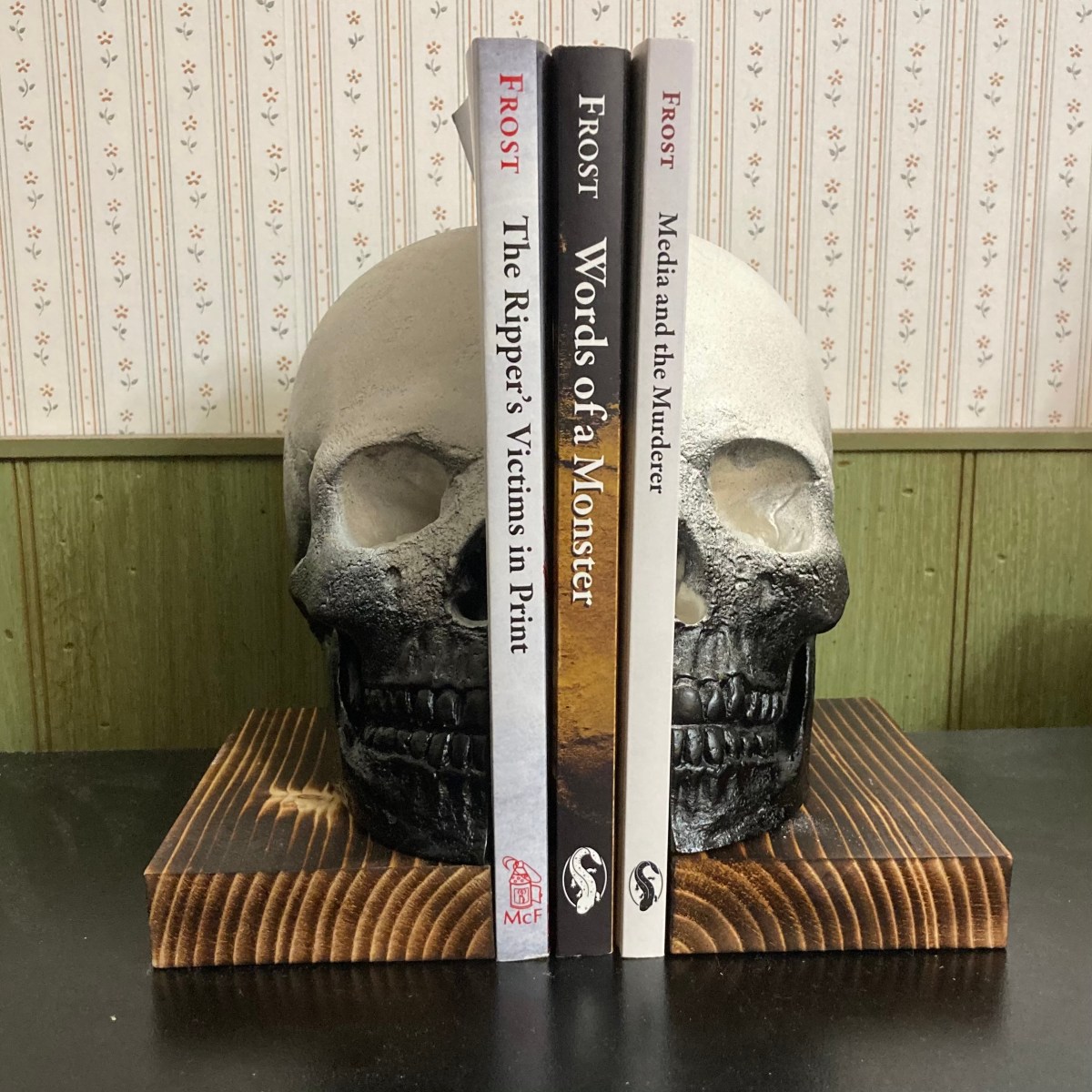
I recently finished creating the one for my most recent book, Media and the Murderer: Jack the Ripper, Steven Avery and an Enduring Formula for Notoriety, and I got a lot of surprised responses: wait, a person has to do that? Why?

There are a number of reasons why it takes a human to sort through a book to make the index actually … useful.

For example, I reference the Duke of Clarence and Avondale; Prince Albert Victor; and Prince Eddy … and they’re all the same person. A computer could be asked to search for and categorize all proper nouns, but someone along the line has to recognize that they’re all the same person. (And add in the cross-references in the index to make sure that someone who knows him as Prince Eddy can find all the references.)

The proper nouns are probably the easier ones to find, too. When I’m scanning through a page to see what to underline for the index, the capital letters help.

This time around I settled on four colors to help me sort through what was going on and keep the ideas in mind as far as what I was looking for. Green was general; blue referred to the murdered women; yellow was names of secondary importance; and prink referred to Jack the Ripper and Steven Avery.

There’s another rule of thumb here: if it’s mentioned in your title – as the Ripper and Avery are – then they’re on a lot of pages and they don’t get their own entry. The Ripper mentions got divided into their own categories (although there’s always the chance that this might get changed once someone at the publisher has a look and maybe a chuckle – things have been consolidated before) but what happens with Steven Avery, the main subject of Making a Murderer?

He gets his name, yes, but not a list of pages where he’s mentioned. If you know anything about MaM, you know he’s got a wrongful conviction and an exoneration – and those two categories go under his name with page numbers to follow. Instead of just being one big blob of Steven Avery mentions, he gets categorized.

The same thing can happen with some of the people I label as secondary figures. Ken Kratz, for example, has a “press conference” category, and Brendan Dassey has his “confession.” So even when it’s an easy search for someone’s name, there’s still some parsing going on. What do I think people who pick up this book might be looking for? How can I make it easier for them to find it (and therefore cite me)?

But it’s a pain. I groan at my past self for making all sorts of connections to serial killers both factual and fictional, because each mention is another entry in the index. Zac Efron, Mark Harmon, Johnny Depp … they’re all in this one. Hannibal Lecter is on multiple pages. Ted Bundy, John Wayne Gacy, Jeffrey Dahmer … they all go in the index.

Aside from the proper nouns, there are certain themes that happen to appear in my work. Some of them were major players in my dissertation: Puritan execution sermons, trial reports, and the explanation of why the adversarial trial matters. Some are specific to this book.

And the reason you do it yourself, as opposed to hiring someone else to do it, is that you know from the start what your important parts are. So therefore I knew that execution sermons had to make it in, even from the very first mention. That got underlined.

I can use the search option to go back through and make sure I’ve gotten all the pages for a certain term, as long as I remember that profiling, profiler, and profiles are all possible terms to file under “psychological profiling” … but I still need to make all of those connections so that someone who wants to use my book can know exactly where to look.

Ripper suspect: Montague John Druitt

Jack the Ripper was never caught. He murdered five women in the fall of 1888 – or more, or fewer, depending on which story we want to tell – and then, to be melodramatic, he slunk back into the fog without ever showing his face. Anyone who was arrested under suspicion of being the murderer had to be released, and the police file was closed in 1892 without any public declaration of his identity. This, of course, has left the door open for any number of suspects.

One of the earliest Ripper suspects was a young lawyer named Montague John Druitt. We’ve seen him before as part of my favorite, and very convoluted, Ripper theory, but why was he considered a viable suspect in the first place?

druittIIDruitt was a young lawyer who committed suicide in late 1888 after the murder of Mary Jane Kelly. He had been working at a boarding school in order to supplement his income, and was dismissed from that post in late November. There is no evidence supporting a reason for this dismissal, but Druitt killed himself not long after. His body was found floating in the Thames on December 31, 1888, and had been in the water for some time.

What evidence is there that Druitt was the Ripper? Honestly, none.  Some authors – again, see my favorite theory – try to place him near Whitechapel and give him a motive for the murders by tying him to the Crown and other conspiracy theories. Druitt even caught the attention of Melville Macnaghten, who rose to the position of Assistant Commissioner and, years after the crimes, penned the “Macnaghten Memoranda”: a list of three people Macnaghten thought likely to have been Jack the Ripper.

(It should be noted that, if you really want to get into Ripperology, you need to be familiar with terms like “the Macnaghten Memoranda” and “the Swanson Marginalia.” This means knowing who Macnaghten and Swanson were, their connection to the case, and when and where they penned their various notes. It’s rather confusing and frustrating, especially since said notes were not made in 1888, but years later, and are jottings and therefore fragments.)

Macnaghten’s Memoranda even confuses the issue by naming a Mr. M. J. Druitt and calling him “a doctor of about 41 years of age.” This Druitt, though, was a barrister and school teacher, and 31 years old. Macnaghten was likely working from memory instead of notes, and simply recalled that someone had drowned himself in the Thames after Mary Jane Kelly’s murder. The timing meant that Macnaghten could argue Druitt’s mental health was deteriorating and that, not long after this final brutal murder, he could no longer live with himself and took his own life.

Montague John Druitt was not, however, experiencing mental health issues. He was still working at the school and as a barrister through the end of November. Although Macnaghten  argues that Druitt’s family believed he was the Ripper, there’s no evidence of this outside of Macnaghten’s statement. Even the way Macnaghten words it makes it seem as though he heard it thirdhand at least, and not directly from the family members themselves.

But, because Druitt’s name appears in the Macnaghten Memoranda, written by one of them involved in the case in 1888 and who had risen further to a respected post, his name has been tied to the murders. It doesn’t matter that he had no known connection to Whitechapel or that Inspector Fredrick Abberline went on record saying that there was nothing to incriminate Druitt – from the timing of his suicide, likely a reaction to losing his teaching position, Druitt’s name must always be brought up when discussing Ripper suspects.

The Curse of H. H. Holmes

We’ve already spent a lot of time covering the real-life events of one H. H. Holmes, “America’s first serial killer.” If you missed them, check out Holmes story Part I, Part II, Part III, and the murder castle discussion. But maybe all of those are too depressing, considering the man didn’t actually murder 250 people in his custom-designed building. Maybe I’ve taken all the fun out of it.

So. Let’s talk about Holmes’ curse.

We already know that Holmes had his body placed in an extra-large coffin and encased in cement so that no one would be able to dig him up and use him for medical experimentation. He was eventually disinterred for an episode of American Ripper, to dispel the rumor that Holmes himself had snuck away and a lookalike was executed his place, but that just prevented people from reaching in. It did not, apparently, prevent Holmes from reaching out.

The death of anyone who had any connection whatsoever to the Holmes case was considered suspicious … and another victim to add to Holmes’ list. Holmes was said to have “the evil eye” – have you counted how many times Erik Larson mentions his eyes in Devil in the White City? – and, in the two decades or so following his execution, around 30 deaths were attributed to it.

The Superintendent of the Indianapolis Police Force, responsible for the invesigation into Howard Pitezel’s death, was thrown from his horse during a parade. He was, perhaps, lucky – he didn’t die, but he dealt with the effects of his injuries for the rest of his life.

One of the coroner’s physicians who had testified against Holmes at his trial suddenly dropped dead from blood poisining.

The trial judge and lead coroner both died suddenly from previously undiagnosed illness.

The prison superintendent at Moyamensing Prison, where Holmes was held and executed, committed suicide.

The father of one of Holmes’ victims was horrifically burned in a gas explosion.

Frank Geyer, the detective who had finally tracked down Alice, Nellie, and Howard Pitezel, was struck with a sudden illness. He did recover.

The office of the claims manager for the insurance company Holmes had cheated caught fire and burned. Apparently the only untouched items inside were a framed copy of Holmes’ arrest warrant and two portraits of Holmes.

The fiancee of one of Holmes’ defense lawyers died suddenly.

An occupant of Holmes’ Murder Castle committed suicide.

The jury foreman was electrocuted.

Marion Hedgepeth, who had informed on Holmes’ insurance scam, was shot and killed during a holdup.

The Murder Castle itself was mysteriously gutted by fire.

Holmes’ caretaker committed suicide and left a note that said “I couldn’t sleep.” His relatives said he had been suffering hallucinations and may even have been “haunted.”

The list goes on.

It reads rather like Holmes’ own confession to 27 murders, with a variety of people from different walks of life, with various connections to him, and different causes of death. They would never have been linked together at all if not for the name of H. H. Holmes … or for the rumor of the curse that Holmes himself began before his death.

What do you think? Is each and every death on this list completely explicable? Or was Holmes working to increase his body count from beyond the grave?

5 tips to get yourself writing

Even if you’re good at writing – even you say you like writing – there will be some days when you don’t want to do it. Days when you have to use every trick up your sleeve to make yourself get words on the page. (Days when you write a blog post rather than work on your current project, even …)

Days when you’ll seize any conceivable distraction.

So what can you do to keep up the momentum?

  • Schedule your writing time. Block it out in your calendar. Tell other people that it’s your writing time. Granted, you’re not going to be writing at top speed for every minute of that time, but you’re making it a clear intention. When I’m distracted during that time, I’m distracted from writing. It’s like what they tell you about meditation: acknowledge the fact that your mind is wandering, and then bring it back to the task at hand.

  • Recognize what parts of the project are going to be most troublesome. This is absolutely a personal thing, but right now I’m about to “start” something. The start is my struggle. It’s not just the start of a project, but the start of a section – a chapter or something under a new heading. The way I usually get around it is to never end a writing session at the end of a section – at the very least I’ll give myself a few notes to go on.

    You can’t always plan it that way to be nice to yourself. Today, for example, is my first day back at the project since writing and sending in the proposal. I had other things going on and didn’t want to continue writing it without knowing if the proposal might be rejected, so I have to get over this hump. But, whenever possible, I do what I can to make Future Rebecca’s life easier.

  • Remove distractions. I have a specific writing desk. There are books in the room, yes, but I don’t bring my knitting in here – one distraction down. There’s no door to keep the cats out, so that’s a wash, but there’s also no tv. I rarely turn off the wifi when I write – I’d rather do a quick search and put the proper date in now instead of later – but I’ll turn on the Forest app on my phone and put it on the harshest setting: you can’t leave the main screen until the timer is up, or else your little digital tree dies. I’ve even got the comments customized so it tells me to keep on writing.

    Do I mean “Bore yourself into having to write the thing you’re putting off”? I might indeed.

  • Give yourself a carrot. Set a reasonable, achievable, goal and then tell yourself you can’t do something fun until you’ve reached it. Dickens used to tell his servants not to give him his clothes until he hit his daily word count, so he’d be naked and confined to his study until he got there, but it doesn’t have to be that extreme.

    It also doesn’t have to be mean – this isn’t “I can’t get up to use the bathroom until I hit 500 words” or “No refills on my coffee until I finish this section.” You don’t want to make writing harder because you’re ignoring bodily needs or running low on caffeine. It’s a reward: once I hit my word count, I can have some candy, or spend 20 minutes working on my fun knitting project, or get lost in an internet search of nothingness for a while.

  • Write something – anything – else to get words flowing. You can hop to another section of the project, or start making notes about what’s bugging you about the project, or write something else completely – it doesn’t have to be connected to the project you’re putting off. You can also switch it up and get out a pen and some paper instead of using your laptop. This is your chance to use different colors, or to write down the other things that are bothering you, or to get a quick shopping list out of the way. Once you start writing, it makes it easier to switch the flow of words back to your original topic.

The more you write – the more you follow your schedule – the better you’ll get at forcing yourself to focus simply by trial and error. If something works for you, hang on to it. If one of these tips doesn’t, then reject it and start searching for another.

What do you do to help yourself focus on writing?