The other day an old friend of mine texted to say that one of her students was convinced that Mahatma Gandhi was Jack the Ripper. He’d seen a TikTok video on it, she explained, and it was convincing.
The problem with TikTok videos–and of course, their appeal–is that they’re so short.
Let’s take a look at the premise:
See? Short and to the point. Gandhi was in London in 1888, when the Ripper murders happened. He left in 1891, and there weren’t any murders after that.
Fun fact: the rebuttal also fits in a TikTok.
The long and short of it is, we don’t even have to get into Gandhi’s personality to dismiss this rumor: Gandhi may have been in London in 1888, but not all of the right weeks in 1888. He arrived after the murders of Polly Nichols and Annie Chapman (and Martha Tabram, if we want to go beyond the Canonical Five) and only a matter of hours before the Double Event.
But that’s not the only recent TikTok suspect.
For the record, I fully love that people will message me to ask my thoughts on the newest rumor. That’s how I learned that now apparently Edgar Degas is a Ripper suspect, too.
He’s not the only artist accused of being the Ripper. Patricia Cornwell, author of the Kay Scarpetta series, has now written two books focusing on Walter Sickert. Her first, 2003’s Portrait Of A Killer: Jack The Ripper Case Closed, laid out her initial thinking. If you know about the Degas argument, a lot of it sounds similar: hated women. Painted women. Violent art. Cornwell further backed up her argument in Ripper: The Secret Life of Walter Sickert in 2017, in part having to defend herself against “ruining” Sickert’s work in her quest to prove her theory.
Cornwell, at least, can show that Sickert did indeed live in London and spent quite a bit of time there. Degas, on the other hand? Apparently he lived “close” to London.
He lived in Paris. Redditor mbelf says it well:
I would agree with point 1: Jack the Ripper lived within a 472 km radius of the murders 😆
One of the issues with picking simply anyone who we know was alive in 1888 is how it’s not just that the Ripper murders happened in Whitechapel, but that the killer knew the area well. He avoided beat cops when he only had a 14-minute window before they passed by again, and he blended in so well that no “eye-witness” account can be trusted. Nobody noticed the Ripper at work, and none of the men mobbed on the street and accused of being the Ripper actually were.
Degas was certainly alive in 1888, so that ticks the main box, but the idea that he could’ve been Jack the Ripper belongs in the junk pile.
So why do we keep seeing these new accusations?
According to Kiki Schirr, she didn’t mean to actually post the video.
“I was running a fever of 101 and on my way to the doctor’s office, which is why I kept mis-speaking….. I was sitting in the parking lot and bored and I swear I hit ‘save to draft’ and it went live because my iPhone is terrible.”
But of course now it’s out there, and it’s clearly captured public interest. Quite simply, we want to know who the Ripper was. We want to top the Victorian Metropolitan Police and come up with the answer.
And it’s easy for us to pick a name and throw it into the ring because, quite simply, it’s not personal. We don’t live there or back then. The Ripper has long since turned into a logic puzzle instead of a real-life case of murder with actual victims and consequences, and who knows where the truth will come from? Perhaps the case will be solved by a TikTok video of someone simply throwing out another name and leaving the internet to argue over the suspect’s merits.
Wait, so should we stop accusing people of being the Ripper?
Now there’s an idea.
Think about it: if you suspect someone living of having committed a murder, there are steps to go through to make sure that you’re not just flinging around the name of your ex or trying to get someone in trouble because they violated the HOA’s ruling on how long their lawn should be. Filing false police reports is a crime, as are libel and slander, but the chances of someone coming after you with any of those charges vastly decreases when the case happened over 100 years ago and all the direct players are dead.
On the one hand, it’s promising that so many people are searching for evidence to either prove or disprove these short accusations. On the other hand, they’re clickbait, looking for that kind of interaction to boost engagement. People who seriously want to name a suspect aren’t going to do it solely in a TikTok without all their own research to back it up.
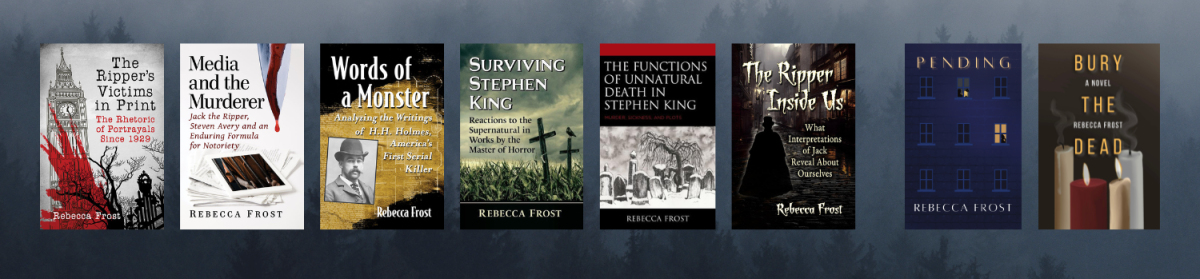
Speaking of Jack the Ripper, I’ve got a new book out: The Ripper Inside Us: What Interpretations of Jack Reveal About Ourselves. Nope, I’m not looking to name any suspects, but I’m fascinated by our fascination with the case. From newspapers to rock operas to waxwork, I trace the ways we keep trying, and trying again, to tell – and make sense of – the Ripper story. Seriously, we come back to this case time and time again, in every new media that emerges. Isn’t it time we asked why?



 Rebecca Frost