The usual parts of an academic book proposal

So you’re thinking about getting an academic book published. Maybe you’re pretty confident about the writing process, but what about proposing it? There are a number of common elements in an academic book proposal, so it would help to take a moment and think about those just so you know what’s coming.

Although these are common, always (always, always) read the specific requirements of the agent or publisher you are querying. Make sure you include all the information they’re looking for, and in the format they request.

  • sample chapters – you’ll be asked to submit a number of sample chapters. It’s usually low – one to three – and, for the purposes of the proposal, the introduction doesn’t count. It’s helpful to include the intro, though, because it will show how you plan to catch readers’ attention and then how your entire book will be organized. Most academic proposals do not require the entire manuscript to be complete at the time of the proposal.

  • an index or outline – because of this, you’ll be asked to include either an index of chapter titles, or some sort of outline. Most recently I had to provide an abstract for each of the chapters I didn’t submit. This helps you really solidify what your book is going to be about, and shows them that you know enough about your subject to craft a throughline long enough to fill a book.

  • estimated length of the final manuscript – some will ask for word counts and others for page counts, so double-check before making your best guess. Contracts usually come with a range or a limit. The consideration here is writing enough to cover your subject, but not so much that the size of the book drives up printing costs toward something most people will consider to be too expensive. Your book doesn’t need to be long to be good, and you might have to narrow your focus a little if it looks like it might start to grow as you write it.

  • proposed delivery date – because you’re not submitting the entire book, you also get to tell them when, exactly, it will be in their hands. If you think this date is more than a year out, then it’s probably not the time to query. Many academic presses want to know that they’ll have your manuscript that quickly. This also shows them that you know there’s enough information out there, and that it’s accessible enough, for you to complete the manuscript.

  • proposed title – pick a good, informative title, but keep in mind that this will change. The title falls under marketing, and a lot of people will have input on it before your book is published. They factor in things like key words and where those words appear within the title, considering where a lot of internet searches cut off the display. So make it a good one, but don’t stress too much about making your proposed title perfect.

  • comp titles and your book’s nicheI mentioned this last week, but this is part of the marketing: what will be the competition for your book? Who publishes those other titles? What gap will your book fill? Basically, convince them that your book will actually sell and not simply crowd a shelf in the store. Those texts should be fairly easy to name, since you’ve been immersed in the literature as you plan writing your book, but it’s not something many people are used to writing.

  • ideal audience – who is going to want to read your book? Are there specific college classes that will reach for yours instead of whatever’s currently on their standard list? Not everyone in the world will want to buy your book (sorry), but they’ll want to know that the interested group will be large enough to make publishing worthwhile.

  • a list of possible peer readers – if you don’t need peer review, or the publisher doesn’t require it, you won’t have to do this step. If it is needed, then you’ll provide contact information for the requested number of possible peer reviewers. They need to be people with whom you don’t have a personal or professional relationship, in order to preserve the purpose of the peer review process.

  • whether this manuscript is under consideration by any other publisher – it is rare these days to see bans on simultaneous submission due to the length of the process and the fact that “publish or perish” means not being able to sit around and wait for each possible publisher, in turn, to get back to you. If you do already have someone interested, dropping that into the proposal might catch the attention of a publisher you think could be a better fit for the book. If this is the case, include the deadline by which you have to get back to the interested party.

  • any pertinent information about yourself – this is where you can name your credentials and past publications. It helps position you as the expert on your topic and shows that yes, you have experience working with getting feedback on your writing. This is especially useful if you’re querying an agent, who will want to know that you’re familiar with the process of revision and the idea that the document you deliver is not already perfect and can, in fact, be improved.

No matter which path you go with proposing your academic book, make sure to read the submission guidelines in full before delivering the requested documents. Chances are good you’ll have to provide all of the above information in form or another – the submissions page will tell you how many documents to submit and, if they prefer them to be labeled in a specific way.

The submission process itself is a long one and involves a lot of waiting to hear back to find out whether your proposal has been accepted. You want to make sure that the packet you send out is the best you can make it and addresses all the questions the publisher asks, so you’re not caught up in a back-and-forth as they request it again. Make sure you look over the submission requirements carefully and go down each publisher’s checklist, giving yourself enough time to think about the answers to each of these areas.

Writing the proposal is very different from writing the book, and you need to spend enough time thinking about it, too, the way you do with your manuscript.

So you want to write an academic book proposal

Academics are used to proposing things: special topics courses. Conference presentations. Chapters for edited collections. To an academic, “CFP” means “call for proposals.” We’re used to the idea that we need to sum up our ideas and present them to a group of peers for approval before moving forward.

A book proposal, though still a proposal, is a different genre.

Most of the proposals we write are short. The people reviewing it don’t want to read more than, say, 300 words. We’ve learned to summarize the main ideas while invoking the proper number of references and making ourselves sound both smart and intriguing given a small amount of space. It’s enough to prove to strangers that we can speak on a topic for 15 minutes or give them a 5-7,000 word chapter by the given due date.

A book is, of course, a much longer project, and the purpose of the proposal can be a shift, especially for academics not used to writing things like grant proposals. You’re no longer arguing solely that your research is relevant and interesting, or that you’re an expert able to coherently and intelligently discuss your topic. For a book proposal, you need to shift your thinking slightly and consider facets of marketing.

When I was in graduate school, one of my professors, Bob Johnson, was telling us about the process he went through to propose his book Romancing the Atom. The part he stressed was how it was up to him, the author, to show the niche his book would occupy in the market. He told us that he had to provide the titles and authors of books that were similar and could be seen as competitors to the one he was proposing.

Granted, this shouldn’t be too difficult for scholars who in fact do research in their own field, but it’s a shift from reading books to add to your own argument toward thinking of those books as competition. This is especially true if someone who’s a big name in your field, and whom you may have met, has recently come out with a book: now you have to say why your book, written by a newcomer, would be chosen over this other one by an established researcher.

The publisher wants to know why your book is unique. This means you need to be able to set your idea apart from the others – while still connecting to the field and remaining in conversation – and to tell them why, exactly, people will buy yours instead. What is it about your book that makes it special, aside from the fact that you’re the one writing it? What gaps do the others leave that yours might fill?

We’ll get more into the usual parts of an academic book proposal next week, but this tends to be the main sticking point and the biggest new thing. Market my work? No, no – I just write a short proposal and then go talk about it. Journals have subscribers who are already interested in the sort of content that will be selected to be included, but this is a step taken by the editors of a book collection, too: does this chapter idea fit with the others? Does it make the point we want to make?

Is it the sort of thing someone would see and then want to buy?

But, come on – can’t the publisher have someone do all that work? If it’s marketing, isn’t it their job instead of mine?

Sorry, no. As the expert in your field, you’re the one best positioned to argue for how your work will fit and what new things it offers. The publisher takes care of a lot of things, but making these points in the proposal is really an argument for them to take the risk on your and your book. If they offer you a contract, they’re committing to the costs and hours involved in publishing your book, and they want to know that it’s worth it to them.

So: if you’re thinking of proposing an academic book this year, start also thinking from the side of marketing. Who’s going to buy your book? What does your ideal audience member look like? What classes might want it on their required reading lists? And why should they reach for yours instead of others already out there, either by the same publisher or a competitor?

New Year, Same Me

So it’s the time of year when we’re all supposed to be setting new goals, and they really should be SMART ones: Specific, Measurable, Achievable, Relevant, and Time-bound. My husband is really good at this kind of thing and ends up with a whole list of proposed achievements for the new year, and he’ll check in on them and adjust as the months go by. Me? Eh …

Making up goals for a whole year gives me the same sort of feeling I get while looking at a syllabus: I’m supposed to do how much in how long? Even if I’ve taught the class before and I know it’s very much doable, it just seems ridiculous. Insurmountable. After all, how am I supposed to accomplish all this when I’ve never really done much of anything before?

With that attitude in mind, my only real goal for 2021 is to keep better track of what I do accomplish. My husband is better at this, too: he’s been keeping a journal of accomplishments for years at this point. I tried last year, in a blank book, but didn’t keep it up. I felt like maybe I was padding my days (I wasn’t) and worried I might forget something or leave things out (I probably did). But I also had a discussion with someone the other day that made me realize it’s important to at least keep track of my writing progress.

If you don’t have a mentor or someone in your life who’s done it and is therefore able to remind you of how far you’ve come, it’s easy enough to forget. When you’re living it, it doesn’t necessary seem easy, exactly, but come on. If I can do it, surely anybody could do it … right? So what you really need to do is remind yourself that this thought is in fact … wrong.

I’m using my planner as a place to keep track of how many words I write during a session (instead of random notebooks kept haphazardly to prove to myself I’m actually doing something) and to just … keep track of the things I do in fact accomplish. To remind myself that I’m not just a lump on the couch and that, on days when I am, it’s because I’m resting from everything I’ve already done.

How about you? What are your goals for 2021?

Taming the Inner Two-Year-Old

Sometimes trying to write feels like wrestling an angry two-year-old, except you’re the two-year-old. You’re cranky, and distracted, and you’d really probably like to have a snack right about now. The problem is, if you’re writing toward a deadline, you also have to be the adult.

The adult is the part that reminds you of your due dateand your daily goal. The part that points to the calendar and calculates what your new daily goal would be if you slacked off. The part that wheedles and begs … but also the part that can find ways to appeal to the two-year-old inside you.

The other day I was telling someone that things have to be Just So when I’m writing. It’s not a ritual, exactly, but an acknowledgement of my inner two-year-old. The toddler inside my head will take any reason to stop working and give up on something that’s too hard, or will just get distracted by anything else. So I’ve developed a number of things to keep myself focused so, as much as possible, the toddler has nothing to grab onto.

Instead of getting frustrated with myself for not being able to focus in a certain way, I’ve figured out a number of workarounds. It’s one thing to get frustrated with a kid who doesn’t want to do something, and another to try to figure out why the kid is being so stubborn. In these cases, I’ve chosen kindness toward myself and have purposefully organized my writing space and process to give myself the best chance. Weird, right?

Take these sheet protectors. I totally got them for Christmas and I am thrilled because I use them a lot. I like printing things off and having them in front of me so that my screen can be devoted just to the document I’m writing – fewer clicks and fewer distractions for the toddler – but I discovered a while back that I have this thing about writing on what I’ve printed. If it’s notes, I don’t want to do it. Making marks just messes things up.

Enter the sheet protectors. I don’t know why they work for me, but they do: the marks go on the sheet protectors, so I can still color-code to my heart’s content, but the original notes remain unsullied. It’s weird, sure, but it’s a step that I know happens to work for me.

Or how about this one: some days I start with a blank document, and it actually helps. Most days – and for a lot of people – the huge amount of white space is paralyzing. The flashing cursor just counts off all the seconds you should have been writing, but haven’t yet. But, on my worst days, I feel like adding to the original document would be like writing on my notes: sullying something that might not have been perfect, exactly, but isn’t going to be made any better by my current ramblings.

So, on those days, I open a blank document and release myself from any sort of expectations. They don’t even have to be titled properly. I’ve got one called “written doodles” that just worked for me because clearly it didn’t have to be great. They were just doodles, after all. Just me, trying to get my thoughts in order.

Other times it’s the room itself: the proper chair. Background noise, or silence. A better playlist. Turning on a space heater or opening a window. When I’m at my crankiest, I have to tend to all of these things first and make myself as physically comfortable as possible so that my thoughts can then focus on something other than “I’m hungry” or “The tag on this shirt itches.”

You don’t have to power through that kind of stuff. Writing is hard enough as it is without giving yourself more hurdles. The longer you work at it, the more you’ll discover your own little quirks and be able to tackle those straight off, building up your writing space and priming yourself to be as comfortable and distraction-free as possible.

Be nice to your inner two-year-old. Sometimes they really know what they’re doing.

How do you read for research?

Reading for research is different than reading for fun. Research comes with a purpose, and it’s helpful to have that purpose at least sketched out before picking up a research book. Otherwise you’ll end up having to go back and re-read more often than not. So: how do I read for research?

Short answer: with two highlighters and a pen.

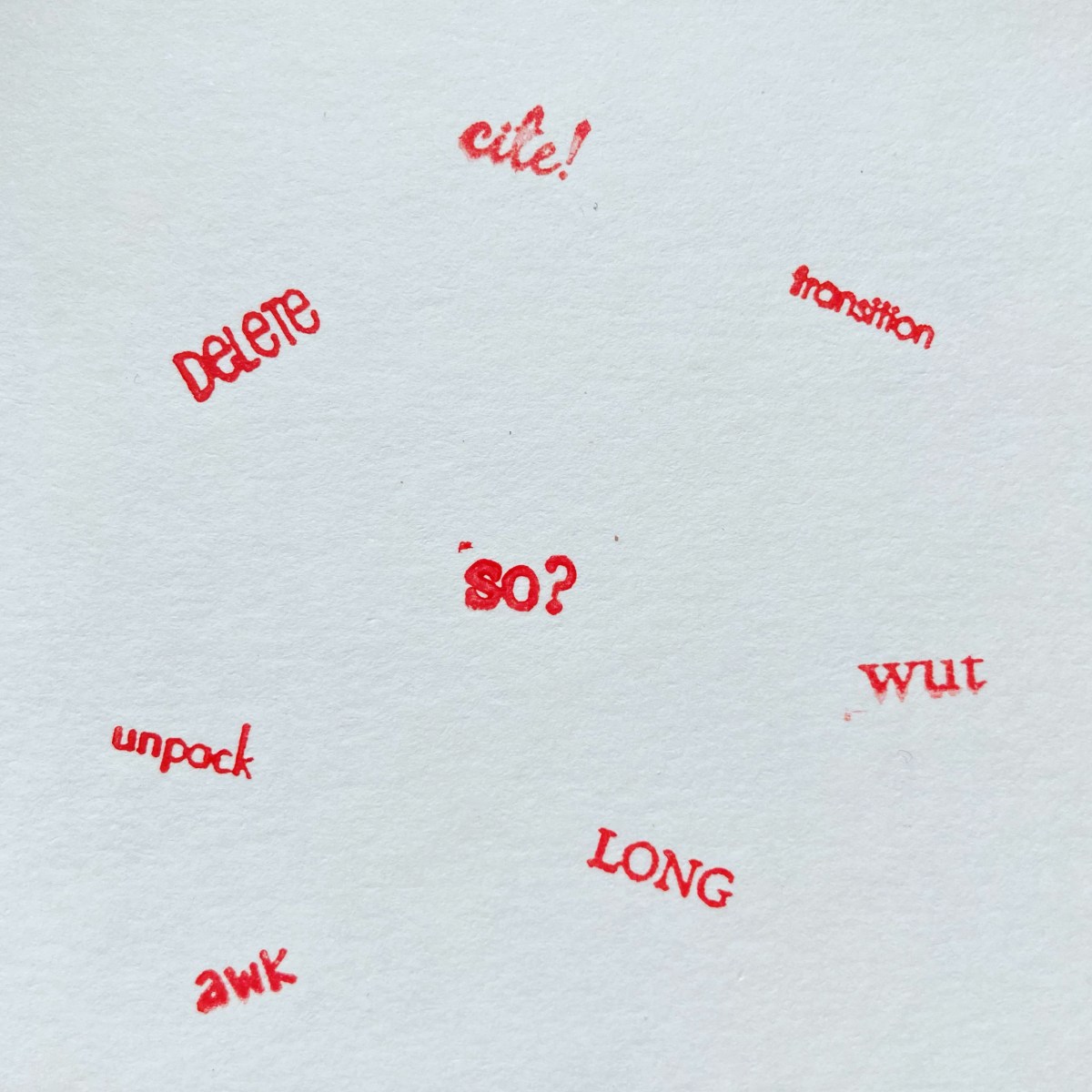
Longer answer: it depends on whether it’s for a specific project or just a general true crime book. For general true crime reading – I can’t even just pick one up for fun anymore because there’s always something I want to highlight – I stick with my usual interests: representations of criminals and victims. If something is particularly interesting, important, or aggravating, I’ll also fold down the corner of the page. (Clearly on books I own. Don’t do this to an interlibrary loan. Scan them and make your own copies if they’re, say, a Ripper book so rare you can’t buy one for less than $2,500.) One color is for normal highlighting, and the other is for the most important of the important things. The pen is to scribble bon mots in the margins. (These usually look like “wut” or “no” or “???”)

If I’m reading for a project, sometimes the colors explode because I know a number of things I’m looking for. My old, ragged copy of The Stranger Beside Me, for example, has been highlighted and sticky-noted in six coordinating colors. Purple is where Ann Rule describes the scenes of the crimes, but there are colors for how Rule describes Ted Bundy; how he describes himself; about his romantic relationships; and so on. I did the close reading with all these themes in mind and yep, it took quite a while. This wasn’t during my first reading of the book, either – I’d already read it and knew the general plot, which helped. During the deep dive I could therefore concentrate on the threads I was looking for without having to worry about completely understanding everything I read.

Adding the sticky notes also helped me see patterns. Rule jumps back and forth between talking about her own life, her friend and coworker Ted, and the mysterious “Ted murders.” Seeing where the purple cropped up, for example, as compared to the sections Rule wrote about herself, says something about the narrative and how she wanted to tell it. There’s also one important sticky note hundreds of pages in where she finally admits that her Ted is indeed the Ted. (The downside? Clearly there are a ton of sticky notes on there, so the super most important of all the important ones can get lost. They’re a different style, but it can still take me a while to find the quote that I just know is in there.)

I’ve learned since then, though – one of my more recent multi-color adventures has a key in the front. That book is a reprinting of various newspaper articles and documents from police files, and it’s not always clear who the author or subject of each text is, so the colors help distinguish between the major players. This one isn’t the result of reading through from beginning to end with a bunch of colors in hand, but using the index to go color by color and person by person, because of the nature of the project. I didn’t need to do another complete read-through, especially since I’m already rather familiar with the general topic.

I’ve tried reading in ebook format for research, and a couple books I’ve found have only been available as kindle versions so I’ve been forced to highlight and bookmark digitally, but that just doesn’t work as well for me. On the plus side you can easily download all the highlights from a single kindle book, including the location, which makes compiling notes easier than having to type them up, but on the other hand it’s all part of the process for me. I’ll do a lot of reading and highlighting and then a lot of typing up notes so that I’m reminded of various things I’ve read and I have a better idea of where things are going and how they hang together. I tried using a digital highlighter for a while, but the act of typing up the notes helps my memory. (Plus no digital highlighter is perfect, and correcting a scanned sentence just felt more annoying than typing up the whole thing.)

I think the most important thing, though, is to not limit yourself. I always have that extra highlighter as an “other” sort of category: I wasn’t specifically looking for this, but it’s interesting and it should be remembered. It might not affect my current project and its argument, but it could be useful to remember for a future idea. Or it might actually twist one of the themes I already had in mind and needs to be taken into account immediately. It always helps to know what you’re looking for when you dive in to a book or a chapter, but keep an eye out for the things you never expected, too.

How do you get back to a writing project you haven’t worked on in a while?

November is National Novel Writing Month, and I’ve participated every year since 2010. The goal is to write 50,000 words during 30 days, and it’s geared toward fiction. By the end of the month you should have a large chunk of a first draft of a novel. Which is awesome, and I love the community and everything that comes with it, but … academic work? What academic work?

It hasn’t been a whole month since I’ve worked on this project, but it’s been a good couple of weeks. So now I have to pick it back up, and recalibrate my brain to academic writing instead of fictional fantasy, and remind myself of what, exactly, I said I’d write in the first place.

So the good part: Past Rebecca wrote up a book proposal. Academic book proposals don’t usually include a full manuscript – it’s “just” the intro and a sample chapter or two – but they do include a full outline. It’s something I really don’t like doing at the time, but I rely on it a ton as I’m working on the book. For this project, I not only had to submit chapter titles, but also a quick summary of what each chapter is about. The framework is there.

Before this break, I’d also compiled my notes for each chapter. I like to print them out so I have have them next to my laptop while I’m writing. They’re not entirely organized the way I need them for each chapter, but they’re all present and accounted for, so I can highlight the most important things and then cross them off as I use them.

I’ve even got my little tabs so I can switch to a different chapter if the muse is being difficult. (That’s a good way to get your words in for the day – switch to a different section. You paint yourself into a corner by the end and have to write the more difficult bits, but by then you’ve got so much of the project done that it looks like such a small hurdle. Or so I tell myself.)

But then the new problem I give myself is that I have various files for various chapters but, especially after a break, I don’t remember what chapter is in what step of the process.

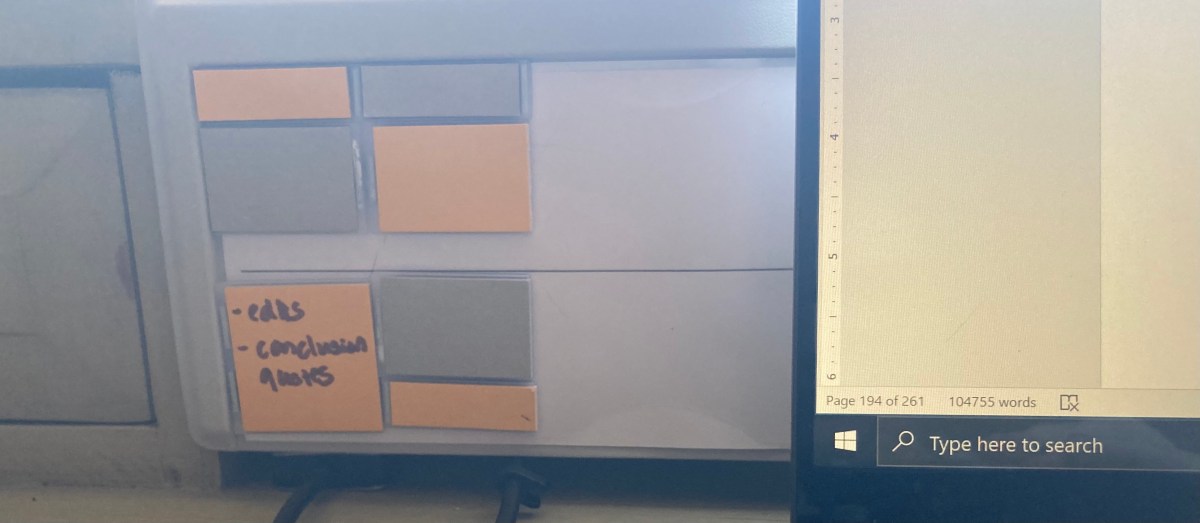
So I started off my day with arts and crafts. I figure I’ll use this again, so I’ve got my foam board divided into sections with labels across the top: not started; notes exist; barely begun; mostly there; needs another look; integrated (into the whole book and not just as a stand-alone file); and ready for a final read. These are all chosen based on what I know about myself and my writing process, so you could easily have more or fewer, depending on how you work. 

The chapter numbers, plus a quick reference word or two, are on sticky notes that can be moved from column to column. (I’ve made all the sticky notes one color because there are times I’m working on multiple projects, so … there might need to be another color added if, for example, my chapter proposal for an edited collection gets accepted in January.)

This helps me step back and take a look at the forest instead of my trees (or, in the case of paragraphs, individual pine needles). Nine chapters, plus intro and conclusion, feels a lot more manageable than “Okay in this chapter I need to discuss three books, but this one has fourteen, and this other one over here …” It also helps me remember which chapters have been completely abandoned in search of inspiration and which still need just a little something before they get integrated.

Some days it’s also easier to focus on the small thing: today, I’m going to move this chapter from “notes exist” to “barely begun.” (That’s actually my goal, although I’ve already put Chapter 5’s sticky note into the other column. It’s only jumping the gun if I finish this blog post and then don’t work on chapter five.)

It may look a bit like silly arts and crafts, but it helps remind me of the scope of the whole project, and how much I’ve already done – and, perhaps most importantly, it reminds me of all these cool ideas I’ve had that are worth the struggle to actually write down.

What does it look like when you come back to an older project?

Why I write about serial killers

“How did you get interested in serial killers?” Let’s face it – that’s probably the most common question I get asked once people learn what I do. At least it’s one I actually have an answer to. And even a specific date for.

I was in London in July 2007. My mom was helping me plan the trip and I told her that I had to be there on July 20, because Harry Potter and the Deathly Hallows came out at 12:01am on the 21st. I stood in line, got my book, and made sure to read all of it before leaving my hotel room in the morning, just to make sure I wouldn’t run into any spoilers. Except then I didn’t have anything to read.

I took the underground to the zoo but for some reason on my way back the station I’d used was closed. There was a sign directing people to the next station, and that street took me past a bookshop. (Not there one where I got Harry Potter – that was at King’s Cross Station.) I went in and decided to look for a book about Jack the Ripper, since there were advertisements everywhere for Ripper walks and the like, but they all started after dark. I didn’t feel like trying to find my way back to the hotel that late, all by myself, so I figured hey, let’s see if they have a book.

I ended up asking if they had any books about Jack the Ripper – silly question – and I got directed to an entire bookshelf. I’d been hoping for, I don’t know, a couple books to choose from, instead of a couple dozen, and was honestly stumped. I’d already been given a bit of a long-suffering look when I’d asked if they had any books, so I decided not to ask again. I pulled out the two thickest books and arbitrarily chose Philip Sugden’s The Complete History of Jack the Ripper.

It’s not a small book, and not quick reading. I had it done in a matter of days. And I’d bought my second Ripper book before leaving London. By the time I’d signed the contract to write Ripper’s Victims, I owned around 40. That book cites about 80. At last count, thanks to an app on my phone that helps me keep from buying doubles, I own 120. And those numbers are just for single-subject book-length accounts of the Ripper crimes. (For comparison, in that same app, my general “true crime” bookshelf has 187 titles listed.)

Almost every bookstore has a true crime shelf. It’s the one genre I routinely seek out when I go into them, and the one genre where I still prefer to have paper copies instead of eBooks – it makes citations easier, and it’s easier to scribble notes in the margins or flip back to find that one special quote. When I start organizing an idea I’ll pull books out and reorganize them, grouping certain ones together as a visual representation of my ideas. Plus it’s just cool to have so many bookshelves full of my research.

So how did I get interested in serial killers? I was in London for the ending of Harry Potter, and it turned out that the next book I picked up marked a new beginning.

But what does it actually mean to “kill your darlings”?

It’s a common piece of writing advice that is frequently attributed to William Faulkner: “In writing you must kill all your darlings.” And it sounds cool – a little bit of murder, a little bit of love. But … what does it really mean? Is it just for novelists who need to off their favorite character somewhere within the story?

That’s the most common misinterpretation of the advice: that it calls for a literal – or at least literary – death. That aspiring authors need to read up on fight scenes or medical terminology and autopsy reports. That well-loved characters need to be offed and then mourned, perhaps in the spirit of reaching a word count goal. It’s actually a bit more brutal than that.

Your darlings are the things that make you not want to hand over your work to an editor. The parts you know you’ll resist changing, even if the comments come back and make it clear that no, this won’t be publishable until you do. The words, phrases, or ideas you’ll cling to because yes, this does indeed seem like a fine hill to die on, thank you very much.

Sometimes the comments you get back tell you about other people’s darlings. I had a manuscript returned that asked me to get rid of every single instance of “Therefore.” There were only two, but someone, somewhere, had killed this person’s darlings in the past and it was a lesson he remembered. Therefore (I know, I know) he had to make sure no one else allowed his darlings to live.

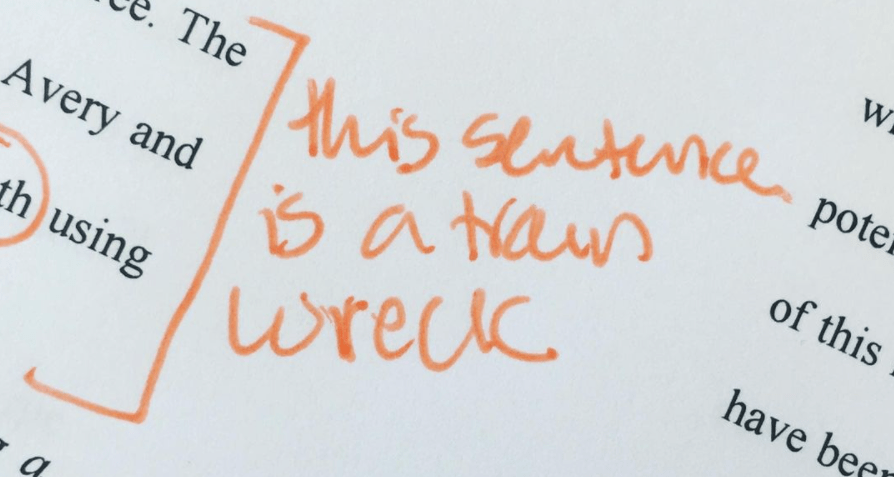
Other times it’s a lot harder than searching your document for a single word and finding substitutes. Your entire proposal can be a darling, and it can be rejected outright. Or, of course, there’s “revise and resubmit” in which you’re confronted with a list of changes, and you have to get out your ax. Or at least your red pen.

It’s a balancing act. Clearly whatever you wrote will not be published at this venue exactly as it is, but presumably you want to see it in print there, since you submitted it. Usually, upon first read-through of the comments, some of them even seem reasonable. They might feel like easy changes. Yes, of course I can do A, B, and C. A change here, a tweak there, and you’re working your way down the list exactly like you’re supposed to. Until …

Your darling.

Now, you don’t always have to accept and implement the comments and suggestions with 100% agreement. There is space for a conversation here: I understand where you’re coming from, but I made these choices for this reason. But, more often than not, there’s still some sort of issue that has to be changed. The sticking points where you’ll just be told to revise and resubmit again – or take it elsewhere because clearly you’re refusing to play the game according to the rules – unless you do something about it.

That. That’s your darling.

I, for one, am a fan of copying and pasting my darlings into a separate document where I can pretend they live out a happy life. On a farm in the country, perhaps. Where I could totally visit, if I really wanted to. And where they can live on, unchanged, while I negotiate the feedback and do my best to keep my ego in check (because just look at how darling my darlings are!).

Kill off your characters if you have to, but they’re not your only darlings.

What about you? Do you know your own darlings? Are any of them absolute sticking points?

The Craft of an Index

It’s one of the last steps needed before a nonfiction book can be published, but it’s also tedious … annoying … and incredibly necessary: the index.

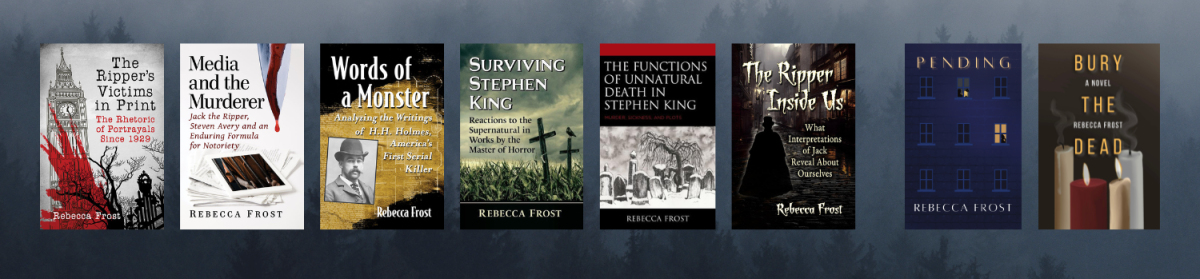
I recently finished creating the one for my most recent book, Media and the Murderer: Jack the Ripper, Steven Avery and an Enduring Formula for Notoriety, and I got a lot of surprised responses: wait, a person has to do that? Why?

There are a number of reasons why it takes a human to sort through a book to make the index actually … useful.

For example, I reference the Duke of Clarence and Avondale; Prince Albert Victor; and Prince Eddy … and they’re all the same person. A computer could be asked to search for and categorize all proper nouns, but someone along the line has to recognize that they’re all the same person. (And add in the cross-references in the index to make sure that someone who knows him as Prince Eddy can find all the references.)

The proper nouns are probably the easier ones to find, too. When I’m scanning through a page to see what to underline for the index, the capital letters help.

This time around I settled on four colors to help me sort through what was going on and keep the ideas in mind as far as what I was looking for. Green was general; blue referred to the murdered women; yellow was names of secondary importance; and prink referred to Jack the Ripper and Steven Avery.

There’s another rule of thumb here: if it’s mentioned in your title – as the Ripper and Avery are – then they’re on a lot of pages and they don’t get their own entry. The Ripper mentions got divided into their own categories (although there’s always the chance that this might get changed once someone at the publisher has a look and maybe a chuckle – things have been consolidated before) but what happens with Steven Avery, the main subject of Making a Murderer?

He gets his name, yes, but not a list of pages where he’s mentioned. If you know anything about MaM, you know he’s got a wrongful conviction and an exoneration – and those two categories go under his name with page numbers to follow. Instead of just being one big blob of Steven Avery mentions, he gets categorized.

The same thing can happen with some of the people I label as secondary figures. Ken Kratz, for example, has a “press conference” category, and Brendan Dassey has his “confession.” So even when it’s an easy search for someone’s name, there’s still some parsing going on. What do I think people who pick up this book might be looking for? How can I make it easier for them to find it (and therefore cite me)?

But it’s a pain. I groan at my past self for making all sorts of connections to serial killers both factual and fictional, because each mention is another entry in the index. Zac Efron, Mark Harmon, Johnny Depp … they’re all in this one. Hannibal Lecter is on multiple pages. Ted Bundy, John Wayne Gacy, Jeffrey Dahmer … they all go in the index.

Aside from the proper nouns, there are certain themes that happen to appear in my work. Some of them were major players in my dissertation: Puritan execution sermons, trial reports, and the explanation of why the adversarial trial matters. Some are specific to this book.

And the reason you do it yourself, as opposed to hiring someone else to do it, is that you know from the start what your important parts are. So therefore I knew that execution sermons had to make it in, even from the very first mention. That got underlined.

I can use the search option to go back through and make sure I’ve gotten all the pages for a certain term, as long as I remember that profiling, profiler, and profiles are all possible terms to file under “psychological profiling” … but I still need to make all of those connections so that someone who wants to use my book can know exactly where to look.

5 tips to get yourself writing

Even if you’re good at writing – even you say you like writing – there will be some days when you don’t want to do it. Days when you have to use every trick up your sleeve to make yourself get words on the page. (Days when you write a blog post rather than work on your current project, even …)

Days when you’ll seize any conceivable distraction.

So what can you do to keep up the momentum?

  • Schedule your writing time. Block it out in your calendar. Tell other people that it’s your writing time. Granted, you’re not going to be writing at top speed for every minute of that time, but you’re making it a clear intention. When I’m distracted during that time, I’m distracted from writing. It’s like what they tell you about meditation: acknowledge the fact that your mind is wandering, and then bring it back to the task at hand.

  • Recognize what parts of the project are going to be most troublesome. This is absolutely a personal thing, but right now I’m about to “start” something. The start is my struggle. It’s not just the start of a project, but the start of a section – a chapter or something under a new heading. The way I usually get around it is to never end a writing session at the end of a section – at the very least I’ll give myself a few notes to go on.

    You can’t always plan it that way to be nice to yourself. Today, for example, is my first day back at the project since writing and sending in the proposal. I had other things going on and didn’t want to continue writing it without knowing if the proposal might be rejected, so I have to get over this hump. But, whenever possible, I do what I can to make Future Rebecca’s life easier.

  • Remove distractions. I have a specific writing desk. There are books in the room, yes, but I don’t bring my knitting in here – one distraction down. There’s no door to keep the cats out, so that’s a wash, but there’s also no tv. I rarely turn off the wifi when I write – I’d rather do a quick search and put the proper date in now instead of later – but I’ll turn on the Forest app on my phone and put it on the harshest setting: you can’t leave the main screen until the timer is up, or else your little digital tree dies. I’ve even got the comments customized so it tells me to keep on writing.

    Do I mean “Bore yourself into having to write the thing you’re putting off”? I might indeed.

  • Give yourself a carrot. Set a reasonable, achievable, goal and then tell yourself you can’t do something fun until you’ve reached it. Dickens used to tell his servants not to give him his clothes until he hit his daily word count, so he’d be naked and confined to his study until he got there, but it doesn’t have to be that extreme.

    It also doesn’t have to be mean – this isn’t “I can’t get up to use the bathroom until I hit 500 words” or “No refills on my coffee until I finish this section.” You don’t want to make writing harder because you’re ignoring bodily needs or running low on caffeine. It’s a reward: once I hit my word count, I can have some candy, or spend 20 minutes working on my fun knitting project, or get lost in an internet search of nothingness for a while.

  • Write something – anything – else to get words flowing. You can hop to another section of the project, or start making notes about what’s bugging you about the project, or write something else completely – it doesn’t have to be connected to the project you’re putting off. You can also switch it up and get out a pen and some paper instead of using your laptop. This is your chance to use different colors, or to write down the other things that are bothering you, or to get a quick shopping list out of the way. Once you start writing, it makes it easier to switch the flow of words back to your original topic.

The more you write – the more you follow your schedule – the better you’ll get at forcing yourself to focus simply by trial and error. If something works for you, hang on to it. If one of these tips doesn’t, then reject it and start searching for another.

What do you do to help yourself focus on writing?