
Interview with Grab the Lapels

Melanie over at GTL has interviewed me for her Meet the Writer Series. Go on over and check it out! If GTL is new for you, Melanie explains:

Meet the Writer is a feature for which I interview authors who identify as women. We talk less about a single book or work and more about where they’ve been and how their lives affect their writing. Today, please welcome Rebecca Frost. 

She starts off by explaining a bit how we met. She tracked me down through this website and we emailed back and forth for quite a while about true crime, books, reading … the good stuff. And then we realized we actually have a friend in common.

Melanie asked if I’d like to be featured in her Meet the Writer series, and I jumped at the chance. Head on over to her blog to see what I have to say.

About handling multiple projects again …

I had a virtual conference this past weekend and I was talking to some friends I haven’t seen in over a year. This is usually how it goes for me: someone asks what I’ve been up, to, and … I realize I need to start counting things off on my fingers. Which inevitably leads to another question of “How in the world do you do it?”

Right now, in this very moment, I’ve got three book projects going. They’re all in different stages, but they’re all currently in progress. Some of the progress of getting a book published is actually “waiting,” which is helpful, because I can fill the “waiting” time with other work.

It’s also something I rather seriously compartmentalize. Two of the projects are currently in the “waiting” stage. I’m waiting for one of them to get me proofs, and for feedback on the other, so currently I don’t really consider either of those as “active.” I don’t know exactly when they will be “active” again, but, until they hit my mailbox with the next step and a new deadline, they’re basically snoozed.

A downside to the “waiting on other people” can be that multiple things hit your inbox at once. There was that one memorable year when I wrote three chapters for different collections, plus a book, and things just kept hitting my inbox with tight deadlines and a lot of tasks. That’s when I had to step my compartmentalization up to the next level, assigning each project a block of time per day instead of a block of days.

This is also the time when anxiety can kick into higher gear and imposter syndrome can rear its head, because people are actually reading what I wrote, or they’ll soon be able to. They can pick it apart and tear my argument down piece by piece. (For some reason anxiety never worries that the publisher won’t be able to keep up with demand and people will complain about that.)

And usually when you get feedback, there are at least some positive comments in the mix … but you’re not concentrating on those. You’re looking at what you have to change, and how you’re going to do it, and whether you’re going to be able to keep to your main goals and ideas secure while responding to outside influences. (This is why it’s nice to only have one project in the feedback part of the process at a time, if possible, so at least you can retreat to something else for a break.)

And honestly, it’s only when I have to catch someone else at my life that I step back and see the forest for the trees. I know that’s usually meant as something people should do, because otherwise they miss things, but … for me, at least, focusing on one project at a time (and strictly outlining what those times should be) helps me block out the wider anxieties and put as much of my energy as possible into the project at hand.

How do you deal with working on multiple projects at once?

Is it worth it for humanities scholars to have a website?

This question’s been going around Twitter lately, so here are my thoughts:

  • Yes, because if you have a blog, you have more space to answer questions like this and can link people back to it instead of trying to type out the same answer, but shorter. (I’ve been doing this lately when people ask about academic book proposals: two blog links in one tweet. I’m not crowding your feed, but bam, these are my thoughts.)
  • Yes, because it’s a way for people to reach out and contact you. If you’ve ever tried to track down a scholar based on a thesis or dissertation, you might know: .edu emails disappear. They aren’t always checked. Even though my website hasn’t even been around a year yet, I’ve had multiple people contact me through it, either because they’d already read something about me or they googled something about my research and came across it that way.
  • Yes, because if you don’t have a website, you’re never going to randomly wake up one morning to a notification that Smithsonian Magazine has linked to it. Okay, that’s very specific, but: if you don’t put things out there for people to find (for free), then these things won’t happen. It’s also a place where you can share your research on a more accessible level, both as in “not behind a paywall” and “I don’t have to put on my ‘scholar voice’ when I write this stuff.”

People who are curious about the work I do are more likely to click on a link than they are to buy a book. Especially a book from an academic press – we all know the price tag on those can be higher than average. But, if you read what I post and like what I do, the chances of a purchase go up.

On the other hand, the possible drawbacks:

  • Starting a blog means having to continually produce content. I draw either from research I’ve already done and published or my interactions with other writers, but it still takes time to write up these posts so that there’s continually something new. Having a static website is still totally recommended because of my second point – giving people a current means to contact you – but, if you’re thinking of going the blog route, it’s another to-do in your list.
  • Costs. Depending on the kind of website you want, you might have to budget for it. There are plenty of opportunities for people who don’t know either coding or design (hello!) to set up their own websites, but taking the time to look around and decide which one seems best for you is a cost of its own.
  • Overnight success takes a decade. Well, maybe not quite that long, but I looked at this website and blog as a long-term investment. Sure, the views and comments would be low at first, but … maybe … some day … even more things will happen that I never dreamed of. Through all of the “shouting into the void” weeks, though, you still need to be producing content. That’s just something to be prepared for.

What do you think? Do you have your own website? What’s your experience been like?

You’re not a train

Say you’re sitting down to write a new project and it’s just … not working. You’ve got a deadline coming up, but that doesn’t seem to be helping. You’re going through all of your usual tricks to get words on the page, and the blinking cursor still taunts you.

The thing is, you’re not a train. You’re not stuck to a single track. There’s more than one way to get from point A to point B.

Trains can only go where the tracks have been laid, and the tracks themselves have to follow a bunch of rules: no turns tighter than such-and-such. No inclines steeper than so-and-so. They need this much track to get up to speed, and this much to stop, and if they come off the tracks, they’re in big trouble. Anything from a cow to an avalanche can ruin everything, up to and including your perfect murder plot on the Orient Express.

But you’re not a train.

That’s one of the reasons there are so many “how to write” books out there. Maybe a bunch of writers agree on certain sets of train tracks, and there’s a lot of traffic there, and maybe they even usually work for you, but the world is so much more than train tracks. There are paved roads, and dirt roads, and trails through the woods, and not only are you capable of off-roading when necessary, you can even fly. You’re a drone with controls in the hands of a master.

Not a train.

I fall into this, too: thinking that, since x, y, and z have worked well for me in the past, they’re the only paths I have. The only ones I know. The only way to get from point A (the blank screen) to point B (the completed manuscript.)

As though I haven’t read (and rejected) other ways of writing, and I haven’t heard about other apps and technology, and there’s no pen or paper in the house.

When you get stuck with writing, the best thing is to stop trying to force it and take some time away. Deadlines don’t always allow for that, so the second best thing is to stop trying to force it this way and try another approach. Instead of cutting straight on through, the way you always have, look for a different path to see if it’ll skirt the issue and get you where you need to be.

It’s like the old rhyme about going on a bear hunt, except you can go under it. Or around it. Or over it. You’re not forced to always stay on the same tracks and always go through it.

You’re not a train.

The tracks are there, and well-known, and comfortable, but if they’re not meeting your needs right now … leave them. Seek out the path that’ll get you where you need to be, because sometimes plowing through the trees gets you there faster than continuing to inch painfully along the tracks.

(With apologies to my brother, who might actually be a train. He works at the Strasburg Railroad, and that’s him in the front. He’s even written a book about trains and how to make your own.)

Blinders on

There are a lot of times I point out how useful it is to put on your metaphorical blinders when you’re working on a project – or especially when you’re working on multiple projects. Having a clear focus helps keep you from getting sidetracked, especially if today you’re supposed to be working on Manuscript 2, so stop thinking about 1. But, sometimes … the blinders work against you.

Lately I’ve been working toward the tail end of a couple projects. Proofreading, final manuscript preparations, that kind of thing. Generally surface-level stuff and final checks before sending something off. I’ve just finished the current step on a couple of these, and I was telling a friend that I don’t know what I’m going to do with the rest of my week, since I know I’m getting comments back from someone next week.

He told me he’s spending his week reading.

… oh. Right.

I’ve been so focused on these particular steps for these particular projects that I’ve been ignoring the stack of books to the left of my desk in my “read these next” pile. Not to mention a whole bunch of other books lined up behind them.

I have to admit, though, that this isn’t new. Once I get to the end of my to-do list, even two items at a time, there’s generally a moment of stunned silence and a feeling of “Uh … so what now?” I’ve been so focused on getting this one thing done – thank you, blinders – that, once I’ve checked it all off, I have to blink a few times before I can back up and take a look at the forest again.

So: this week, I’ll be reading. Also known as “putting words back in my brain.” Making notes in the margins and highlighting all sorts of things and writing down any new ideas and connections that occur. (But not messing with anything I’ve already handed off – nope: once you put something out there for someone else to look over, don’t even look at it again. Because you can’t go changing it now, anyway.)

Writing blinders, off. Reading blinders, on.

On good days, write. On bad days, write.

I’m not sure who originally said it or where I first saw it – Joanne Harris tweeted it in 2017 – but it’s been on my mind this week. And it seems to sound at least a little better than “You’re going to be writing for the rest of your life.” That’s more like a prison sentence.

I’ve been thinking about it based more on how much of a process writing is and how long the timeline stretches. For a single piece, you’re conceptualizing, drafting, rewriting, submitting, revising and resubmitting, getting rejected, getting to the next step for more revising and resubmitting, and – eventually, if you’re lucky – proofing something and seeing it in print. It takes a long time to get something from inside your head to in front of other people’s eyeballs.

When I was in grad school, they cautioned us about it in another way: if you’re tenure track, go for many articles instead of one book. If the book falls through (and they do, for all kinds of reasons, during different steps of the process), then you have nothing. If a single article stalls out, at least you have others.

It’s one of the reasons to always have multiple projects in process, all at different stages. Some of those stages are a bunch of waiting. Others are quick, possibly frenzied, work. You can’t always control when you’ll hit each step – when you get the proofs back and when they’re due, for example – so you need to be flexible. When you’re juggling, know which balls are rubber and which are glass, so you know which ones can be dropped without shattering.

But it’s also because, when you get a rejection, you didn’t put all your eggs (or breakable glass balls) in one basket. There’s something else to fall back on for the days when you can’t bring yourself to wade through reviewers’ comments, and a way to boost yourself up again to get to the point where you can.

(Disclaimer: yes, okay, having multiple projects going on at once also increases your chances of getting multiple rejections at once. Say, two in one day, even. But you can handle rejection, and the way you think about rejection, and you won’t ever get to acceptance, even with minor revisions, if you don’t keep submitting.)

But here’s the other thing: after you get good news, you keep writing. Even then.

Part of it is the previously-mentioned precarious nature of publishing. Until your writing is actually in print, there are still a bunch of hurdles and stumbling blocks. You don’t get to permanently hang up your writer’s hat once you get that acceptance email. There’s always more work to do prior to publication, for one. And you probably want to get published again, too.

So on bad days – rejection days – you write. And on good days 0\- acceptance days – you write, too. Maybe not on the project that got the rejection or the acceptance, but … you write. Having multiple projects means you can make sure it’s useful writing, especially when you don’t want to deal with reviewers’ comments or confront why, exactly, your piece got rejected. And on good days, you can take that energy and channel it into another project because you’re not done yet.

Writers write, period.

On good days, write. On bad days, write.

Whether you drink vodka or champagne instead of coffee as you do is up to you.

The garbage will do

The other day someone took to twitter to ask writers what their first drafts look like. Are they tight and polished? How much work do you have to do once you get things drafted? Is it all clean and basically perfect?

I’ve got more space to answer here, so I’ll start with this: no one sees my first drafts. Just me. I’m not even going to take a photograph of one of the pages to give you an example of what it looks like after I’ve read it through and marked it up. So that’s comforting, at least: nobody ever has to see your first draft.

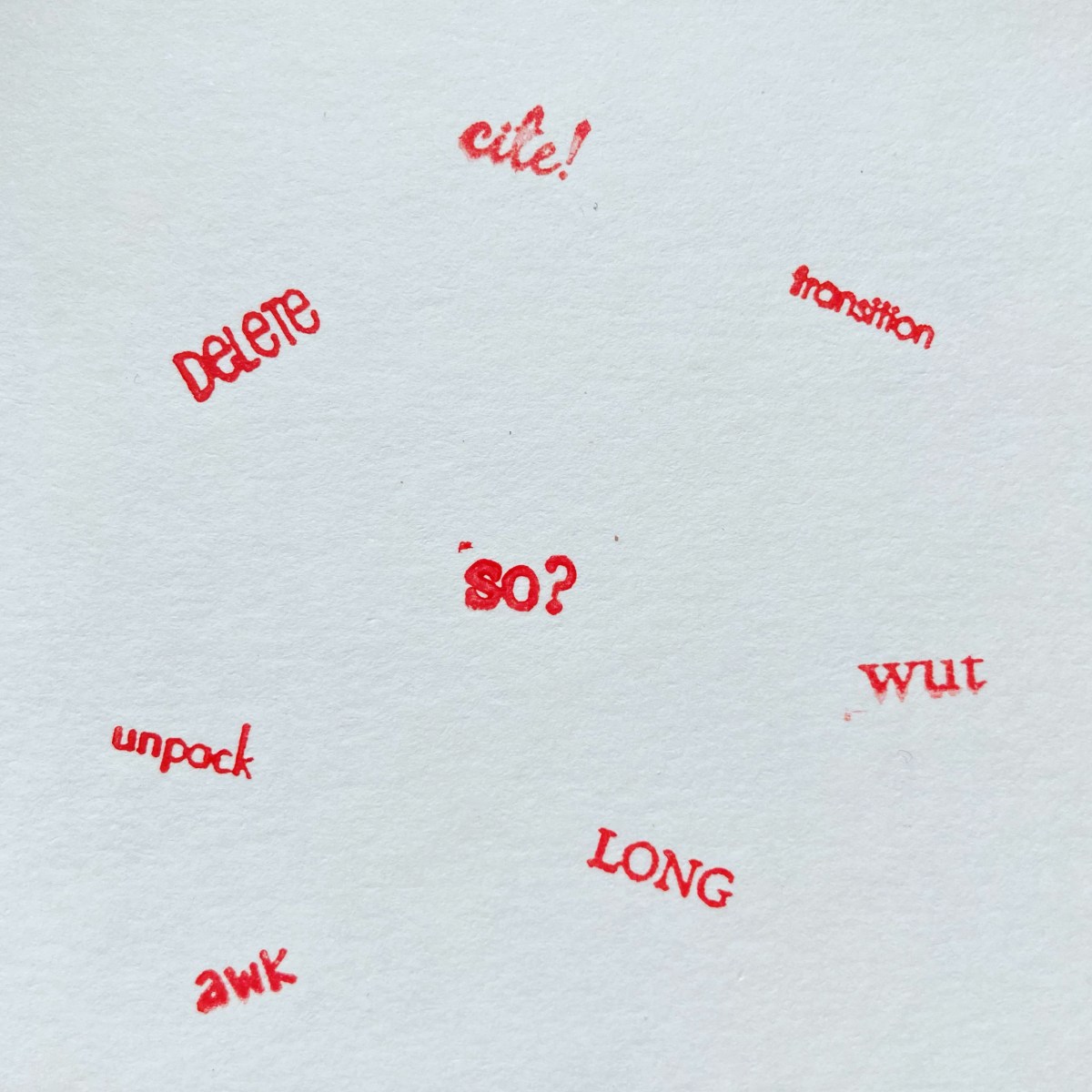
I did respond with this photograph of my personalized editing stamps, and I want to talk a bit more about them. Starting with a question to you: how many times would you have to anticipate writing something before you bought a self-inking stamp to use instead?

Yeah.

Not only are my first drafts far from perfect, but I know what issues I should be looking for. I’m predictable.

Why not just correct those issues while I’m drafting, then? You try it. Writing’s hard. It’s enough of a struggle to get the words on the page without also adding the idea of perfection on top of it. Have you ever found yourself staring at a blank cursor because you don’t want to make a mistake? That’s no way to get things written.

So, while I won’t show you an ink-covered draft page, I will at least go through my stamps with you.

cite! – the meaning behind this one should be clear enough, but having this stamp also means accepting a particular practice: that I don’t have to always stop and look something up when I’m writing. If it’s going to interrupt the flow, I’ll just dump something in that’s close to what it should be and then go back and look it up later, during editing.

delete – not everything I write will make the final cut. It’s sad, but sometimes darlings have to be killed. Or at least moved into a different document.

transition – ah, yes. I am fond of using headings to jump from one topic to another without adding in a transition. Part of it is how I need to write the next section before I fully understand what I’m transitioning to. Another part is being able to jump from section to section when I’m writing without forcing myself to follow the outline point by point.

SO? – the big one. I’m rather fond of knowing exactly why I’m talking about something and how it connects back to my main point, but not actually coming out and saying it. And again, that’s fine, because (again again) nobody reads my first drafts. It’s something that can easily be picked up and worked in on a second pass.

unpack – yeah, it’s a buzzword, but these stamps are tiny and you can only fit so many letters on them. Basically this fits in with SO?: there’s something going on here, but I haven’t actually slowed down enough to say it. I’m trying to get through all of these ideas without fully laying them out and explaining and making connections. The ideas are all there, which is the most important part, and I can add in the support while I revise.

wut – everyone’s favorite. Look, there are times when I just have no idea what I was saying. Maybe I’ll figure it out. Maybe it’ll get changed to delete.

awk – sometimes I’m an awkward duck and it shows in my writing. Revising makes me look less awkward. Did I mention I never show anyone my first draft?

LONG – I like long sentences. I think they make me look more academic. But, when I go back and read them, I really see that they make me look difficult to follow. It’s another easy fix.

I have stamps of these things because I know that I do them. I anticipate that I’ll keep on doing them.

I give myself permission to keep on doing them.

The first draft is just you telling yourself the story. (Thanks, Terry Pratchett.) No one else has to see it. No one has to judge it – not even you. Get the words on the page first so you can shift to concentrating on having them make sense before you show them to someone else.

I, personally, recommend the personalized stamps. They add a little bit more fun to the process. And maybe a little bit more self-acceptance, too.

How do you care about a project for months?

Books take a long time to write. It’s exciting at first, getting the initial idea, working up the proposal, and hoping you get accepted, but then … you live with the idea for months, writing and revising, and other ideas pop up and seem more interesting. How do you hang in there long enough to finish when staring at a page of the manuscript makes you want to tear your hair out?

The advice totally comes from the James and the Giant Peach movie: try looking at it another way. (Imagine a giant stop-motion earthworm saying it with an English accent. Unless that makes it more scary than helpful.)

Last week I forced myself to tackle the conclusion of the book I’m currently working on. When you start a book, you pick one way of organizing your ideas. You have to – otherwise it’s nonsense. And you pick something that you thing readers will be able to follow easily, while still getting your point. But, when you pick one organization, it means rejecting all the others.

I like to write up all my chapters and read them through before going for the conclusion. The time between reading and starting to write can vary, but it’s at least long enough for me to read what I’ve actually written (as opposed to what I thought I’d write) and highlight the main points. Then I like to type up all my notes, print them off, and cut then apart so I can rearrange them.

For me, the actual act of cutting and arranging is more useful than manipulating everything digitally. I start sorting my little strips of paper into piles based on very general section ideas. Last week I put a bunch of sticky notes on the floor with proposed categories and dealt out the strips of paper into each one. This can mean adding another sticky note if there are too many strips that don’t seem to fit, or combining a couple if their piles are smaller and the ideas too similar.

Sorting my ideas this new way made me remember why I’d liked it in the first place. I’ve been working with them in one order – the chapter order, the book proposal order – for months, but putting all the main ideas together in a single pile helps me see how the chapters are connected to each other instead of being isolated ideas.

It also helps remind me of the “so what?” that can get forgotten when focusing on each individual chapter instead of the whole book.

And I kept hearing Earthworm in my head: try looking at it another way. Taking a step back to look at the forest and organizing it in a way other than just by type of tree. Putting down the individual puzzle pieces and looking at the picture on the front of the box again.

It can be a lot harder when the deadline suddenly seems closer and you realize you have to finish something that you might not think is any good anymore. There’s the temptation to keep banging away the same way you always have, just trying to get it done, instead of taking a breath and trying something else. But keeping your nose to the grind isn’t always the best way to get things done.

Sometimes you need to let things drop, take a deep breath, and look at them a different way so you can help remind yourself about why this idea was worth all the effort in the first place.

Was H. H. Holmes really a “serial killer”?

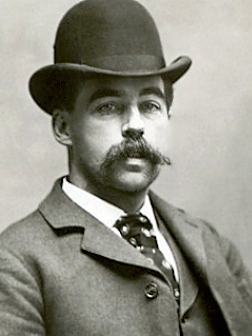
He gets called “America’s first serial killer,” but H. H. Holmes – born Herman Webster Mudgett – was hanged in 1896 for a single murder. Only one count was ever brought against him a courtroom, and we know by now that his confession to 27 murders isn’t believable. So was he really a serial killer, or is that just part of the myth?

The thing is, Holmes didn’t know the phrase “serial killer” when he was confessing. The backstory that everyone seems to know today – absent father, abusive mother, history of starting fires and harming animals and wetting the bed, etc. etc. – didn’t become common knowledge until the last quarter of the twentieth century. (Mindhunter, anyone?) Although the term may have been coined earlier, it still wasn’t in enough time for Holmes to have known it.

And when you consider the “big names” of serial killing – what Peter Vronsky calls the Golden Age – they look more like Jack the Ripper than H. H. Holmes. The most famous serial killers murder and mutilate for their own personal pleasure, and the crimes are usually messy. These get categories as “lust murders,” and Holmes wasn’t a lust murderer.

The murder for which he was hanged, that of Benjamin Pitezel, was part of an insurance scam. Holmes tried to stage his friend’s murder as some sort of accident so that Pitezel’s widow could collect on the $10,000 life insurance policy … and Holmes could relieve her of much of it.

The Pitezel children – Alice, Nellie, and Howard – are harder to explain, considering the strange journey Holmes took them on before killing them, but he used Alice to identify her father’s body and then all three children to control their mother. Holmes may not have had a plan fully hatched by the time he took possession of Nellie and Howard, and he may have abandoned the children in multiple cities, but he doesn’t seem to have tortured them. When Holmes decided it was time to kill Howard and then the girls, he didn’t use a knife. Holmes opted for poison and suffocation.

His earlier murders, at least the ones it seems reasonable to think he actually committed, weren’t killing for the sake of killing. Holmes killed for money, or when one of his mistresses either tired or annoyed him, but he wasn’t a lust murderer. When Holmes could con someone or talk his way out of something, he did.

Not all serial killers are lust murderers, a subset of hedonistic killers. But Holmes doesn’t really fall under any of the other main categories of visionary, mission-oriented, or power/control, either. He doesn’t come across as looking for revenge, trying to eliminate a certain group of people, or someone who gets any sort of pleasure out of murder. For Holmes, it feels like the next step for a con man when he can’t talk his way out of a situation and he doesn’t particularly care about the sanctity of human life.

Where Holmes does fit the definition, though, is how he killed multiple people at different times and in different locations, returning to “normal life” between the murders. He hid the murders, getting rid of physical evidence and even writing letters to cover up for his victims’ absence when noticed. He knew that what he was doing could lead to legal persecution, but that’s exactly what he used murder to avoid.

So: is Holmes a serial killer? The answer is “Yes, with a few buts.” Yes, but he isn’t a lust murderer like Bundy. Yes, but it’s hard to diagnose him for certain considering the time and place in which he killed.

Yes, but he wasn’t America’s first. Just the first one to show up in most contemporary timelines. Serial murder existed long before the term and the FBI’s Behavioral Science Unit (now the Behavioral Analysis Unit), and therefore long before expert definition and explanation could be applied during their lifetime. Holmes made his mark – and started his own myth – at a time when he couldn’t claim the title for himself.

Reframing rejection

The other day I was updating my spreadsheet of proposals and queries. It’s kind of a depressing process, because it means checking my emails again for dates of rejections, but it also reminds me of what I’ve sent out, what’s been decided, and what’s still hanging. As far as guessing when I’ll hear back, well, that’s another question for another time, but it got me thinking about rejections.

The thing is, there’s no secret language in a rejection that actually means “You suck.” Even those form rejections – they don’t actually mean your work is terrible or that you’ve somehow failed as a person. It’s not the greatest feeling in the world to receive them, no, but “I’m sorry, this isn’t a fit” honestly, truly doesn’t mean your ideas are worthless or your writing is garbage.

Imagine you’re decorating a wall. Maybe you’ve just moved, or rearranged the furniture, or put up new wallpaper. You’ve got this space, and you have a lot of lovely artwork. Of course it’s lovely – you’ve bought it all, and you’ve got a good eye. But you’re working with a few limitations.

The first is simply space. If you have more art than you have wall space, something has to be cut. As hard as you try, you just can’t squeeze it all in there.

So next you look at composition: what goes with what? Can you make a nice arrangement of these five pieces, but the other three don’t really fit? Maybe they don’t work with the color scheme or the overall theme. The other three might go together, but they aren’t going to work here. If you tried to cram one in, it would just stand out and throw everything off.

And when you do get the five arranged, does the light hit them properly? Are they too crowded, after all? Do you need to switch something around, or buy a new frame, or even wait until an order arrives so you have enough hardware to hang things?

You’re not passing on something because it isn’t good. It just doesn’t fit here, among all the other pieces. Pieces, of course, that you personally can see, but the artists can’t. Van Gough wasn’t pondering how he might paint something that would look good between this Monet and that Picasso. He was just … painting. Producing his best work. Not sure which pieces would become popular enough to be dorm room posters and which would become obscure.

When you’re the writer submitting your work, you don’t really get to see the wall or the other pieces. You’re offering your idea up and hoping that it makes the final cut – that it looks good in the space and fits with the other authors around you.

And that’s something you have no control over. When you get the “Thank you for sharing, but this doesn’t fit” email, that’s all it means: I’ve got a wall and a wide selection of artwork, and yours didn’t end up fitting the overall tableau.

There are certainly ways to get an idea of the wall – reading multiple issues of a journal before you submit to it, for example – but unless you’re an editor selecting articles for your own collection, there’s no guarantee of getting in. Which means a list of rejections, and the need to be resilient and seek out the next possible wall on which to display it.

How long is your list of rejections?