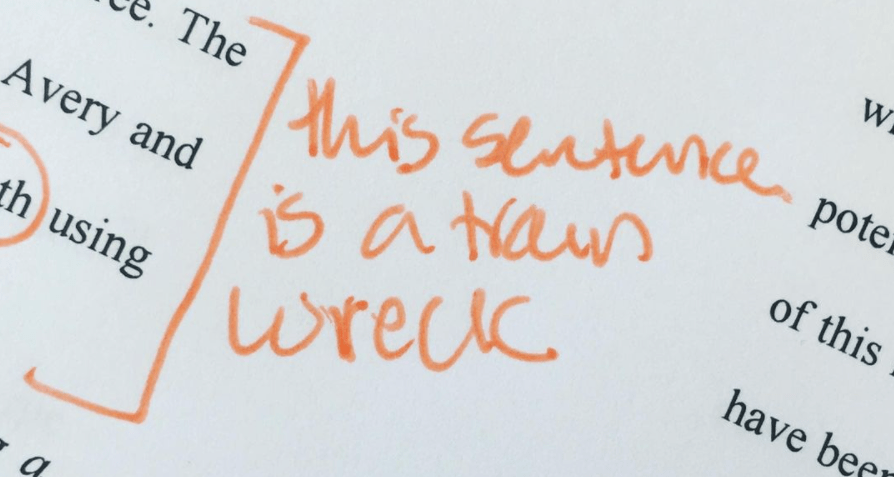

Okay, we don’t really like talking about this part: rejection. Putting your work and ideas out there means giving other people the chance to say “No thank you.” Or “I love this but it doesn’t belong here.” Or “This is a form email.” (I mean, I kind of assume most of them are, but I got one that proclaimed it loudly.)
A couple weeks ago I got three rejection emails. Within seven days. That’s not very fun. On the glass-half-full side it means I’ve been putting my stuff out there a lot, but when you do that … you open yourself up to the possibility of three rejections in a week.
If you want to get published, you run the risk of rejection. So: how do you deal with it?

I have someone that I text with every single rejection. This started because he teased me that I didn’t have enough rejections, so I decided he had to know every single one. It’s not just about annoying him with texts – it’s about how he reacts.
He “judges” the rejection on whether or not it “counts.” Form letter? Yes, okay, that’s a “real” rejection. But if it’s got any sort of encouragement in it, like a revise and resubmit, it doesn’t. He focuses on the good parts and shoves them in my face and makes me go “Yeah, okay, fine, I don’t suck as much as I first thought.”
He also gets any good news texts, too, and this might be the more important part: even if he’s envious of my good news, he cheers me on. Lots of people just … can’t do that. So if you’re going to annoy someone with your rejection texts, make sure it’s someone who’ll be excited for you if you get a response that isn’t a rejection.
I also have a group who gets updates on a more relaxed schedule – usually about once a week. I can whine and complain and sort of get the “failure” idea out there so it’s not such a big deal. (They, too, are more apt to be “Wait how many things have you sent out???” and not secretly keeping a tally of my shortcomings.)
So: have your crew. Have the people who respond to your rejections the way you need – snark and dismissal work best for me, honestly. Then it’s not such a big deal. It’s just all part of the process, and they’re all rooting for me to get the successes. (Seriously, this can be difficult to navigate. Lots of people respond to good writing news with something like “Oh cool. My cousin is published.” Which totally deflates you because then it’s not special anymore. You want the people who will cheer for you, however small the steps, because man, sometimes they feel really small.)
The other important thing here is the fact that these are not general announcements to the world (or my social media). Have you ever heard “Don’t make it public unless it’s permanent”? Good advice. You don’t want to annoy someone who comes across your twitter feed, for example, and get them in a bad mood when you might end up proposing something to them in the future. And even good news, especially good news with a long processing time, might not stay – you don’t want to announce something eagerly and overshare, only to have to retract it later. Even with an offer, not everything works out.
So basically I follow two rules when it comes to rejection: 1) I don’t keep it to myself, and 2) I don’t announce it to the world. I’ve got my people, my team who’ll soothe my ruffled feathers and tell me to bounce up and get back out there so that, eventually, I can do the big public “Look what I did!” announcement.
Rejection is part of the process, even we don’t like to talk about it much – my support staff is a small group, thanks – and it’s something we all have to deal with. The important part is figuring out what approach is going to work for you and help you keep moving forward.
He’s bumped up the number, certainly. At the trial Holmes was accused of a single murder – even the deaths of Alice, Nellie, and Howard Pitezel were not mentioned, since they did not happen in Pennsylvania. Now he’s progressed to “the greatest criminal in history” with 27 murders.
First, he lied. Some of the people Holmes named actually came forward before his execution two weeks later to inform the world that Holmes had not, in fact, murdered them.
What I’ll do is write the idea down immediately. I’ve got plenty of notebooks –
This is my other notebook. It’s a
First confession in Boston, right after being taken into custody: at this point nobody was all that concerned about the children, so Holmes said that they were with their father, Benjamin. Who was totally alive. In South America somewhere, but totally alive. He had first stolen and then mutilated a corpse to be buried in Pitezel’s place.
This is also where Holmes switched from spoken explanation to written. Holmes’ Own Story, published before his autumn trial for Benjamin Pitezel’s murder, is a multi-part book that starts with Holmes’s autobiography. It continues into the second part which is meant to be his prison diary. Then, once the diary structure falls apart, he finally gets around to his explanation of how Alice, Nellie, and Howard could be dead … but it wasn’t his fault.
So 
Please meet H. H. Holmes. If you did actually meet him, though, sometime between his birth in 1861 and his execution in 1896, he might not have given you that name. He was born Herman Webster Mudgett and didn’t adopt the Holmes name until he’d completed medical school at the University of Michigan and then moved away from home (and his first wife).
Detective Geyer made use of the newspapers in his search of the various cities so that he didn’t have to keep explaining himself to various realtors. In Toronto, he gave an interview to numerous reporters so that the story of Holmes and the three children became front-page news. After this, he only had to walk in for the realtor to tell him no, he had never rented to anyone matching Holmes’ description – or that yes, he did indeed remember a man using Holmes’ favorite cover story. Geyer was able to speed through his list of realtors and find the house where Alice and Nellie had been killed.

Take my most intense process so far. A call went out for people who wanted to write about heroic criminals in American popular culture. A friend of mine sent it to me and I debated, but … well, rejection on a proposal hurts far less than rejection on a full paper, so I submitted. Even before something was really written, the two editors had their eyes on it.
Wilding published Jack the Ripper: Revealed in 1993 and an updated version (Jack the Ripper: Revealed and Revisited) in 2006. He starts with Mary Jane Kelly, the final victim of the Canonical Five, putting her in a difficult position. Wilding’s Mary is pregnant, and the father is the Crown Prince himself. For some reason, once she discovers her pregnancy, Mary goes to lawyer Montague John Druitt to inform him of her situation.
When they try to follow her one night, keeping track of Mary by her unique bonnet, Mary Kelly passed that bonnet to Mary Nichols in order to throw off her tail. She did not recognize Druitt and Stephen, and they did not realize that they killed the wrong woman. Thus Mary Nichols’ death was a case of mistaken identity. Mary Kelly worried that it was her bonnet that got her friend killed and told another friend, Annie Chapman. She also made the mistake of expressing the same concerns to Druitt and telling him Annie’s name, turning Annie into the second Canonical victim.
Finding it is usually the problem. Past Rebecca was good about making notes, but she also tended to write them longhand. Take a look here – these are my notes from my independent study course on Jack the Ripper’s victims from way back in 2011. The box is full. That’s a lot of information. And at least it’s divided by subject, with sources up front, and at least Past Rebecca had neat handwriting, but … that’s not the easiest thing to search. It’s a nice physical representation of the research that went into that paper, which turned into my first conference presentation and then my first book. Still, it’s not very user-friendly.
Oh, I still print things off. Here’s my notebook that I worked from while writing Ripper’s Victims. You can see some of my quirks – teeny font, two columns, printed sideways and then stuck in sheet protectors so I can scribble over it with markers. I find it’s easier to have the pages sitting by my laptop when I’m working on that specific section, and if you know me, you know I love my colored pens.
If you’ve only read one book about Jack the Ripper, chances are it’s Patricia Cornwell’s 2002 Portrait of a Killer: Jack the Ripper – Case Closed. Here she is on the back, examining a document carefully while wearing clean white gloves to apparently indicate she’s in an archive. Known for her fiction, especially her series about medical examiner Kay Scarpetta, Cornwell decided to use her personal wealth to investigate the Ripper crimes. Her research, which was updated first in a Kindle single and in a 2017 follow-up book, directed her toward accusing artist Walter Sickert as having been Jack the Ripper.
There are a couple issues here, in spite of how cool she might look on the back cover of the second book in her Matrix-style coat. First, her methods assume that the Ripper himself licked the stamps and the envelopes. This means both that the letter wasn’t handed over to an employee who sold the stamp and did the honors, and that the Ripper actually wrote the letters. And second, because of the age of the letters, only mitochondrial DNA could be tested. At best, mDNA showed that Sickert could not be excluded from the tens (or possibly hundreds) of thousands of possible people who could have licked the envelope. Cornwell’s experts told her she had narrowed the Ripper down to about 1% of the Victorian British population, and in her book she translates this as indicating that yes, it was Sickert.
In 2007, Russel Edwards bought the shawl at auction, believing the story of its provenance when other Ripper scholars present scoffed at the idea. Like Cornwell, he had DNA tests run, this time checking for matches to two people. (Again, note the CSI-style photographs.) Edwards concluded that the blood found on the shawl could indeed have come from Catherine Eddowes, and that the semen did not exclude his personal choice for Ripper, Polish barber Aaron Kosminski.