
2026 is Pending

2025 did not shape up to be the year I thought it would. It’s kind of hard not to focus on the downers: cancer diagnosis. Being released from the contract with my agent. So, because I need something to look forward to, this is my official announcement that I’ll be posting my new novel, Pending, to my blog here, one chapter a day, starting January 1.

I originally had this idea a couple decades ago: what if you picked up a bestselling novel and realized it was actually written about you? Then, because I’m me, and because I’ve had twenty-odd years to think about it, it morphed a bit.

Nell’s just getting her feet back under her after the terror of five years ago. She’s been in hiding since the serial killer the police dubbed “The Fairy Godfather” came into her life and started taking people out of it. She’s adopted a new identity and moved far away from home, working as a barista and flying under the radar. That is, until her boss hands her an advance copy of a highly-anticipated novel and she starts recognizing the plot.

Since You Went Away is advertised as a romantic literary experience, but Nell realizes what it really is: a serial killer’s confession not only to murder, but to his obsession. The hype around the book means everyone’s talking about it and unwittingly trying to find her, the killer’s own choice of final girl. She needs to uncover the real name behind the author’s pseudonym and learn the identity of the man who murdered her friends before he can come for her, too.

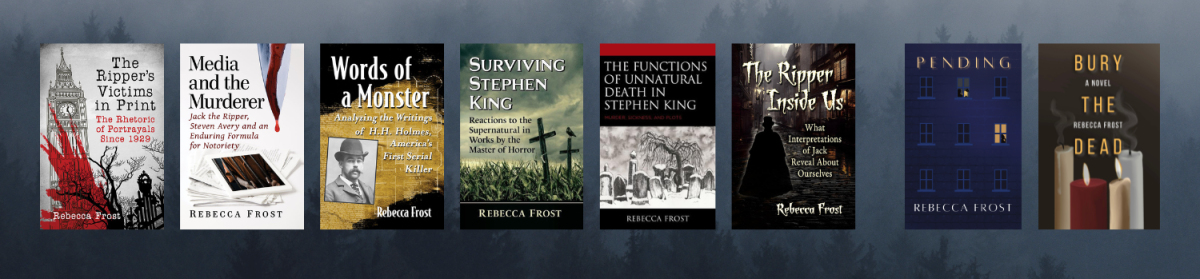
Honestly the most fun part for me is how the cover hasn’t changed since I first thought of the idea, even if so many other parts have. I sent my friend Amara the description and they designed the cover, icons, and headers for me. Don’t they look awesome? And yes, there will totally be a knitting pattern inspired by the cover. Stay tuned!

Pending will be posted here, one chapter a day, from January 1 through February 10, 2026. It’ll be free. Options will be coming to purchase the entire thing, definitely as an eBook and hopefully as a hard copy, because I know some of you will ask about that. For now, let it be known that I’ve decided to make 2026 something I can look forward to, in a way that’s entirely under my own control.

I hope you all have a happy holiday season and I look forward to seeing what the new year brings!

Nessa’s Shrug – a free knitting pattern

Please note: The book referenced in this post is no longer in print. I’m leaving this post up so that the pattern can remain and be knitted. If you’re so inclined, you may purchase any of my in-print titles to offset the work behind offering this pattern. Thank you!

If you’re just here for the shrug, scroll down to the bottom to find the download link. If you’re here for the inspiration behind the shrug, keep reading.

First off, Nessa lives in the UP.

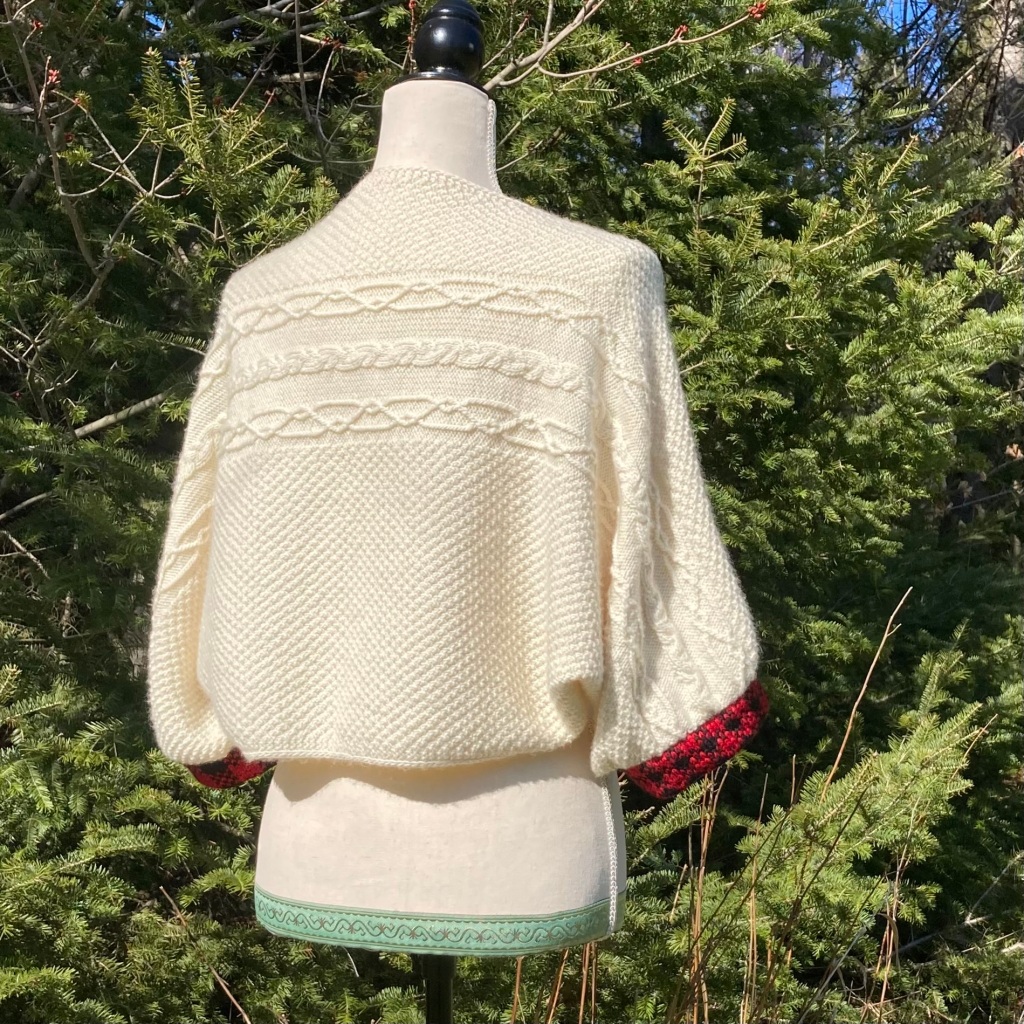
Write what you know, hey? And a good Yooper has a closet full of plaid. I didn’t use just any plaid here – I went for Buffalo plaid in classic black and red. It’s a very bold plaid, with big solid chunks of color, which makes it easier to knit.

However, if you take a closer look and really scrutinize those cuffs with a critical eye …

… they don’t match.

I used the same two colors of yarn (Ravelry Red and Black in Malabrigo Rios, for the record) and both cuffs are Buffalo plaid, but they aren’t the same Buffalo plaid. One uses squares that are three stiches wide, and the other uses squares that are five stitches wide. The cuffs are very nearly the same, but … not quite.

Because the book – and the shrug – isn’t just about Nessa.

Sorry, Nessa.

She’s the main character and one of the two POV characters, but there’s a pretty big important cast going on. For example, Nessa’s got an older brother, Brent, and he happens to be in prison for serial murder. Oops. One of Brent’s murder victims was Sunni Bowen, and in the opening scene of the book her twin sister, Skye Bowen, comes to the UP to talk to Nessa.

You might say the cuffs of a shrug are like identical twins, right? The same thing, done again?

These cuffs aren’t identical, but they’re close. And maybe Sunni and Skye aren’t as identical as people thought … or are they? Cue dramatic music.

There’s also a lot of play on threes.

Let’s take a look at the solid part of the shrug. It’s also in Malabrigo yarn, but this one’s in Washted. (No, that’s not a typo.)

We’ve got three sections to the back, two in moss stitch and one in cables, and that cable section isn’t centered. Plus the middle section has three cable sections, and each cable has three parts. That middle one even feels a bit wonkier than the others, because it could be a standard braid, except … it isn’t. It’s uneven.

There are a lot of uneven threes when it comes to the characters in the book. You’ve got Nessa, Sunni, and Skye … Nessa, Brent, and Skye … Nessa, her husband Josh, and Brent … and a few more I can’t quite say yet. (26 days until publication!) Who’s got the power in each group? Who cares about whom … and doesn’t care for someone else? Once again, cue the dramatic music.

Why a shrug for Nessa?

Marcy got a shawl with some frilly bits because she needed something she could wear over various patterned sundresses to keep warm. Nessa demanded something a little more practical that would stay on while she’s working on her next book (she’s a thriller author, too – write what you know again). A shrug will stay on her shoulders while she madly types her way toward the climax and maybe forgets to eat (or turn on the space heater).

So here we are:

And, of course, since I’ve got you here … preorder a copy of Blood Sisters so I can keep on writing books and knitting patterns. Cheers.

end with a … bang?

I feel like I should do some sort of end-of-year wrap-up because hey, social pressure says that’s hot right now, but … well. I’m never really sure how to approach those kinds of things.

There’s the total high points version

(please imagine that font in sparkles and with accompanying trumpets)

… and those are all awesome things, totally deserving of exclamation points. They’re also the sorts of things we’re used to seeing on these year-end wrap-ups or, say, in your relative’s holiday letters.

Nobody wants to make depressing lists in the middle of winter.

Like, as a completely non-specific example …

Okay I just added this up and now I don’t want to say it.

82 rejections.

That’s across multiple projects. Multiple rounds of querying. Various places. Over the entire year. So and on and so forth, but … ouch.

Or, hey, if we want to go with “middle of the night depressed thinking,” how about the number of manuscripts I’ve written this year that probably won’t be read by more than my usual small group of friends?

4, if we’re going most pessimistic. Because hey, maybe in a few years I’ll be able to come back and check one of them off. But … well. I’ve drafted 4 novels this year (1 rewrite and 3 new ideas) and right now they’re all in various stages of revision that may or may not end up, eventually, one day, with publication.

Or! How about the number of files I’ve opened and started typing, but haven’t finished? That looks like an even dozen. And oof, one of them I’ve been trying to write for over a decade now, but I still haven’t found my way in. (Flashback to the one about failure.)

I know, I know: that’s the most “glass half empty” way to think about things.

Not my earlier post about failure. That one’s very “glass half full.” Because it shows how I’ve kept trying. And all of these stats, both the “yay!” and the “:sadface:” stats, show all of that, too.

I don’t want to end with toxic positivity (Rejections mean you’re putting yourself out there! Abandoned-for-now projects are proof you’re trying!) but it definitely feels better to acknowledge both sides of the year. To say “Buy my debut novel!” but also to allow a peek behind the curtain a bit at the piles of work that don’t always show, for example.

The stuff that can feel like failure.


I’m not good at New Year’s resolutions, for the record.

It feels like too much pressure. And I know that the whole measure of success of “don’t break the chain!” is when you miss a day and just hop right back into building a new chain, but … that’s never really worked for me. (I guess that’s why there’s so much self-help advice – like writing advice, it’s definitely not one size fits all.)

So I’m looking ahead to 2023 more as challenges and deadlines (the good kind, because these deadlines come from a yes! instead of a rejection) and opportunities, and I’m hoping the sparkle font list and the depressing list keep balancing each other out.

Here’s to you and yours being happy and healthy in 2023.

It’s been a while

Let me just dust off this blog a bit …

I’ve been incredibly busy for the past, oh, eight weeks or so. It turns out the local high school was in need of a part-time English teacher for juniors and the concurrent enrollment seniors class (aka teaching a college comp course as an affiliate of a university, to high schoolers, over the course of a full year). So I’ve shifted from part-time freelancing and part-time writing my own stuff, to part-time teaching and part-time writing my own stuff. (Although, with the adjustment to all the new things, it’s meant very little writing my own stuff. As you might have noticed.)

So I’ve been getting used to a new schedule, which means all the normal stuff of a new job plus planning, teaching, and grading. Figuring out all the differences between high school and college. (I knew there’d be more than I anticipated, but wow.) Getting to know a whole bunch of students all at once, but seeing them five days a week instead of two or three, and knowing I won’t have to meet a whole new round of people come January.

Having the seniors for college comp five days a week means I get to do a lot, if not all, of the activities I’ve liked doing with my college comp class before. We’ve already covered, for example, my Golden Record activity, and the rhetorical analysis of propaganda posters and music videos alike. For that class, it feels like being able to slow down and take my time on things, since I don’t have them for just one semester.

But – hopefully? – I’m getting a handle on the teaching side of things and figuring out how much time and headspace it needs, because … well, there’s still the writing thing, too.

I had a book chapter for an edited collection due October 1, and I was able to turn it in exactly one day early. So I’m waiting for editorial comments on that one.

I’m also waiting for editorial comments on my next novel. I can’t really say much more than that, but there is a next novel, and I’ll be diving into revisions on that soon.

I’ve also signed a contract for my next nonfiction book, which I proposed mere days before getting the new job offer. So that hasn’t exactly helped with the stress, but I’ve been able to divide my time a bit more lately and have specific “research time” to work on that.

There’s another book chapter that’s been proposed and accepted, but it’s not due until next August, so we can ignore that one for now.

And of course November is National Novel Writing Month. I’m the only Municipal Liaison (aka regional volunteer) for my region this year, but I’m grateful that other people throughout the (huge) region are willing to host events closer to their homes. But of course that means I’m planning a bit for a new novel on top of everything else, and figuring out where I’m going to get novel-writing time next month.

So that’s where things stand with me right now: busy, as always.

How’ve you been?

12 challenge, book 7 – The Fields

It’s time for book 7 of my 12 challenge: late last December, I decided to go ahead and do the “12 Challenge” that was going around Twitter: 12 months to read 12 books recommended by 12 friends. I specifically requested true crime and thrillers, looking for good books I haven’t read yet. Follow that link for my thoughts on the first six books.

Book 7 is The Fields by Erin Young.

Welcome to the Midwest.

If you’re from the Midwest, you might have the same sort of thoughts I did at the start of the novel: okay why are you taking so long to explain the Midwest?

Right. Not everyone in the world lives here.

There’s lots of corn.

I mean, there’s a lot more to it – and one of the main character’s friends comes from a bit closer to home for me, hailing from Flint, Michigan, which means the water crisis gets mentioned – but this book starts in the corn, and has a lot to do with corn.

Say hello to Riley Fisher.

Some places list The Fields as Riley Fisher Book #1, so presumably we’ll be seeing her again. She’s been recently promoted to Sergeant and the good old boys in the department aren’t happy about it. At this point Riley’s not super happy about it, either, because she’s getting a lot of pressure from a lot of different places. Personal life, family life, work life … Riley’s under a lot of pressure.

It doesn’t help that the murder that opens the book (in the corn – there’s corn everywhere, did I mention that?) combines different facets of her life. Riley’s past is shown in glimpses and flashes because she doesn’t really want to go through it all, thank you very much, but you know there’s trauma there. And the woman who was killed was part of Riley’s life Before The Trauma, so a) she doesn’t want to admit she knows her because it means addressing said Trauma, and b) she hasn’t actually seen the woman in years. So it wouldn’t have been a happy reunion even if both women had been alive.

Did I mention the corn?

I mean, the book’s called “the fields,” opens with a death in a corn field, and takes place in Iowa. The corn’s going to play a role in this. From farmers using drones to inspect their fields, to the intricacies of private versus collective farms, to the science of growing more or better or different corn … there’s a lot of corn in this book.

It’s not the only thing. We’ve already touched on murder, and there are issues with homelessness and drugs. Families have secrets, and not just Riley’s. There’s actually a lot going on in this book, and even when Riley seems to get sidetracked, you just know it’s not really a sidetrack. There has to be something useful in what she learns, even if it all seems either irrelevant or, at best, a red herring.

And here’s where I run into a wall.

That’s the thing about thrillers: you can’t always talk about the stuff that makes them cool. I try to stick to the stuff that’s on the back of the book, or on the author’s website, or in a review, because you don’t want to give things away.

So. Spoiler-free …

The book is more complicated than it first seems. Filler stuff isn’t (necessarily) filler. (Or is it? Thrillers keep you guessing.) There are times when it feels more like a Michael Crichton style techno-thriller than I was anticipating, because most of it isn’t. But even that plays with the Midwest theme: there’s that tension between the idyllic image of the old family farm and the reality of food production in the 21st century.

It’s a book I’m going to want to read again, knowing the ending and how things do – or don’t, or maybe only might – come together. Some books are a trip I only want to take once: I’m glad I went, but I saw enough, thanks, and I don’t need to go back there. I don’t feel like I’m missing anything. With The Fields, I do want to make a second trip, now that I have a better idea of what I’m looking for … in the corn.


Have you read The Fields? Do you think it makes a difference if you live in, or have spent a lot of time in, the place where a novel’s set?

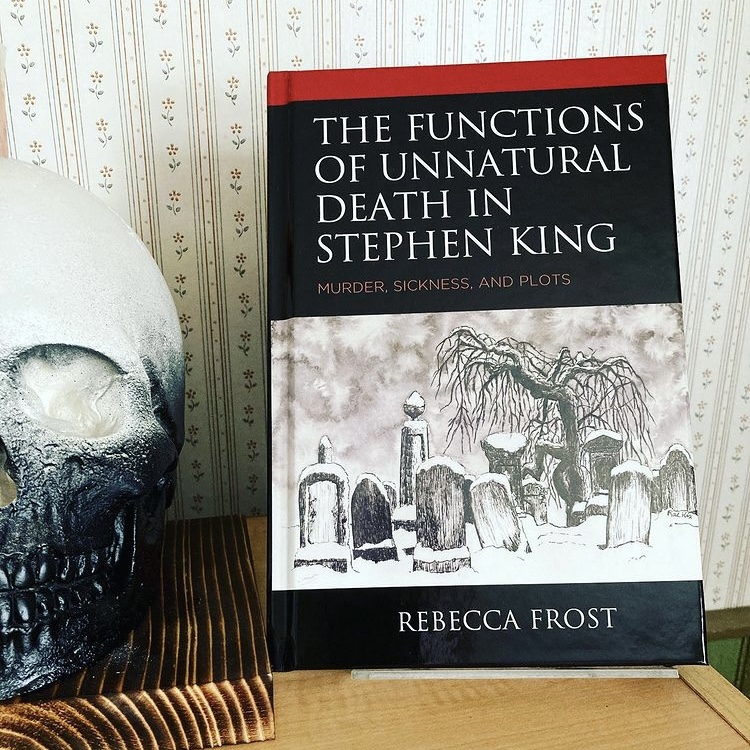
The Functions of Unnatural Death in Stephen King – available now!

It’s here! Out now from Lexington, my latest book, The Functions of Unnatural Death in Stephen King: Murder, Sickness, and Plots. Here’s the back of the book blurb:

The Functions of Unnatural Death in Stephen King: Murder, Sickness, and Plots examines over thirty of King’s works and looks at the character deaths within them, placing them first within the chronology of the plot and then assigning them a function. Death is horrific and perhaps the only universal horror because it comes to us all. Stephen King, known as the Master of Horror, rarely writes without including death in his works. However, he keeps death from being repetitious or fully expected because of the ways in which he plays with the subject, maintaining what he himself has called a childlike approach to death. Although character deaths are a constant, the narrative function of those deaths changes depending on their placement within the plot.

By separating out the purposes of early deaths from those that come during the rising action or during the climax, this book examines the myriad ways character deaths in King can affect surviving characters and therefore the plot. Even though character deaths are frequent and hardly ever occur only once in a book, King’s varying approaches to, and uses of, these deaths show how he continues to play with both the subject and its facets of horror throughout his work.

Phew. So. What does that mean?

A couple years ago now, I sat down with my little red notebook full of Stephen King titles and started making two lists: one of characters who were already dead when the story began, and one of the characters who died throughout the course of the book. For example, ‘Salem’s Lot has vampires – Kurt Barlow was dead before the story started. Duma Key also has some undead, but they’re not vampires. And we all know the Overlook Hotel is haunted.

But it’s not just the undead or the long dead or the who-really-knows-what. Stephen King’s books are full of murder. There are human serial killers (The Dead Zone, “A Good Marriage”); animal serial killers (Cujo); and mass death both disease (The Stand) and homicide (Under the Dome). In fact, I think I counted one King novel that didn’t have any death in it at all. Death is, after all, a large part of horror.

But the two lists – deaths before the story opens and death during the story – weren’t specific enough. I needed to divide them up some more and sort them somehow. The “how” came when thinking back to my comps days and Carolyn Miller’s “Genre as Social Action.” Miller says we sort and define genres by what they do, so I started sorting King character deaths by the role they play in the narrative.

Let’s take a look at a plot diagram.

I took my list of deaths and sorted them according to the diagram. I already had “Who dies before the story starts?” but the in-story deaths got categorized along the rest of it. Usually they don’t happen in the exposition, where we learn about the characters’ “normal” life, but they can certainly be inciting events that lead to the rising action; or happen during the rising action; or at the climax of the book. The falling action and resolution usually don’t have death in them, but in each section I was able to sort the deaths into smaller categories of usage.

I ended up with nine reasons:

  1. to create the thread
  2. to perpetuate the monster
  3. to build suspense
  4. to narrow the focus
  5. to urge the characters on to action
  6. as revenge
  7. as the antagonist’s helper
  8. as heroic sacrifice, and
  9. to restore order

… which is still a lot of death, but I always find things more manageable after sorting things. (Eminent King scholar Tony Magistrale calls it “A cadaverous catalog,” which is just about my dad’s favorite phrase ever.) But, once things got sorted, I could start comparing and contrasting before making even smaller categories.

Which, to be honest, was a lot of fun.

I like re-reading King, making scribbled notes connecting this work with another one and creating my own complicated web. I like listening to the audiobooks and hearing things presented in a slightly different way. Conceptualizing and organizing was fun. Writing and revising based on reviewer comments? Well … not as much fun. But necessary.

So why King?

Isn’t he just the literary equivalent of a Big Mac and fries? Too popular (and maybe too pulp) to be academic?

That sounds familiar. Remember, I also study true crime.

The thing is, the popular stuff – the things it seems everybody reads – is just as worth studying as anything literary or “inaccessible.” The things we read, and especially the things we tend to read without critique, matter because they not only reflect our world and worldview – they shape them. I’ve heard plenty of derisive comments about people devouring true crime or King, especially in paperback form on the beach, but think about how many books get read that way. How many people pick up the paperbacks because of the genre or the author’s name. Just how wide of a reach these things have.

One of the critiques of horror as a genre is indeed its frequent use of death. As Patrick McAleer says in his review of my book, I explore “the numerous and nuanced steps that comprise the ‘danse macabre’ that charge the Constant Reader to look at death as more than happenstance or cheap fright.” After my sorting was done and the analysis started, I ended up writing a generally positive look at King and death. (Yes, that’s a weird sentence to type.)

As often as King might be accused of phoning it in, there are more examples of character deaths taking on a crucial function in the plot of his books. Even when he repeats or makes use of Gothic doubling, there are in fact nuances. As Philip Simpson points out, “Through Dr. Frost’s insightful and refreshingly readable analysis, we discover that the characters who die unnatural deaths in King’s fiction indeed play a significant role in the author’s overall agenda to both support and subvert the generic conventions of horror.”

(Can I just say how grateful I am to have reviews from established scholars in the field that make it clear I hit the notes I meant to?)

King might be prolific, and he might recycle character names (we’ll talk about Alice Maxwell sometime), and not every book hits it out of the park, but there’s a lot to look at and a lot worth analyzing in King.


As a footnote: I know the price of the hardcover and the kindle version. It’s an academic book from an academic publisher.

But! Did you know … you can ask your library to get a copy? And support your favorite authors without having to buy the book yourself? It’s true! If you want to read it but it’s not in your budget, ask a librarian. They’re cool people and experts at getting the right book in your hands.

Do you “cast” your characters in your head?

It’s part of character building: figuring out their biographies and motivations, yes, but also their eye color and hairstyle. How they stand, sit, and speak. I spend more time on my characters than a plot outline because my usual strategy is “Put them together, give them an inciting incident, and chase after them.”

Sometimes I work up complete character sheets with all of this info actually written down, and then I do include a photo of a celebrity as a reference. At times it’s a specific screen shot from a specific role that celebrity has played, so my character is more cued in to that role than the person whose face I’m using. Other times it’s a specific expression that just captures what I’m going for. I can remember one specific character from 2012 where I just searched for “redheaded man” and found one perfect shot of an actor whose name I don’t know, with the exact expression that captured my character. Googling the actor at the time didn’t give me any other angles that really spoke of my character, but that one photo was just *chef’s kiss.*

Picking the photo – or the actor I associate with certain traits – can be key to helping me write the character consistently. In 2019, I had a character in my NaNoWriMo novel who was supposed to be calm. About everything. No matter what I threw at him. And I, myself, am not like this. So.

I picked Patrick Dempsey as my casting for that character even though they don’t really look alike. I’ve just seen Dempsey play a number of characters who are soft-spoken no matter what the situation. When things were getting exciting in the plot, I’d picture Dempsey in one of those roles saying my character’s lines, and it helped me focus on the character’s (almost unnatural) calm. It helped me get out of my own head and my own reactions and into the character who, being an immortal warlock, had little in common with me.

Or take my upcoming novel, which you’ll actually get to read. Not Your Mary Sue opens with two characters, Marcy and Jay. Marcy is a televangelist’s adult daughter, a white woman in her early 30’s. Jay happens to be the notorious Fresh Coast Killer. He’s also white and in his thirties, but … a male serial killer. That’s not within my personal realm of experience.

For Jay, I was playing with the idea of an actor who presents as someone absolutely horrible onscreen, but who is apparently a very nice person in real life. Jay is, of course, the opposite: the “nice person” is his act and the “absolutely horrible” is his real self, but it was a good jumping off point for me. I started thinking about that sort of character around the time when Sherlock and the Loki fandom were big, so you have Benedict Cumberbatch and Tom Hiddleston playing these characters who are, at best, jerks, and yet who have fans fawning over them because they’re apparently really nice people. I mean, you’ve got Loki killing 80 people in two days and Tom posing with kids for UNICEF. That contrast spoke to me.

I’ll say at this point that I haven’t done any looking into Benedict and Tom to actually confirm any of this. Their real lives, that is. Tumblr posts praising their public lives? Sure. Just this idea that they can have these two incredibly contrasting public faces, no matter what their private lives are actually like.

Jay is more Loki than Sherlock, and having that idea of someone who could present such a range of emotions – and inflict such a range of emotions on other people – helped me start sorting out his background, and his various reactions to things, and his view of himself. He had to be changeable, and secretive, and that’s got to take a toll on his mental health even before we add in the Fresh Coast Killer aspect.

I’m looking ahead to NaNo this year, and I haven’t cast my characters yet. I’m debating doing picrew versions, building them from the ground up instead of trying to find the absolute perfect actor and image. (I don’t draw, so that’s out.) I’ve got the basics – hair color, eye color, height differentials, that kind of thing – but sometimes being able to just look at a face really helps things fall into place for me and help me get into that headspace of who a character really is.

How about you? Do you cast your characters at any point in your writing process?

Do you think about writing rules or advice while you’re writing?

There are a lot of rules that go into writing, and a lot of advice books out there. Mind your grammar, to start with, and remember the punctuation goes inside the quotation marks. Use complete sentences, always finish everything you start, hit this plot beat by this manuscript percentage … if you’re not sure about something, Google it and I’m sure someone, somewhere, has a rule. How do you keep them all straight?

I … don’t. At least, not while I’m writing.

If there’s any single piece of advice I’ve adhered to, even before I read it, it’s Stephen King’s “Read a lot and write a lot.” I just found this CD I’d burned in January 2007 with fanfiction and original fiction dating back to 2000, and there were over 70 individual documents on it. A lot of them were various starts instead of complete plot arcs, but there were still a good number of “complete books.” (Hey, I was 15 in 2000. I wasn’t writing 80k, but I was completing plot arcs in things longer than short stories.)

Mostly because of the “read a lot” part, my grammar and punctuation is good, even back then. When you’re exposed to it on a regular basis – especially when it’s a regular, fun basis – you see how it’s done, so it’s easy to imitate. I don’t remember anyone explaining how to write dialogue because, by the time someone probably did, I would’ve just tuned it out. (My parents let me read anything and everything I wanted from a very young age, with one exception: they said Pet Sematary was too scary for a second-grader, even though it had a kitty on the cover.)

Now, is my grammar perfect? Nope. Have I taught multiple college-level grammar courses at this point? Yep? And still …? Nope. But here’s the thing: it doesn’t have to be. People hardly ever speak with perfect grammar. Plus, if you really need it to be polished and shined for a specific, that’s what revision is for.

And this isn’t just about my fiction. When I’m writing my nonfiction, I might try to shift the voice in my head to Full Academic, but … I don’t bog myself down by worrying about it too much on the first pass. The main goal of writing is, for me, to get the darn words on the page, however they’ll come. Jump around, sketch some notes there, plop something in the middle and figure out how to connect it later … whatever. Just get the ideas down.

The “rules” are for revisions.

The first draft of something for me is play. We’ll turn to Shannon Hale here:

I’m writing a first draft and reminding myself that I’m simply shoveling sand into a box so that later I can build castles.

Shannon Hale

And, for the record, my approach to that first draft is “shovel allllllll the sand!” Things can always be deleted later – plot beats, random characters, that one cool point I really want to make but probably doesn’t fit … shovel it all in. Get it all down. The hardest step is putting something on the page, so don’t worry about all the things that’ll just make me freeze and leave it blank. Shovel that sand.

Now, like all writing advice, this doesn’t work for everyone. I have friends who, somehow, meticulously plot out books – or even series – before they start shoveling sand. My revision process is a lot more intense than theirs because I’m still organizing my sand and they’ve already got it placed in neat little blocks with turrets and gables and other architectural flourishes from the start. Some of them started out working that way, and others started more like me and got bogged down in the revisions, so they backed up and changed their approach.

I think the number one rule about writing advice is that not all writing advice will work for you.

My biggest struggle is drafting, not revising or editing, so I’ve formed my approach to make that hardest part the easiest it can be for me. When I sit down to write, I throw the rules out the window. Just get the words on the page – form the sense of it so it can be massaged and perfectly shaped later on. Some days are easier and I can pay more attention to the rules, but others … they get thrown out the window.

The first draft is playing. I’m just shoveling sand. Then, once I’m done shoveling, I’ll switch tools and start shaping, matching tenses, paying attention to singular and plural, messing with punctuation, and knowing that, no matter how much I try, by the time my mom reads my proofs, there’ll still be plenty for her to catch. (I get emails like “On page 6, I know you meant x instead of y” and “On page 10, that’s a gerund, so you really need to …”)

So the short answer to whether I consciously think about rules and advice while writing is no, and the longer answer is “Because I come back to that later.” Plus I’m not the only one who considers it. Editors, proofreaders, peer reviewers … lots of people have the chance to catch the rules I’ve missed. It never has to be just you, trying to remember all the rules.

What about you? Do you think of specific grammar or writing rules when you’re tackling your first draft? Are there specific things you know you need to focus on?

H. H. Holmes’ victims: Dr. Russell

You may recall that Holmes’ first alleged victim, Robert Leacock, was also a doctor. Leacock was “a friend and former schoolmate” whom Holmes killed in for his life insurance. (If you’re at all familiar with serial killers, you know that choosing a victim who’s actually connected to you is just a bad idea if you want to stay out of jail.) Holmes’ second confessed victim, Dr. Russell, was a tenant in Holmes’ so-called Murder Castle.

It seems that, while Holmes plotted and intended to kill Leacock, Russell was in fact a mistake. He had been behind in his rent and, when the two men argued about payments, Holmes “struck him to the floor with a heavy chair.” This single blow was enough to make Russell stop breathing.

Since the men had been in Holmes’ office, he locked the door and then thought quickly. He had a second body on his hands and no planned means of disposal, and his first thought – handing the body over to a Chicago medical college to be used for dissections – was apparently foiled, although he doesn’t say how. Instead Holmes sold Russell’s body to a man he refuses to name, although he hints that he’s told other people the man’s name in the past.

Holmes spends more time talking around this anonymous buyer than he does about Russell’s murder. He informs his readers that this man paid between $25 and $45 for each body and that, when Holmes doesn’t explain how he disposed of his 27 victims, he sold their remains to this man. Even though Holmes is writing and publishing this confession mere weeks before his own execution, he refuses to name this man.

There is also nothing in Holmes’ confession about how he covered up this supposed murder in other ways: cleaning out Russell’s apartment, or fending off concerned friends and relatives, for example. He only writes about – or rather, around – getting rid of Russell’s body before moving on to the murders of Julia and Pearl Connor.

Unlike Julia and Pearl, whose mysterious disappearances had been noticed and connected to Holmes prior to his newspaper confession, Dr. Russell does not seem to have been a true victim. His name and the scant details of his death, very much mimicking the fictional death scene of Nannie Williams in Holmes’ Own Story, seem to have been added to boost Holmes’ supposed body count.

The speed of Russell’s supposed death after the single blow with the heavy chair is suspicious, although there wasn’t enough time left for anyone to question Holmes about it. He simply presents Russell’s murder as part of his argument about how, now that he’s taken a human life, it’s so much easier to do it again. Leacock was killed for money, but Russell was murdered accidentally in a moment of high emotion. It was a mistake, yes, but Holmes was able to respond in such a way as to remain free – and free of suspicion – in order to enact 25 more murders.

The main argument about Dr. Russell’s death seems to be that killing is a slippery slope, and that Holmes had found his preferred means of body disposal early on in his career. Nothing exists of Russell but his last name and he’s quickly bypassed as Holmes moves on to two better-known victims his readers will have already heard about.

1 like = 1 fact about me as a writer

I did this last week on Twitter, and wanted to compile them and share them here. I got 17 likes, so here are 17 random facts about me as writer.

I did this last week on Twitter, and wanted to compile them and share them here. I got 17 likes, so here are 17 random facts about me as writer.

1. I wrote my first novel-length original fic at age 15 because I couldn’t get my plot to work as a fan fiction.

2. My favorite of my published books so far is Ripper’s Victims, because that’s the work closest to my heart. (My mom’s favorite is the one about H.H. Holmes.)

3. I keep track of how much I write each day, but not always in the same place. Sometimes it’s on the NaNoWriMo website, sometimes a sheet of graph paper, and sometimes in my daily planner. (I’ve written over 300k so far this year.)

4. My writing schedule varies wildly. Some days I write 0 words. Others I’m up and at the computer immediately and forget to take breaks for real-life things. It all balances out.

5. In 2020 I decided to complete NaNoWriMo (50k words) in two days, simply because I did it in three days in 2019. I hit 50k by 8pm November 2. And had to baby my wrist for months afterward because … people aren’t meant to type 50k in two days.

6. Because of 5, I taught myself how to dictate my writing, both academic and fiction. I didn’t think it was possible for me but really it’s just the learning curve I didn’t want to tackle.

7. I started lighting a candle when I write as a signal to my brain that it’s time for words, and somehow it’s grown up into this entire thing.


8. The proposal for an academic book is the hardest part for me. I love having swirling ideas and hate forcing myself to commit to a very specific outline. I’ll put off writing the outline as long as possible, even when I know what I want to propose next.

9. I got the contract for Ripper’s Victims because my editor saw my published dissertation and emailed to ask if I had anything she might be able to help me with. (Put yourself out there!)

10. When it’s time to edit, I prefer a hard copy to a screen. Considering the usual length of my manuscripts, this generally means going somewhere to have it printed, since our elderly printer isn’t up to the task.

11. Printing things off means I can use my custom stamps. I get tired of writing the same thing over and over on my first drafts so … I had these made. And of course they’re red.


12. When I’m writing fiction, I tend to “cast” actors as my characters. It especially helps when a character is very much not like me – say, when I have someone whose speech patterns are very calm in moments of stress. If I can picture the actor saying it, it helps.

13. I frequently right click to find synonyms for words I’ve used in my own writing that I’m pretty sure mean what they think they mean, just to be positive. Sometimes I realize I’ve used a word that doesn’t mean what I think it means …

14. I used to write all my “novels” by hand, in pencil, and super teeny – two lines of writing per ruled line on college-ruled paper. I did NaNoWriMo by hand in 2013, but otherwise I type the first draft these days.

15. I used to say all my dialogue out loud as I typed it. My brother laughed because he could hear me arguing with myself. I can write out in public now because I don’t have to do that anymore … but some days I still find myself muttering things as I type them, dialogue or not.

16. I don’t like doing book titles, chapter titles, or heading titles. They’re usually last-minute things I put in before I have to deliver something. It’s rare for me to have a title early on in a project.

17. When the words are flowing and the writing is good, I write fast. Really fast. Which makes the slow days feel agonizingly slow.

Share a random fact about yourself below!