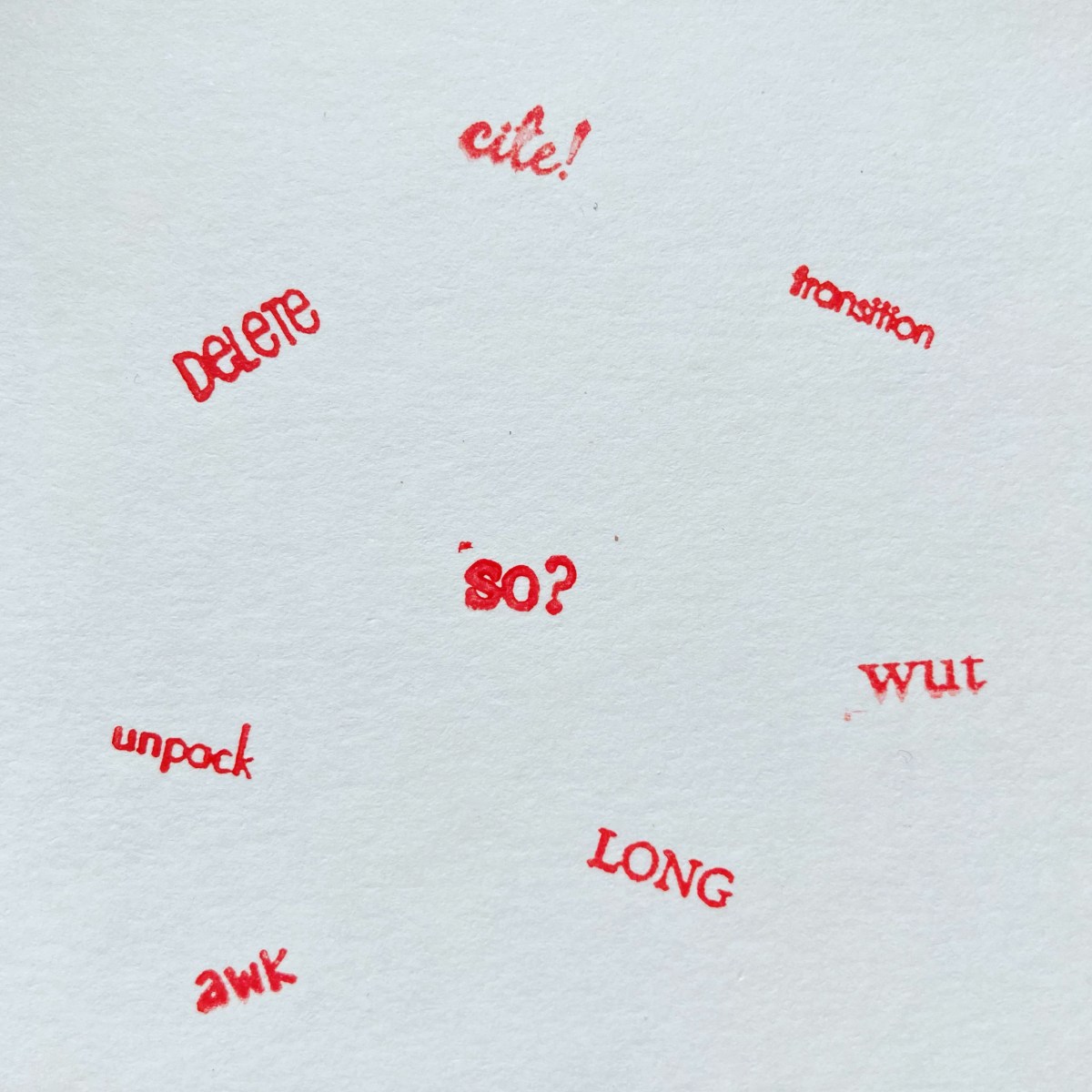
So you want to write an academic book proposal

Academics are used to proposing things: special topics courses. Conference presentations. Chapters for edited collections. To an academic, “CFP” means “call for proposals.” We’re used to the idea that we need to sum up our ideas and present them to a group of peers for approval before moving forward.

A book proposal, though still a proposal, is a different genre.

Most of the proposals we write are short. The people reviewing it don’t want to read more than, say, 300 words. We’ve learned to summarize the main ideas while invoking the proper number of references and making ourselves sound both smart and intriguing given a small amount of space. It’s enough to prove to strangers that we can speak on a topic for 15 minutes or give them a 5-7,000 word chapter by the given due date.

A book is, of course, a much longer project, and the purpose of the proposal can be a shift, especially for academics not used to writing things like grant proposals. You’re no longer arguing solely that your research is relevant and interesting, or that you’re an expert able to coherently and intelligently discuss your topic. For a book proposal, you need to shift your thinking slightly and consider facets of marketing.

When I was in graduate school, one of my professors, Bob Johnson, was telling us about the process he went through to propose his book Romancing the Atom. The part he stressed was how it was up to him, the author, to show the niche his book would occupy in the market. He told us that he had to provide the titles and authors of books that were similar and could be seen as competitors to the one he was proposing.

Granted, this shouldn’t be too difficult for scholars who in fact do research in their own field, but it’s a shift from reading books to add to your own argument toward thinking of those books as competition. This is especially true if someone who’s a big name in your field, and whom you may have met, has recently come out with a book: now you have to say why your book, written by a newcomer, would be chosen over this other one by an established researcher.

The publisher wants to know why your book is unique. This means you need to be able to set your idea apart from the others – while still connecting to the field and remaining in conversation – and to tell them why, exactly, people will buy yours instead. What is it about your book that makes it special, aside from the fact that you’re the one writing it? What gaps do the others leave that yours might fill?

We’ll get more into the usual parts of an academic book proposal next week, but this tends to be the main sticking point and the biggest new thing. Market my work? No, no – I just write a short proposal and then go talk about it. Journals have subscribers who are already interested in the sort of content that will be selected to be included, but this is a step taken by the editors of a book collection, too: does this chapter idea fit with the others? Does it make the point we want to make?

Is it the sort of thing someone would see and then want to buy?

But, come on – can’t the publisher have someone do all that work? If it’s marketing, isn’t it their job instead of mine?

Sorry, no. As the expert in your field, you’re the one best positioned to argue for how your work will fit and what new things it offers. The publisher takes care of a lot of things, but making these points in the proposal is really an argument for them to take the risk on your and your book. If they offer you a contract, they’re committing to the costs and hours involved in publishing your book, and they want to know that it’s worth it to them.

So: if you’re thinking of proposing an academic book this year, start also thinking from the side of marketing. Who’s going to buy your book? What does your ideal audience member look like? What classes might want it on their required reading lists? And why should they reach for yours instead of others already out there, either by the same publisher or a competitor?

Ripper Suspect: H. H. Holmes

There’s been this trend lately of explaining unsolved murders by blaming someone who was caught for a different series of murders. While on the one hand it makes sense – at least in these cases the chosen suspect has indeed proven to be a murderer – it can also feel like grasping at straws. In the case of Jack the Ripper, some have proposed that American killer H. H. Holmes was actually responsible for the deaths in Whitechapel in 1888.

If you need to review who Holmes was, here are Part I, Part II, and Part III of his rather lengthy, and often convoluted, story. So: what does Holmes have going for him?

He was alive at the time: check. He was a confessed murderer – at least sometimes: check. And, um … well …

The problem with Holmes is that all of his confirmed murders were very closely tied up in money or other personal gain. Holmes doesn’t seem to have murdered because murder was fun and all he needed to enjoy himself, the way many serial killers are depicted. Holmes was a con artist who talked his way out of situations if he could but killed people to clear the way if he had to. This M.O. does not describe what happened in Whitechapel in the autumn of 1888.

Further, although Holmes was alive at the time, there are no records of his having traveled to England at all. (Adam Selzer looks at this in his book, H. H. Holmes: The True History of the White City Devil, if you want to read about the reasoning behind dismissing this, and other, Holmes rumors.) True, Holmes liked using false names, but Selzer has also tracked down various stateside interactions during those specific months. In none of his various confession or life stories does Holmes mention traveling to England, although he does suggest that Minnie Williams took the Pitezel children there.

It would seem that, if Holmes concocted his 27 supposed victims for his newspaper confession in order to make money and help them sell more headlines, that he really should have mentioned the Ripper murders if he had been responsible. Instead, this confession outlines the murders of people who then turned up to announce they were still alive, and also created fictional people to add to his death toll. It is true that Holmes was accused of many crimes after his arrest, but the Ripper murders were not one of them.

Granted, as a confessed murderer whose confessions must be in doubt, Holmes makes a better Ripper suspect than many. But why accuse him in the first place?

Holmes is marketed as “America’s first serial killer,” while the Ripper often gets the byline of “world’s first.” Even the origin of the term “serial killer” is debated between an American and a Brit. If the Ripper turns out to be American, then Holmes becomes “world’s first” and America can claim the dubious honor and add more titles to the true crime bookshelf.

Was Holmes a murderer? Yes. How many people did he actually murder? That’s still a mystery, but the number is far below his top claim of 27. Did he murder Mary Ann Nichols, Annie Chapman, Elizabeth Stride, Catherine Eddowes, and Mary Jane Kelly? No.

Who did? Good question.

New Year, Same Me

So it’s the time of year when we’re all supposed to be setting new goals, and they really should be SMART ones: Specific, Measurable, Achievable, Relevant, and Time-bound. My husband is really good at this kind of thing and ends up with a whole list of proposed achievements for the new year, and he’ll check in on them and adjust as the months go by. Me? Eh …

Making up goals for a whole year gives me the same sort of feeling I get while looking at a syllabus: I’m supposed to do how much in how long? Even if I’ve taught the class before and I know it’s very much doable, it just seems ridiculous. Insurmountable. After all, how am I supposed to accomplish all this when I’ve never really done much of anything before?

With that attitude in mind, my only real goal for 2021 is to keep better track of what I do accomplish. My husband is better at this, too: he’s been keeping a journal of accomplishments for years at this point. I tried last year, in a blank book, but didn’t keep it up. I felt like maybe I was padding my days (I wasn’t) and worried I might forget something or leave things out (I probably did). But I also had a discussion with someone the other day that made me realize it’s important to at least keep track of my writing progress.

If you don’t have a mentor or someone in your life who’s done it and is therefore able to remind you of how far you’ve come, it’s easy enough to forget. When you’re living it, it doesn’t necessary seem easy, exactly, but come on. If I can do it, surely anybody could do it … right? So what you really need to do is remind yourself that this thought is in fact … wrong.

I’m using my planner as a place to keep track of how many words I write during a session (instead of random notebooks kept haphazardly to prove to myself I’m actually doing something) and to just … keep track of the things I do in fact accomplish. To remind myself that I’m not just a lump on the couch and that, on days when I am, it’s because I’m resting from everything I’ve already done.

How about you? What are your goals for 2021?

Taming the Inner Two-Year-Old

Sometimes trying to write feels like wrestling an angry two-year-old, except you’re the two-year-old. You’re cranky, and distracted, and you’d really probably like to have a snack right about now. The problem is, if you’re writing toward a deadline, you also have to be the adult.

The adult is the part that reminds you of your due dateand your daily goal. The part that points to the calendar and calculates what your new daily goal would be if you slacked off. The part that wheedles and begs … but also the part that can find ways to appeal to the two-year-old inside you.

The other day I was telling someone that things have to be Just So when I’m writing. It’s not a ritual, exactly, but an acknowledgement of my inner two-year-old. The toddler inside my head will take any reason to stop working and give up on something that’s too hard, or will just get distracted by anything else. So I’ve developed a number of things to keep myself focused so, as much as possible, the toddler has nothing to grab onto.

Instead of getting frustrated with myself for not being able to focus in a certain way, I’ve figured out a number of workarounds. It’s one thing to get frustrated with a kid who doesn’t want to do something, and another to try to figure out why the kid is being so stubborn. In these cases, I’ve chosen kindness toward myself and have purposefully organized my writing space and process to give myself the best chance. Weird, right?

Take these sheet protectors. I totally got them for Christmas and I am thrilled because I use them a lot. I like printing things off and having them in front of me so that my screen can be devoted just to the document I’m writing – fewer clicks and fewer distractions for the toddler – but I discovered a while back that I have this thing about writing on what I’ve printed. If it’s notes, I don’t want to do it. Making marks just messes things up.

Enter the sheet protectors. I don’t know why they work for me, but they do: the marks go on the sheet protectors, so I can still color-code to my heart’s content, but the original notes remain unsullied. It’s weird, sure, but it’s a step that I know happens to work for me.

Or how about this one: some days I start with a blank document, and it actually helps. Most days – and for a lot of people – the huge amount of white space is paralyzing. The flashing cursor just counts off all the seconds you should have been writing, but haven’t yet. But, on my worst days, I feel like adding to the original document would be like writing on my notes: sullying something that might not have been perfect, exactly, but isn’t going to be made any better by my current ramblings.

So, on those days, I open a blank document and release myself from any sort of expectations. They don’t even have to be titled properly. I’ve got one called “written doodles” that just worked for me because clearly it didn’t have to be great. They were just doodles, after all. Just me, trying to get my thoughts in order.

Other times it’s the room itself: the proper chair. Background noise, or silence. A better playlist. Turning on a space heater or opening a window. When I’m at my crankiest, I have to tend to all of these things first and make myself as physically comfortable as possible so that my thoughts can then focus on something other than “I’m hungry” or “The tag on this shirt itches.”

You don’t have to power through that kind of stuff. Writing is hard enough as it is without giving yourself more hurdles. The longer you work at it, the more you’ll discover your own little quirks and be able to tackle those straight off, building up your writing space and priming yourself to be as comfortable and distraction-free as possible.

Be nice to your inner two-year-old. Sometimes they really know what they’re doing.

H. H Holmes’ victims: Dr. Robert Leacock

Every serial killer has to start somewhere. The “serial” part means they had to keep going, eventually, but there’s always a first. For H. H. Holmes – at least in his newspaper confession – his first victim was a former medical school classmate, Dr. Robert Leacock.

Holmes attended the University of Michigan for medical school and did indeed graduate. Although “H. H. Holmes” wasn’t his real name, the MD was earned. Many sources trace his murderous intentions back to medical school, where he has also been accused of participating in grave robbing in order to have cadavers on which to learn. This also led to questions of whether enterprising medical students – or those looking to make money off a sale to a medical school – might murder in order to provide the students with learning material.

In his newspaper confession, Holmes actually says very little about Dr. Robert Leacock. He dismisses the murder because it “has been so often printed heretofore” and quickly moves on to the lament that, “like the man-eating tiger of the tropical jungle, whose appetite for bloodlust has once been aroused, I roamed about the world seeking whom I could destroy.” That’s all very dramatic, but it doesn’t tell us much about Leacock.

Earlier, in Holmes’ Own Story, Holmes had written of a previous insurance scam he had run in order to somehow prove that he could not, in fact, have murdered Benjamin Pitezel in a similar scam. The few details he gives about Dr. Robert Leacock’s murder do not quite line up with the information provided in Holmes’ Own Story but, since each is most likely a lie, that’s understandable.

But what’s the tale of the insurance scam he supposedly committed with his former schoolmate?

More than a decade before Pitezel’s death, Holmes supposedly decided to fake his own death using a lookalike cadaver in order to reap the insurance money. (He says that his wife would have been the one to inherit, but his third wife – the one he claimed at the time of the trial – hadn’t even met him yet. Apparently no one caught this inconsistency before his book went to press.) In this version, however, Holmes simply waited for someone to die who would look enough like him to count. He didn’t, according to the book, kill anyone for this scheme.

He also didn’t prepare very well. Holmes wanted to take the lookalike body north into Michigan and leave him, head crushed and with Holmes’ papers in his pockets, to be found and identified. Although Holmes should have had plenty of experience with both cadavers and decay during medical school, he planned poorly for transporting a body secretly by train.

It turns into a whole comedy of errors. The first trunk Holmes had specially made began leaking ice and odors, forcing him to stop and buy a new trunk. It couldn’t be seen to be empty, though, so while the shopkeeper prepared the trunk, Holmes walked back and forth with lengths of pipe he had also newly purchased in order to fill it. Then, when the new trunk was delivered to his hotel, he could pretend that it was full of his belongings.

It didn’t seem to occur to him that anyone involved in this various transactions might notice the oddity and remember him.

While apparently lost in a reverie, contemplating the lookalike corpse who was reclined on more ice in the room’s tub, Holmes’ room was invaded by detectives or secret service men or someone just that exciting. Using lies – common for Holmes – and threats (less common) he managed to get himself out of the initial situation, claiming the dead man was his brother. When Holmes left the hotel, though, he knew he was being pursued. (He was, of course, both interesting and cunning enough that any secret service agent would want to follow.)

Unfortunately for Holmes, the train he took ended up having an accident, delaying him just long enough for the secret service agent to catch up. Holmes did not flee the scene, leaving his suspicious luggage behind. No – instead he put his medical degree to use and cared for fellow passengers who were injured in the crash.

Perhaps since the secret service agent was alone this time, Holmes was able to bribe him, and therefore continue his way north with his smelly, sodden trunk. Holmes sums up the tale quickly by explaining that, a few weeks later, his plan went off exactly as he wished, and he walked away with the insurance money. (His wife, whose presence was never fully explained, is forgotten.)

Later he apparently gifted the trunk to friends who laughed with delight when he told them the tale, because they had always thought it was haunted.

Right. So.

Clearly there are a lot of problems with this story. For one thing, according to Holmes’ Own Story, it should have taken place in the early 1880s. Although he would have indeed been married to Clara (Lovering) Mudgett at that time, during the summer of 1895, when Holmes’ Own Story was published, Holmes was insisting that he was married to Georgiana Yoke and that he had never married another. This was because Georgiana was a witness in his murder trial and, if it were proven that the marriage were bigamous, she could indeed testify against him. Holmes married three women in his lifetime without ever divorcing any of them, and all three were still alive at the time of his death.

There is also the question of the insurance money. Different amounts are stated in Holmes’ Own Story and in his confession to the murder of Leacock. If, for example, Holmes had managed to get his hands on the $40,000 he said came with Leacock’s death, what happened to it? Where was it spent? Holmes never clarifies, and he never explains how he ended up with the money from his own apparent accidental death.

The story as originally told is meant to explain that Holmes, although a rogue, is not a murderer. He waited for a body that would look enough like him to be brought to the morgue rather than searching out his own double and then, even once he started to put his plan into practice, he made a mess of things. Far from being a slick and confident criminal, the Holmes in the original story made mistakes at every turn. He only managed to pull of the scam by bribing someone to look the other way.

It did make for a good story, though, so it also makes sense that Holmes’ confession would reference it. He dismisses a number of people in the same way, but arguing that much has already been written about them, without ever actually clarifying what happened, or how much of what has already been written is true.

Did Holmes actually murder a man named Dr. Robert Leacock in order to fake his own death and reap the insurance benefits? No. This is one of his false confessions, albeit one that may have helped boost sales of his book if by chance some curious reader had missed the adventurous corpse, trunk, and secret service man story.

How do you read for research?

Reading for research is different than reading for fun. Research comes with a purpose, and it’s helpful to have that purpose at least sketched out before picking up a research book. Otherwise you’ll end up having to go back and re-read more often than not. So: how do I read for research?

Short answer: with two highlighters and a pen.

Longer answer: it depends on whether it’s for a specific project or just a general true crime book. For general true crime reading – I can’t even just pick one up for fun anymore because there’s always something I want to highlight – I stick with my usual interests: representations of criminals and victims. If something is particularly interesting, important, or aggravating, I’ll also fold down the corner of the page. (Clearly on books I own. Don’t do this to an interlibrary loan. Scan them and make your own copies if they’re, say, a Ripper book so rare you can’t buy one for less than $2,500.) One color is for normal highlighting, and the other is for the most important of the important things. The pen is to scribble bon mots in the margins. (These usually look like “wut” or “no” or “???”)

If I’m reading for a project, sometimes the colors explode because I know a number of things I’m looking for. My old, ragged copy of The Stranger Beside Me, for example, has been highlighted and sticky-noted in six coordinating colors. Purple is where Ann Rule describes the scenes of the crimes, but there are colors for how Rule describes Ted Bundy; how he describes himself; about his romantic relationships; and so on. I did the close reading with all these themes in mind and yep, it took quite a while. This wasn’t during my first reading of the book, either – I’d already read it and knew the general plot, which helped. During the deep dive I could therefore concentrate on the threads I was looking for without having to worry about completely understanding everything I read.

Adding the sticky notes also helped me see patterns. Rule jumps back and forth between talking about her own life, her friend and coworker Ted, and the mysterious “Ted murders.” Seeing where the purple cropped up, for example, as compared to the sections Rule wrote about herself, says something about the narrative and how she wanted to tell it. There’s also one important sticky note hundreds of pages in where she finally admits that her Ted is indeed the Ted. (The downside? Clearly there are a ton of sticky notes on there, so the super most important of all the important ones can get lost. They’re a different style, but it can still take me a while to find the quote that I just know is in there.)

I’ve learned since then, though – one of my more recent multi-color adventures has a key in the front. That book is a reprinting of various newspaper articles and documents from police files, and it’s not always clear who the author or subject of each text is, so the colors help distinguish between the major players. This one isn’t the result of reading through from beginning to end with a bunch of colors in hand, but using the index to go color by color and person by person, because of the nature of the project. I didn’t need to do another complete read-through, especially since I’m already rather familiar with the general topic.

I’ve tried reading in ebook format for research, and a couple books I’ve found have only been available as kindle versions so I’ve been forced to highlight and bookmark digitally, but that just doesn’t work as well for me. On the plus side you can easily download all the highlights from a single kindle book, including the location, which makes compiling notes easier than having to type them up, but on the other hand it’s all part of the process for me. I’ll do a lot of reading and highlighting and then a lot of typing up notes so that I’m reminded of various things I’ve read and I have a better idea of where things are going and how they hang together. I tried using a digital highlighter for a while, but the act of typing up the notes helps my memory. (Plus no digital highlighter is perfect, and correcting a scanned sentence just felt more annoying than typing up the whole thing.)

I think the most important thing, though, is to not limit yourself. I always have that extra highlighter as an “other” sort of category: I wasn’t specifically looking for this, but it’s interesting and it should be remembered. It might not affect my current project and its argument, but it could be useful to remember for a future idea. Or it might actually twist one of the themes I already had in mind and needs to be taken into account immediately. It always helps to know what you’re looking for when you dive in to a book or a chapter, but keep an eye out for the things you never expected, too.

H. H. Holmes’ victims: Julia and Pearl Conner

Last week we took a look at another pair of Holmes’ claimed victims, named in his confession of 27 murders. Minnie and Nannie Williams were sisters. This week we’re looking at a mother and daughter: Julia and Pearl Conner. They, like the Williams sisters, are very likely true victims of “America’s first serial killer.”

Julia’s husband, Ned, worked at the jewelry counter of the pharmacy in Holmes’ building, which explains how their paths crossed. Holmes and Julia began an affair, and eventually Ned simply left his wife and their daughter. Julia and Pearl remained at Holmes’ hotel, although it wasn’t long before no one heard from them again.

The usual date given for their murders is Christmas Eve, 1891. Julia is meant to have told Holmes that she was pregnant with his child and, not knowing that he was already married, demanded that he make her his wife. Holmes supposedly agreed to marry her as long as she would allow him to perform an abortion.

Julia did not live through the operation. It is possible that Holmes used the abortion as cover for his murderous plans, or that something went wrong and she died when he didn’t intend it. Certainly during his very last confession, given on the scaffold, Holmes admitted that two of his patients died as the result of an illegal operation. One of them may well have been Julia Conner. But what of her daughter?

pearlThe order of events is fuzzy and might go a long way to answering whether Julia’s death was intentional. In his newspaper confession, Holmes says that Pearl’s death was due to poisoning, and that Pearl died after her mother. In Holmes’ confession Julia is his third victim, and Peal his fourth – although apparently there was an accomplice in this case.

Holmes writes of a couple who not only wished to save Pearl, but to give the young girl to their elderly parents so they could raise her. They were the ones who actually gave Pearl the poison, although Holmes personally insisted on it. He “believed the child was old enough to remember of her mother’s sickness and death” and so, in time, Pearl might have said things that would have incriminated Holmes.

Aside from this mention of two guilty accomplices, Holmes also takes care to mention that, due to the suddenness of Julia’s death, he was unable to gain possession of some property she apparently owned. Ever solicitous, and at the time of printing two weeks away from his date with the noose, Holmes writes that he will be sure this note is passed to Julia’s relatives, who have more need of it than he does.

Then again, this is the same man who, earlier, stated that Pearl was off with other relatives until she was old enough to speak for herself and therefore out of danger. The same man who claimed the girl was alive could easily lie about money and property, although his usual MO did indeed seem to be to secure such things before committing murder.

Was Julia Conner’s death an accident, or did Holmes poison Pearl before her mother’s “operation” was even set to begin? Were the human remains discovered in the basement of the building actually Julia’s? It seems likely that Julia and Pearl Conner, like Minnie and Nannie Williams, were indeed victims of “America’s first serial killer,” but some things will never be known for sure.

H. H. Holmes’ victims: Minnie and Nannie Williams

H. H. Holmes – born Herman Webster Mudgett – was hanged after being found guilty of a single murder: that of Benjamin Pitezel. But, as we have seen before, Holmes himself confessed to 27 different murders. (At least, for one newspaper publication.) Who, then, did he confess to murdering?

Minnie Williams plays a large role in most variations of Holmes’ stories. As far as anyone can tell, the truth is that she met Holmes and was convinced to come to Chicago with them and then sign her inheritance over to him before he murdered her. Holmes also used her to lure her sister, Nannie, to the big city around the time of the Columbian Exposition, and Nannie also disappeared. The real Minnie was rather naïve and fell under the spell of a clever con man.

Holmes, though, tells us multiple different stories about her.

In Holmes’ Own Story, his autobiography published before his murder trial, Holmes takes a lot of the accusations that have been leveled at him and turns them to Minnie. Rather than an innocent, Minnie comes to Holmes already having had lovers. In this version, she is the one to pursue him, even getting an apartment where the two of them can live together apparently as husband and wife. This was, according to Holmes, all Minnie’s idea.

When Nannie came to visit, she stayed in the guest bedroom of this apartment. Minnie had to be away for one night and asked her “husband” to keep Nannie company. Nannie, however, insisted that she was fine, so Holmes spent the night elsewhere. When he returned the next day it was to find Minnie already there, standing over Nannie’s dead body. She had come home, seen that the only bed slept in was Nannie’s and assumed her husband had spent the night there, as well. According to Holmes, Minnie killed her sister with a single hot-blooded blow.

Holmes helped Minnie get rid of her sister’s body – by putting it in a trunk and sinking it in Lake Michigan – and then told Minnie he never wanted to see her again.

For her part, Minnie left to seek treatment for her mental health, which explained why her relatives were not able to contact her. She was, of course, ashamed of what she had done.

Luckily for Holmes, though, Minnie seemed to gather herself together enough to be schoolmistress to the three Pitezel children he had collected. (You remember the strange journey he took them on.) In Holme’s Own Story, Minnie Williams was a member of one of the groups, traveling with the children and eventually taking them out of Holmes’ care and away with her to England. She, of course, had to hide because she’d murdered her sister. At one point Holmes ordered a coded message to be put in the newspaper, asking Minnie to reveal herself and the still-living children.

Most of the way through the book, however, Holmes comes to a different conclusion. It seems that Minnie returned to him with a new lover, a Mr. Edward Hatch, who looked very much like Holmes himself. Hatch was the one who in fact murdered the children, but, according to Holmes in this instance, it was done at Minnie Williams’ own bidding.

Holmes speculates that Minnie Williams, a woman he had apparently rightfully scorned, was madly jealous of Holmes’ recent marriage. In order to destroy Holmes’ life, she plotted with her lookalike lover to get Holmes framed for the murder of the children. (Why she had Hatch hide the children’s bodies so well if she wanted Holmes to be clearly known as a murderer is not exactly explained.)

Minnie Williams, therefore, becomes not only a loose woman and guilty of her sister’s murder, but is now the mastermind behind the deaths of the Pitezel children.

In his newspaper confession, when Minnie and Nannie Williams become two of Holmes’ 27 murders, he does at least attempt to undo the damage he has done to Minnie’s reputation. He wronged her not only through murder, but through all the lies he told about her afterward.

Minnie and Nannie Williams become murders 20 and 21 in this recitation, and Holmes heaps on the emotion when he does what he can to clear Minnie’s name. Now she was a “virtuous woman” before he met her, and she was never once “temporarily insane,” especially since it was Holmes, and not Minnie, who had killed Nannie. Once Holmes had various signed documents, he killed her, although he does not specify how. Nannie Williams, according to this version, died locked in the giant safe in Holmes’ murder castle.

Although not all 27 victims Holmes listed in this confession were in fact dead – and some were likely made up completely – Minnie and Nannie Williams are two who very likely died because of Holmes and his greed. Holmes had the habit of using people for all he could get from them, and then disposing them so they could not reveal what he had done. Once the Williams sisters had given Holmes what he wanted, he very likely did murder them

How do you get back to a writing project you haven’t worked on in a while?

November is National Novel Writing Month, and I’ve participated every year since 2010. The goal is to write 50,000 words during 30 days, and it’s geared toward fiction. By the end of the month you should have a large chunk of a first draft of a novel. Which is awesome, and I love the community and everything that comes with it, but … academic work? What academic work?

It hasn’t been a whole month since I’ve worked on this project, but it’s been a good couple of weeks. So now I have to pick it back up, and recalibrate my brain to academic writing instead of fictional fantasy, and remind myself of what, exactly, I said I’d write in the first place.

So the good part: Past Rebecca wrote up a book proposal. Academic book proposals don’t usually include a full manuscript – it’s “just” the intro and a sample chapter or two – but they do include a full outline. It’s something I really don’t like doing at the time, but I rely on it a ton as I’m working on the book. For this project, I not only had to submit chapter titles, but also a quick summary of what each chapter is about. The framework is there.

Before this break, I’d also compiled my notes for each chapter. I like to print them out so I have have them next to my laptop while I’m writing. They’re not entirely organized the way I need them for each chapter, but they’re all present and accounted for, so I can highlight the most important things and then cross them off as I use them.

I’ve even got my little tabs so I can switch to a different chapter if the muse is being difficult. (That’s a good way to get your words in for the day – switch to a different section. You paint yourself into a corner by the end and have to write the more difficult bits, but by then you’ve got so much of the project done that it looks like such a small hurdle. Or so I tell myself.)

But then the new problem I give myself is that I have various files for various chapters but, especially after a break, I don’t remember what chapter is in what step of the process.

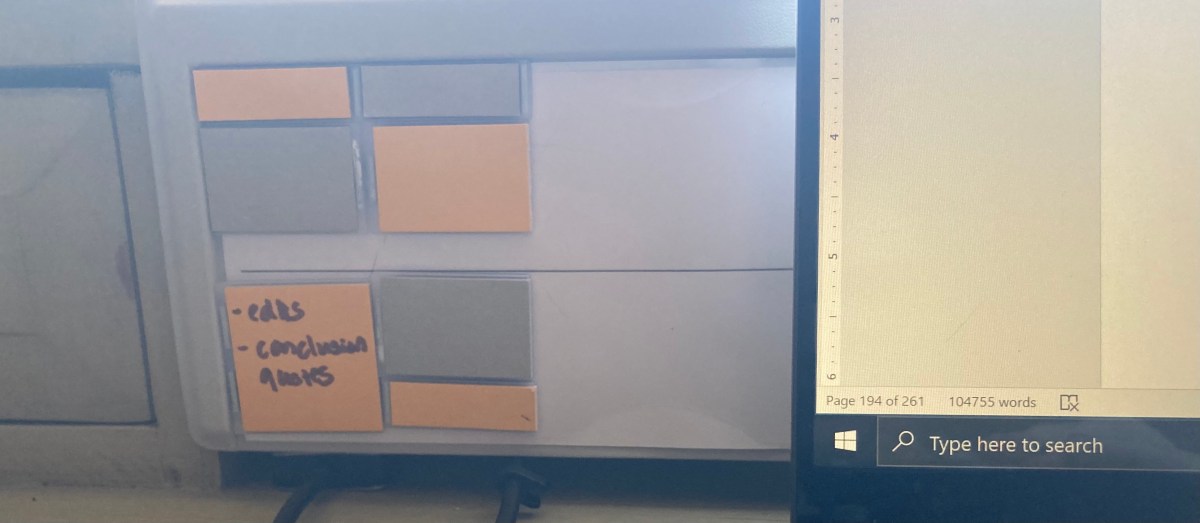
So I started off my day with arts and crafts. I figure I’ll use this again, so I’ve got my foam board divided into sections with labels across the top: not started; notes exist; barely begun; mostly there; needs another look; integrated (into the whole book and not just as a stand-alone file); and ready for a final read. These are all chosen based on what I know about myself and my writing process, so you could easily have more or fewer, depending on how you work. 

The chapter numbers, plus a quick reference word or two, are on sticky notes that can be moved from column to column. (I’ve made all the sticky notes one color because there are times I’m working on multiple projects, so … there might need to be another color added if, for example, my chapter proposal for an edited collection gets accepted in January.)

This helps me step back and take a look at the forest instead of my trees (or, in the case of paragraphs, individual pine needles). Nine chapters, plus intro and conclusion, feels a lot more manageable than “Okay in this chapter I need to discuss three books, but this one has fourteen, and this other one over here …” It also helps me remember which chapters have been completely abandoned in search of inspiration and which still need just a little something before they get integrated.

Some days it’s also easier to focus on the small thing: today, I’m going to move this chapter from “notes exist” to “barely begun.” (That’s actually my goal, although I’ve already put Chapter 5’s sticky note into the other column. It’s only jumping the gun if I finish this blog post and then don’t work on chapter five.)

It may look a bit like silly arts and crafts, but it helps remind me of the scope of the whole project, and how much I’ve already done – and, perhaps most importantly, it reminds me of all these cool ideas I’ve had that are worth the struggle to actually write down.

What does it look like when you come back to an older project?

Why I write about serial killers

“How did you get interested in serial killers?” Let’s face it – that’s probably the most common question I get asked once people learn what I do. At least it’s one I actually have an answer to. And even a specific date for.

I was in London in July 2007. My mom was helping me plan the trip and I told her that I had to be there on July 20, because Harry Potter and the Deathly Hallows came out at 12:01am on the 21st. I stood in line, got my book, and made sure to read all of it before leaving my hotel room in the morning, just to make sure I wouldn’t run into any spoilers. Except then I didn’t have anything to read.

I took the underground to the zoo but for some reason on my way back the station I’d used was closed. There was a sign directing people to the next station, and that street took me past a bookshop. (Not there one where I got Harry Potter – that was at King’s Cross Station.) I went in and decided to look for a book about Jack the Ripper, since there were advertisements everywhere for Ripper walks and the like, but they all started after dark. I didn’t feel like trying to find my way back to the hotel that late, all by myself, so I figured hey, let’s see if they have a book.

I ended up asking if they had any books about Jack the Ripper – silly question – and I got directed to an entire bookshelf. I’d been hoping for, I don’t know, a couple books to choose from, instead of a couple dozen, and was honestly stumped. I’d already been given a bit of a long-suffering look when I’d asked if they had any books, so I decided not to ask again. I pulled out the two thickest books and arbitrarily chose Philip Sugden’s The Complete History of Jack the Ripper.

It’s not a small book, and not quick reading. I had it done in a matter of days. And I’d bought my second Ripper book before leaving London. By the time I’d signed the contract to write Ripper’s Victims, I owned around 40. That book cites about 80. At last count, thanks to an app on my phone that helps me keep from buying doubles, I own 120. And those numbers are just for single-subject book-length accounts of the Ripper crimes. (For comparison, in that same app, my general “true crime” bookshelf has 187 titles listed.)

Almost every bookstore has a true crime shelf. It’s the one genre I routinely seek out when I go into them, and the one genre where I still prefer to have paper copies instead of eBooks – it makes citations easier, and it’s easier to scribble notes in the margins or flip back to find that one special quote. When I start organizing an idea I’ll pull books out and reorganize them, grouping certain ones together as a visual representation of my ideas. Plus it’s just cool to have so many bookshelves full of my research.

So how did I get interested in serial killers? I was in London for the ending of Harry Potter, and it turned out that the next book I picked up marked a new beginning.