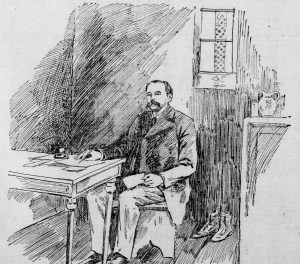

H. H. Holmes’ victims: Miss Rosine Van Jassand

One of the questions that frequently comes up about serial killers is how, considering their large number of victims, they were able to get away with it for so long. Wouldn’t they have been caught trying to dispose of the bodies? (Holmes says he wasn’t, because apparently he knew who to sell them to.) Weren’t there any cases where someone tried to escape? Well …

After his successful murder of Emeline Cigrand, Holmes claims that he tried to murder three young women who were then working at his restaurant. Apparently he would have received $90 from his agent, had he delivered all three bodies, but Holmes’ hubris interfered. He admits to attempting to chloroform all three at once. Apparently he couldn’t even manage to drug one of them, since they all “ran screaming into the street, clad only in their night robes.” (He doesn’t clarify where, exactly, he was trying to administer the chloroform.)

You’d think this sort of spectacle would get Holmes all sorts of unwanted attention, but all he says is that, though he was arrested the next day, he wasn’t prosecuted.

It’s not entirely unheard of for serial killers’ intended victims to escape, or even for the police to go ahead and deliver them right back so they can then be murdered. When 14-year-old Konerak Sinthasomphone escaped Jeffrey Dahmer’s apartment, that’s exactly what happened. Dahmer convinced them they were witnessing a lovers’ spat. But Holmes doesn’t go into any detail about the consequences of this failed triple murder, or even how he managed to avoid prosecution. It’s simply noted between the murders of Emeline Cigrand and Miss Rosine Van Jassand, and lamented because of the boost it would have given his overall body count.

Rosine Van Jassand was initially employed in Holmes’ fruit and confectionery store, but this was only Holmes’ initial gambit. Once she was there, he forced her to live with him, “threatening her with death if she ever appeared before any of my customers.” (Clearly he had enough employees to keep the buisness running without her, although he doesn’t mention if anyone asked what had happened to the newest recruit.)

Holmes doesn’t say why he killed her. He kept her hidden from other people, forcing her to live with him, and one day simply killed her with poison. Holmes apparently didn’t think this through, though, since he admits it would have been suspicious for a large box to be seen leaving the store, so he simply buried her in the basement. Since the Castle had been undergoing excavations to look for human remains, Holmes taunts his readers by saying he expected to hear that similar investigations would have been undertaken at the confectionery store, as well.

Was this woman even real? Holmes had spent his entire trial insisting that he had only been married to one woman, and that he had been faithful to her, and yet this tantalizing story reveals a forced mistress. Even her name is questioned, reported in other papers as Anna instead of Rosine. Perhaps she could have disappeared easily without questions, but how easy is it to bury a body deep enough in a cellar so that the smell won’t put off potential customers? Holmes claims he murdered Rosine “with more caution” than he showed with his previously attempted triple murder, but he still didn’t plan far enough ahead to sell her body to his agent and make any sort of profit off the situation.

Is Holmes just trying to pad his numbers (while including his story of the failed triple murder to make it look like he isn’t)? Or was he honestly so heartless that this story takes up a bare few lines and it’s time to move on to the next one?

Do you always finish every piece of writing you start?

It’s a fairly common piece of writing advice. Neil Gaiman’s got a few quotes about it. For example:

Whatever it takes to finish things, finish. You will learn more from a glorious failure than you ever will from something you never finished.

Neil Gaiman

I general like Neil’s writing advice. We seem to have a lot in common. So, do I obey Neil and always finish everything?

I’m going to be optimistic and say “Not yet.”

Recently I found a CD of my fiction from 2000 through early 2007 and, out of over 70 files, maybe a dozen were “finished.” Call it a completion level of less than 20%. Or … is it?

A lot of those partial documents were attempts at what, in November 2010, became my first NaNoWriMo novel – a completed story. Each individual document is incomplete but, because I kept trying, I eventually completed it. How do I count that one?

In 2011, I stared a NaNoWriMo project that ballooned into a multi-part epic fantasy. I wrote 180k that month and then … stopped, both because the month was over and because I’d written myself into a corner. For over six years, that story was incomplete … until Camp NaNoWriMo in April 2018, when I’d figured out the ending and was able to finish it.

There’s at least one idea left on that CD that I want to revisit, so it’s still in the category of “not yet,” although … that still leaves a bunch of files that aren’t finished. And, at this point, that I don’t think would be worth finishing.

I’d say, like any rule, it’s a bit flexible. You can bend it. Finish things, yes, absolutely – if you never finish things, then that’s an issue. But it’s also okay to look at something, nod to yourself, and agree to put it aside for now. Because you’re not ready for this story, or because you need time to figure out how to get your characters out of this bind. It’s okay to set things aside for later. (The key here being the plan to indeed come back to it later.)

What I see when I look back on these files (from high school and college – go ahead and do the math) I can see both my determination to get it right this time and my acceptance that certain approaches just … weren’t working. The ability to sigh, hit save, take a step back, and try a new path in. (Note that “save” is an important step – save your work! You never know when your ideas will catch on again, or be able to see how far you come, if you get rid of all the evidence.)

There’s also a sense of seeing value in your ideas even when they aren’t working right now. The thought that it’s still worth pursuing, even if this isn’t the right way to do it. The fact that I even saved everything, all my half-pages and random ideas, means I figured I’d want to remember them. They might not be worth anything to anyone other than me, but … I count, right?

There are absolutely lessons you learn from finishing things that you don’t get from abandoning them, but the reverse is also true. Although again, when you save something and set it aside, remember it’s really “for now.” Keep up the idea – or maybe the polite fiction – that this, too, will be finished one day. Maybe all it takes is the right spark, and those can come out of nowhere.

Plus it can be fun to look back on who you used to be, as a writer, and compare it to who you think you are now. (Then check in again, another 20 or so years down the road …) Keeping the old files helps you map out your literary journey in a way abandoning them won’t.

And who knows – maybe some day you’ll finish that one idea that still hasn’t let go. It’s just not done … yet.

How do you approach writing? Do you finish everything you start?

Do you think about writing rules or advice while you’re writing?

There are a lot of rules that go into writing, and a lot of advice books out there. Mind your grammar, to start with, and remember the punctuation goes inside the quotation marks. Use complete sentences, always finish everything you start, hit this plot beat by this manuscript percentage … if you’re not sure about something, Google it and I’m sure someone, somewhere, has a rule. How do you keep them all straight?

I … don’t. At least, not while I’m writing.

If there’s any single piece of advice I’ve adhered to, even before I read it, it’s Stephen King’s “Read a lot and write a lot.” I just found this CD I’d burned in January 2007 with fanfiction and original fiction dating back to 2000, and there were over 70 individual documents on it. A lot of them were various starts instead of complete plot arcs, but there were still a good number of “complete books.” (Hey, I was 15 in 2000. I wasn’t writing 80k, but I was completing plot arcs in things longer than short stories.)

Mostly because of the “read a lot” part, my grammar and punctuation is good, even back then. When you’re exposed to it on a regular basis – especially when it’s a regular, fun basis – you see how it’s done, so it’s easy to imitate. I don’t remember anyone explaining how to write dialogue because, by the time someone probably did, I would’ve just tuned it out. (My parents let me read anything and everything I wanted from a very young age, with one exception: they said Pet Sematary was too scary for a second-grader, even though it had a kitty on the cover.)

Now, is my grammar perfect? Nope. Have I taught multiple college-level grammar courses at this point? Yep? And still …? Nope. But here’s the thing: it doesn’t have to be. People hardly ever speak with perfect grammar. Plus, if you really need it to be polished and shined for a specific, that’s what revision is for.

And this isn’t just about my fiction. When I’m writing my nonfiction, I might try to shift the voice in my head to Full Academic, but … I don’t bog myself down by worrying about it too much on the first pass. The main goal of writing is, for me, to get the darn words on the page, however they’ll come. Jump around, sketch some notes there, plop something in the middle and figure out how to connect it later … whatever. Just get the ideas down.

The “rules” are for revisions.

The first draft of something for me is play. We’ll turn to Shannon Hale here:

I’m writing a first draft and reminding myself that I’m simply shoveling sand into a box so that later I can build castles.

Shannon Hale

And, for the record, my approach to that first draft is “shovel allllllll the sand!” Things can always be deleted later – plot beats, random characters, that one cool point I really want to make but probably doesn’t fit … shovel it all in. Get it all down. The hardest step is putting something on the page, so don’t worry about all the things that’ll just make me freeze and leave it blank. Shovel that sand.

Now, like all writing advice, this doesn’t work for everyone. I have friends who, somehow, meticulously plot out books – or even series – before they start shoveling sand. My revision process is a lot more intense than theirs because I’m still organizing my sand and they’ve already got it placed in neat little blocks with turrets and gables and other architectural flourishes from the start. Some of them started out working that way, and others started more like me and got bogged down in the revisions, so they backed up and changed their approach.

I think the number one rule about writing advice is that not all writing advice will work for you.

My biggest struggle is drafting, not revising or editing, so I’ve formed my approach to make that hardest part the easiest it can be for me. When I sit down to write, I throw the rules out the window. Just get the words on the page – form the sense of it so it can be massaged and perfectly shaped later on. Some days are easier and I can pay more attention to the rules, but others … they get thrown out the window.

The first draft is playing. I’m just shoveling sand. Then, once I’m done shoveling, I’ll switch tools and start shaping, matching tenses, paying attention to singular and plural, messing with punctuation, and knowing that, no matter how much I try, by the time my mom reads my proofs, there’ll still be plenty for her to catch. (I get emails like “On page 6, I know you meant x instead of y” and “On page 10, that’s a gerund, so you really need to …”)

So the short answer to whether I consciously think about rules and advice while writing is no, and the longer answer is “Because I come back to that later.” Plus I’m not the only one who considers it. Editors, proofreaders, peer reviewers … lots of people have the chance to catch the rules I’ve missed. It never has to be just you, trying to remember all the rules.

What about you? Do you think of specific grammar or writing rules when you’re tackling your first draft? Are there specific things you know you need to focus on?

“Do you actually write every day?”

I’ve got a writing buddy who’s working on his dissertation, and his coach just told him that writing every other day isn’t enough – he’s never going to finish it. She wants him to write every day. Well, every weekday, at least. We’ve been meeting two hours a day, three days a week, so we’re going to start meeting every weekday morning. Which is fine, because whether or not we’re zooming, I set my mornings aside for my own work, but my dad asked “Wait, do you actually write every day?”

The snarky answer is “Define ‘writing.'”

As a process, writing isn’t solely “putting words on the page.” It’s a necessary step, but not the only one, and usually not the first one for me. There’s reading, both nonfiction research and fiction in various genres; outlining; planning; editing (and deleting); and so on. Do I try to do at least one of those steps each weekday? Yes. Does that mean I actually do them? Not always.

But I do set aside the time for it. I’ve got a two hour block open for it. Some days I know it’s not going to happen, and I ignore it. Sometimes I work on the weekends. And sometimes I put in more than one writing session in a day. For me, two hours is the optimal amount of time: long enough for me to get into it, but not so long that my concentration wanes.

The more you write, the more you’ll figure out what block of time works best for you – and whether you can trust yourself to give yourself “days off” or if you need to be sterner and make sure you sit down and do it. (I set my own writing deadlines for my dissertation and could make myself stick to them, but my office mate told her advisor that she needed someone to take a firm stand and not budge. If you know which one of us you are, you can negotiate the tools that you, personally, need so you can finish a project.)

One of the things it’s taken me a long time to accept is that there are some days when even sitting here in front of the laptop isn’t going to get me more words. Days when I need to take a break and do something else. Days when that means recharging instead of avoiding. Sometimes it’s a shorter break, and sometimes it’s an “until tomorrow” break, but the important thing is that it’s only ever a break, not quitting. I set the next writing time in my mind and let myself ignore all writing things until then.

I also do my best to write down ideas as soon as they hit, whether it’s in my little writers’ notebook or on my phone. “I’ll remember it later” doesn’t always work, no matter how big the idea seems – write it down. Make a note. On your break times, this helps you get back to whatever else you’re doing. If you’re working on one project and a lightbulb shows up for another project, you can write it down and then get back to what you were doing.

Does “getting one good idea and writing it down” count as writing for the day? I don’t know, but that’s just one place where “Do you write every day?” gets tricky.

The thing is, when I’m working on a project, or even when I’m between projects, I’m frequently thinking about it. Letting it churn over in the back of my mind. Coming up with these ideas and scrambling to write them down before I forget. Piecing things together or figuring out a way through the latest plot snarl. Sometimes this happens years later – I only finished my 2011 NaNoWriMo epic fantasy in 2018 after finally figuring out how to wrap everything up – but hopefully it’s faster when I’m on a deadline. I’ll think about characters and plot bunnies from ages ago, either to work them into a current project or to see if I can actually do something with them.

But that’s not as easy to track. It doesn’t fit neatly into my two-hour block of time, and I don’t have a word count increase to show for it. Some people might label it “useless daydreaming.” But it’s still a necessary part of the process.

If I’m going to wrap it up and try a concise answer, I guess I’d say “Yes, I write every day, but it doesn’t look the same every day.” That’s not my process. It’s changed over the years as I develop and grow as a writer, but that’s who I am now: writing every day, even if “writing” doesn’t always look like writing.

What about you? Do you have a writing schedule? What works best for you?

H. H. Holmes’ victims: Lizzie

I don’t know that we can say there are acceptable reasons for a serial killer to commit murder, exactly, but there are certainly reasons more common than others. Even Holmes himself follows a pattern: he meets someone, discovers they have money, and murders them to get it. Sometimes he murders someone to keep them from telling other people that he murders people. But, in this case …

Lizzie (no last name given) was apparently under Holmes’ employ in the Castle restaurant. He doesn’t say exactly when this was, since most of his confessions don’t include a year. What he does say is that his janitor, Quinlan, was paying far too much attention to Lizzie, and Holmes just couldn’t have that. Apparently Quinlan was far too valuable to Holmes to get distracted because … he might reveal that his employer was a serial killer? Holmes doesn’t actually say.

Quinlan completed suicide in 1914 and left a note saying simply “I couldn’t sleep.” His surviving relatives said that he’d been haunted by the ghosts of Holmes’ victims in the months prior to his death. Because Holmes had killed so many under his nose and he hadn’t known about it? Or because he had? Quinlan was never officially accused of participating in any of Holmes’ crimes and by this point I think we all know better than to take Holmes’ word.

Instead of firing Lizzie, Holmes decided to kill her. Apparently he was worried she’d simply find other work nearby and continue to entrance his janitor. It’s that crass and that simple: he no longer wanted to employ her, so he decided to murder her.

Holmes says Lizzie was the first victim to suffocate in the by-then-infamous vault in his Castle office. He doesn’t explain how he lured her inside or how long it took her to die. Perhaps suffocation in a sealed vault was supposed to be interpreted as a peaceful death.

In a technique that he claims to use again and again, Holmes made Lizzie write letters before she died, explaining her sudden absence to her loved ones. Did he get her to hand over the letters and then shove her back inside to seal her up and wait for her to die? Or did she calmly allow herself to be suffocated without thinking that she could tear them up and ruin his plans? Clearly readers aren’t supposed to concern themselves with such grisly scemantics.

Holmes even attempts to end this description of murder on a lighter note. The prosecutor in the Pitezel case apparently offered to track Lizzie down, based on the letters she had sent, believing she was still alive. Somehow proving that Lizzie had actually gone west as her letters claimed was meant to help Holmes defend himself in the case of Benjamin Pitezel’s death by proving that he was not, in fact, a murderer. Holmes seems both amused at the notion and pleased that his ruse worked so well … although again we’re not supposed to wonder how his innocence in one case is supposed to prove his innocence in another.

Is this a serious confession so that Holmes can go to his execution with a clear conscience or a criminal gleefully crowing over his crimes?

“How much do you talk about a project while you’re working on it?”

This question can be approached from a few angles and is kind of hard to tackle, which is why this is the fourth first sentence I’ve written for this blog post. So let’s just dive right in.

Angle #1: I don’t talk about my WIPs (works in progress) because I don’t want someone stealing my ideas.

That’s the fear, isn’t it? If we share our work in writing groups or online, it’s not just the emotional vulnerability of putting ourselves out there. Plagiarism is real, and nobody wants to lose years of work to someone who swoops in and scoops our best ideas. So … do we just never talk about our work at all?

Angle #2: If I talk about my WIP, then I lose all the joy and momentum. Writing it feels like chewing my food twice.

If this isn’t you, then you probably know someone like this: they’ve got the backstories and world building and character design all planned out. They talk about it all the time. But as far as actually getting words down on the page and writing it … it’s not happening. Talking is joy. Maybe talking is less work. And once you’ve said it and gotten an audience reaction, what’s the point of writing it down for an audience you won’t actually see?

Angle #3: I don’t talk about my writing because nobody’s interested.

Maybe your topic’s too niche, or maybe you don’t have writing friends. You don’t want to talk about your WIP because it’s not a conversation – it’s just the other person waiting for you to run down so they can have their turn.

… or maybe a bit of all three?

I’ll say straight off that the people I talk to in real life get a lot more details about my projects than anyone online, possibly because of all three of these reasons. If all I tell you about my novel is “a serial killer kidnaps the woman he wants to write his bestselling biography,” we’re never going to write the same story. Even if you somehow stumbled across my summary on the NaNoWriMo website years ago and spent all this time working up your own version, it’s not my book. (And even that summary is pretty darn vague.)

But do I keep my WIP talk vague solely so nobody steals the idea? No. That’s not the only reason.

Part of it is Angle #2: if I already tell people all the interesting bits, what else is there? You’d know the climax (which should be, of course, the most interesting bit). You’d know who lives and who dies and how it all comes out. So … why read it if you’ve already been given the CliffsNotes version? Don’t people get those so they don’t have to read it?

And yeah, part of it is Angle #3: I know not everybody cares about my work at all, much less half as much as I do. I don’t want to bore people with long info-dumps. That’s not a conversation – that’s a monologue. So I’m careful even in person, when I’ve got body language and such to judge when someone’s attention wanders. (Here on my own blog I get to ramble as much as I want, I guess. You can always click away.)

There’s also another aspect to it. Maybe not a full angle, but at least a partial one: I don’t want to jinx it. I don’t want to get all publicly hyped about an idea only to have the project fizzle out at a later step and never actually appear. I’m talking one of the later steps in the publishing process nobody wants to think about: contract signed, manuscript delivered, and still something falls through. Complete superstition, I know, but it’s still totally there for me.

So online I’m incredibly vague. In person, if we don’t really know each other, I’m the same level of vague: unless it’s been officially announced, I deflect. But, if you’re in my writing group, or if you’re my husband …

Yeah. They get the CliffsNotes. The questions. The rambling “I don’t know if x or y should happen” and “I’m thinking of killing Z.” The people who are there for the process get to see the entire thing – the excitement, the frustration, the internal debates. My writing group gets weekly updates because everyone gives weekly updates. They want to know about the comments I get back and how I’m either going to address them or argue against them. They’ve heard about so many manuscripts I’ve completed that will never, ever see print.

(They’ve argued that, someday, a library will want to collect all of my unpublished manuscripts and people will actually read them.)

So I guess the short answer is that, for most of you, I’ll talk very little about my WIPs. I’ll wait for official announcements and share exactly that much information. Which is all a personal decision about what feels right for me – you don’t have to do that part.

What I would encourage all writers to do, though, is to find community. In person, online, however it comes. Find the people who’ll celebrate each step of the process with you and who understand it – the ones who make you feel safe to share without prefacing something with “Okay nobody steal my idea seriously I mean it.” The people who’ll remember your characters’ names and ask if you’ve decided their fate yet.

I like talking about my writing, but mostly I just like writing it.

How about you? How often do you talk about your projects?

H. H. Holmes’ victims: Mrs. Sarah Cook, her unborn child, and Miss Mary Haracamp

We’re used to serial killers doing what Holmes usually writes about: killing one person at a time and gradually building up his victim count. After all, it’s hard enough to get rid of a single body without coming under suspicion. But even the smartest serial killer has to adapt to the given situation.

Holmes writes that a Mr. Frank Cook moved into “the Castle” in 1888. When he married Sarah, Holmes himself was present at the wedding. He apparently even lived with the couple in his own Castle for a while. There were many threads connecting him to them, which of course means danger even for the most intrepid serial killer.

Miss Mary Haracamp, a niece of Mrs. Cook, also came to Chicago in order to work for Holmes as a stenographer. (He seemed to have a bad habit of killing the young ladies who came to Chicago to work as his stenographer.) In this case, though, it wasn’t because he was having an affair with her (or her aunt). It was because Mrs. Cook and Miss Haracamp somehow got their hands on a master key and happened to walk in on Holmes while he was “busily engaged preparing my last victim for shipment.”

Like Bluebeard, Holmes cannot let the women live once they’ve unlocked the wrong door. Unlike some of his previous murders, though, the solution isn’t a single blow to the head. No: Holmes managed to get the women into his large vault and then forced them to write a letter to Mr. Cook telling him that they were sick of life with him and were going away. Never coming back. Don’t follow. Etc.

And then he killed them, presumably by keeping them sealed in the now-infamous airtight vault. Holmes does admit that he only got the letter out of them by saying he’d let them live if they did actually leave Chicago, never to return, but of course he lied. Presumably he got the letter from them and gave it to Mr. Cook, although he would have had to open the vault to do that, risking their escape. Leaving it inside with them while they died would have meant they could have torn it up and left him with nothing.

Holmes doesn’t discuss how Mr. Cook took either the women’s sudden absence or their letter, but he does end this short segment with a very interesting sentence: “These were particularly sad deaths, both on account of the victims being exceptionally upright and virtuous women and because Mrs. Sarah Cook, had she lived, would have soon become a mother.”

Well now. Holmes really likes this long sentences, and he’s packed a lot into this one.

He’s got a bit of a Dexter thing going on when he rates these murders as “particularly sad.” Apparently killing rascals doesn’t tug at the heartstrings (although none of the previously described murders have been of particularly bad people). Is he trying to appeal to the masses by telling readers what he thinks they want to hear? Showing some sort of remorse to prove he’s not entirely a monster? Simply tossing in some flowery language to pad his word count?

Then there’s the fact that he counts Mrs. Cook’s unborn child as one of his 27 supposed victims. It’s long been theorized that the murder of Julia Conner might actually have been an accidental death during an illegal operation – that is, an abortion. Granted, admitting that he’d had an affair with one of his tenant’s wives would not have been a good look for Holmes, who’d married three women under three different names without ever divorcing any of them, but it’s still an intriguing question. Holmes counts Mrs. Cook’s unborn child among his victims, boosting the number, but makes no mention of Mrs. Conner’s possible unborn child, which he could have used to push the count to 28.

Is Holmes still somehow trying to protect his honor in the middle of a confession to 27 murders? Prior to his trial he certainly clung to the idea that he had only one wife and he’d never been disloyal, to keep Georgiana Yoke from testifying against him during the Pitezel murder trial, but this confession came after the death sentence had already been handed down. It was meant to be Holmes finally telling the truth about everything and owning up to being the worst criminal monster the world had ever known … although apparently even criminal monsters don’t want the world to discover exactly how morally monstrous they are.

If Mrs. Cook had been a real person, it seems that Mr. Cook – and anyone else who knew her – would have known she was pregnant and could then have pointed this out after Holmes’ confession was published. If he’d omitted it, the world would know. However … Holmes made up a number of murder victims from whole cloth, and confessed to murdering people who then made it known they were still alive, so clearly he wasn’t above lying or padding his confession. So … why, then?

What do you think this account of murder tells us about H. H. Holmes?

“Do you do more research for your fiction or your nonfiction?”

An academic friend of mine asked me this after my novel was announced. She’s familiar with how much work (a lot) goes into academic writing, and she wanted to know how fiction compares. It’s a good question, but I don’t really have a short answer.

My upcoming novel deals with a serial killer. Generally writing about characters who are nothing like you takes a lot of research. However … that is my research area. I’ve read true crime documents in the hundreds, from the cheap paperback, read-it-on-the-beach variety to textbooks used in training courses. That includes execution sermons from the 1700s, newspaper articles from the 1800s, the best-selling books from the 1900s, and Netflix documentaries from this century.

And that’s just the nonfiction. I also read widely when it comes to books generally shelved under thriller or mystery. True, there are some I put down before I finish them, but I still make it through most of them. (Usually I google the plot of something I’m not sure is worth my time, just to see if it’s worth finishing. Sometimes the twist or reveal makes me keep going just to see how the author pulls it off. Other times I put the book down because it’s the author playing with the reader instead of the characters doing the concealing – it’s a small difference, but a deal breaker for me.)

I picked up a lot of the true crime specifically for my academic side, but I generally want to just be able to enjoy my thrillers when it comes to fiction. I want a book I’m going to enjoy and want to finish because I care enough about how it’s all going to come out, whether it’s written “well” (whatever that means) or not. I want a story that’s going to pull me through to the end and then, only after I’m done, will I sit back and start to pick it apart.

(Side note: it kind of sucks making your passions into your research. You can’t just read things for fun anymore.)

So when I think about research for my fiction, I’m including not just the shelves upon shelves of true crime, but also all of those novels on my “have read” list. The novels don’t really feel like research, and the research is usually directed toward my nonfiction writing … but it all plays together when it comes to writing fiction about serial killers.

I tend to set my fiction in places I’ve lived so I don’t have to spend too much time figuring out the literal lay of the land or the sort of people who live there. I don’t need to look up “common Midwestern sayings” because it’s the sort of stuff that just comes out of my mouth, or to wonder about what sorts of restaurants are available to my characters. I’ll bring up the website and double-check the menu, but I already know where they’re eating.

I don’t usually stop in the middle of writing to look something up, but then, I also put off actually starting the writing for months at a time, letting things swirl around in my head. Not Your Mary Sue was initially drafted during NaNoWriMo 2017, in November, but I had the idea going since February that year. Instead of drafting on paper, I was putting things together in the back of my mind, examining them, and taking them apart, all the while reading things and adding to my general store of knowledge. I had a very solid idea of who my serial killer was – his motivations and his personality – before I sat down to write him.

So when I look back on it, the answer is “A lot. Seriously a lot.” That’s a ton of research I’ve been over and over, all sorts of words from both killers and authors, perspectives from killers to prosecutors to researchers to surviving family members of victims, all piled up and put into my writing. I mean, I wrote my dissertation on the history of written crime narratives in America and then came up with a situation where someone’s demanding his own written crime narrative. The two things can’t easily be separated.

So really, if you’re considering writing fiction, I’d suggest starting by taking a look at what you’re already reading and what you already know. The areas where yeah, maybe you need a little more exploration on some specific details, but you’ve already got the broad strokes handy. It’s not so much “write what you know” as “write what you’ve read,” especially when you’ve already done so much work to learn about your passions. Not every tiny tidbit of information is going to make it into a novel, but it can inform a lot, from plot to characterization to setting.

How about you? How much research do you do? Do you write fiction, nonfiction, or both?

H. H. Holmes’ victims: Rodgers and Charles Cole

Not all of H. H. Holmes’ murders occurred within his Murder Castle in Chicago, even after he’d begun killing people there. And not all of his murders are worth more than a couple paragraphs. The two we’re discussing today, a man only referred to as Rodgers and a man named Charles Cole, have very little information attached to them.

Holmes confesses to murdering Rodgers as his fifth victim in 1888, even though his previous murder – the double murder of Julia and Pearl Conner – took place around Christmas 1891. Wait, what?

Similar things happened in Holmes’ previously published autobiography, Holmes’ Own Story, where the timeline jumps around as though the reader won’t notice. It’s entirely possible they won’t – although Holmes opens Rodgers’ tale with the year, the only date he includes in his short discussion of the Conners is in reference to when the newspapers caught the story. The casual reader, eager to snap up the Sunday edition of the Philadelphia Inquirer, wouldn’t be looking for such inconsistencies.

Apparently murdered in 1888, although now of course in doubt as to his standing as fifth, Rodgers was murdered in West Morgantown, Virginia, while Holmes was “boarding there for a few weeks.” Why was he in Virginia? Holmes doesn’t say.

What he does say – and what tracks with some of his other stories – is that he found out Rodgers had money and decided to kill him for it. Holmes invited Rodgers on a fishing trip and killed him with his near-trademark single blow to the head, this one on purpose and using the boat’s oar. Although Rodgers’ body was found about a month later, Holmes writes that he wasn’t suspected until after his trial for the murder of Benjamin Pitezel. Apparently upwards of fifty people in Virginia recognized Holmes’ picture in the papers and therefore suspected him of the then-unsolved murder.

Because Holmes wasn’t home in Chicago, with his usual method of disposing of a body, he apparently had to leave it. How much money he took from Rodgers, and what he did with it, is left up to readers’ imaginations.

Charles Cole suffered a similar fate, although he met his death in Chicago. Cole was a Southern speculator who had been corresponding with Holmes for some time and had finally been convinced to come visit the Castle. Cole died because of a single blow to the head, yes, but there’s an added wrinkle here: Holmes didn’t strike him. It was apparently his job to distract Cole while “a confederate” wielded a pipe and “crushed his skull to such an extent that his body was almost useless to the party who bought” it.

Hang on.

Holmes, in writing his final confession to be published mere weeks before his execution, tells the world that he didn’t act alone in all of his murders. In the case of Charles Cole, he both lured and distracted the man, but someone else killed him. Someone Holmes refuses to name. He simply teases readers by observing it was likely the other man’s first murder, but that the unnamed other man is even “more heartless and bloodthirsty” than Holmes is when Holmes is awaiting execution and confessing 27 murders … but he doesn’t name him. He’s just dropping hints that hey, there’s still another murderer wandering around Chicago, and he’s probably got some help, too.

In other words: dear reader, this doesn’t stop with me.

Holmes may not have been much for keeping his timelines straight, but he was an accomplished liar and teller of tall tales. He knew how to capture other people’s attention – usually in person, but in writing, too. His confession, real or fake, was written in order to sell newspapers, and Holmes added his own flair. A flair that Ted Bundy would repeat almost a century later when he threatened “We serial killers are your sons, we are your husbands, we are everywhere. And there will be more of your children dead tomorrow.”

These contrasts exist throughout Holmes’ confession: the reassurance that all of his victims died suddenly, as the result of a single blow, so he’s actually less of a monster than he might seem … followed by references to his accomplices and helpers, people who have killed for him or kept his secrets, and who are still anonymous and out there, ready to strike again.

At this point it seems ridiculous to ask if Rodgers and Charles Cole actually existed, and if they were murdered the way Holmes claims. Instead, let’s focus on the storytelling aspect. Knowing he was two weeks away from his execution, what do you think Holmes was trying to accomplish? Did he only write these things so he could entertain, or was he hoping for a stay of execution while people fought to get those names out of him?

What we leave out when we talk about writing

I’m working on knitting a sweater right now. It’s far enough along that I tried it on to check for the sleeve length and posted a mirror selfie, and one of my friends commented that the body is a perfect fit. Which meant I made a list of all the steps I’d gone through to make sure of it. And then got me musing on knitting patterns and writing books.

Bear with me.

When you buy a knitting pattern, you get instructions on how to make the exact object in the photo, sometimes in different sizes. Let’s focus on a sweater. You choose your sweater size off the bust measurement – how big around you want to make it – and go, right? Because all the information is right there. Nyoom! Sweater!

Well.

When you walk into a store and can try on clothes, they’re sized. You know what one to start with and what generally fits, but if it’s more expensive, you’ll take it back and try it on and see how the standard measurements actually look on you. So yes, you can make a sweater following a pattern exactly – and that’s the easiest way to do it the first time – but … it’s not just about customization. It’s about apparently commonly-known tricks and hurdles that patterns often leave out.

If you’re just knitting on your own, without a community, you might wonder why the heck your armholes always end up holier than they should be. Maybe it’s just you. It takes communication with other people – people willing to show the mistakes and oopsies, even – to learn that hey, actually, lots of people have that issue with armholes, and here’s an easy trick to fix it.

Or, until you knit more than one sweater or talk to other people, you might not consider all the ways you can customize a sweater. Neck, sleeves, shaping, length … top down or bottom up … seamed or in one piece … you can adapt the things you like about a pattern and swap out the things you don’t like.

Patterns also use shorthand like “take time to check gauge” for things that actually take a lot of work. The sweater I’m knitting right now, for example: I’m not knitting the size of my actual measurements. I’ve got another sweater using the same yarn and needles (which, for the record, is very important when you’re using it to do the math) and I measured that, plus a couple other shirts I own that are similar in construction to the pattern I’m knitting (and which I like to wear), and I did a lot of math. Like … a lot. That’s before I even started knitting. But a normal knitting problem doesn’t tell you all that. It assumes you either know about checking gauge and substituting yarn, or you’ll google it on your own.

Non-knitters, you still with me?

Thinking how much gets left out of knitting patterns – how much knowledge you’re assumed to already have at the ready – started me thinking about writing advice. What do writers leave out when we’re talking about writing because it just seems so essential to us, so much like habit, that we forget we once had to learn it? Is there advice out there like “take time to check gauge” that tells you plenty if you already know what it means, but is confusing and overlookable if you don’t?

So much of writing is invisible to the reader, if the writing’s good. All of the stuff that goes behind “take time to check gauge” – measuring the already knit and washed garment in multiple places to calculate stitches and rows per inch, and then measuring clothes of a similar style that give me a good fit, and doing the math to figure out circumference, and then making sure things like armhole depth aren’t going to be completely out of whack, and remembering that my own gauge changes when I knit flat versus knitting in the round …

Do we always share all the stuff that we, personally, had to learn the hard way? (Pro tip: make the sweater that looks like the sweaters you’ve already got in your closet. You know you’ll wear it. And you won’t put in 50+ hours of work on something that looks different and you won’t actually wear.) Or do we just internalize it and think everyone else already knows it, too?

I’ve had some good conversations lately with my writing buddy and a friend of mine who asked me things about my writing, both the nonfiction and the fiction, and I’m compiling a list of those questions to answer in blog posts moving forward. Things that other people want to know, and not just the things I think other people want to know.

If you have any questions about the writing process, or things you’d like to hear me muse about, please share them! I love talking about my research, and I love talking about writing, so if there’s something you’ve always wondered or wanted to ask … now’s the time. Let’s de-mystify the writing shorthand.

(Oh, and the part about how you can change up a sweater pattern to add your favorite sleeves or preferred shaping? That also goes for writing advice. It’s not one size fits all. You pick what works for you, and maybe set some pieces aside to look at more later, and move on from the stuff that doesn’t. The more you read or talk about writing, the more options you’ll have.)